For three years, freelancers have been bracing for a $600 reporting threshold on Form 1099-K. It was supposed to arrive in 2022, then 2023, then 2025, then 2026. It never did. The IRS updated its official 1099-K guidance this year to confirm the threshold is staying at $20,000 in payments and more than 200 transactions, the same level that has applied since 2011. The One Big Beautiful Bill Act, signed into law on July 4, 2025, made that permanent by repealing the lower thresholds Congress had written into the American Rescue Plan Act.
If you send invoices through BillyPaid, this change barely touches you directly. Bank transfers, card payments, and payable links tied to an invoice are not what triggers a 1099-K. The threshold applies to payment apps and online marketplaces, the “third party settlement organizations” the IRS calls Venmo, PayPal, Etsy, Upwork, and similar platforms. But a lot of freelancers use both an invoicing tool and one of those platforms, and the confusion around this threshold has become its own small industry. Getting the actual rule straight matters.
What changed, and what did not
Under the American Rescue Plan Act, the 1099-K threshold was scheduled to drop from $20,000 to $600 starting with the 2022 tax year. The IRS delayed that repeatedly through transitional relief, first pushing it to 2023, then applying a $5,000 threshold for 2024 as a phase-in step, then $2,500 for 2025. The plan was to land at $600 for 2026 and every year after.
OBBBA scrapped that phase-in. The threshold reverts to $20,000 and more than 200 transactions, which is where it stood before the American Rescue Plan Act touched it. In effect, the lower thresholds never took hold at scale. Anyone who spent the past few years expecting a flood of 1099-K forms at $600 can stop expecting it.
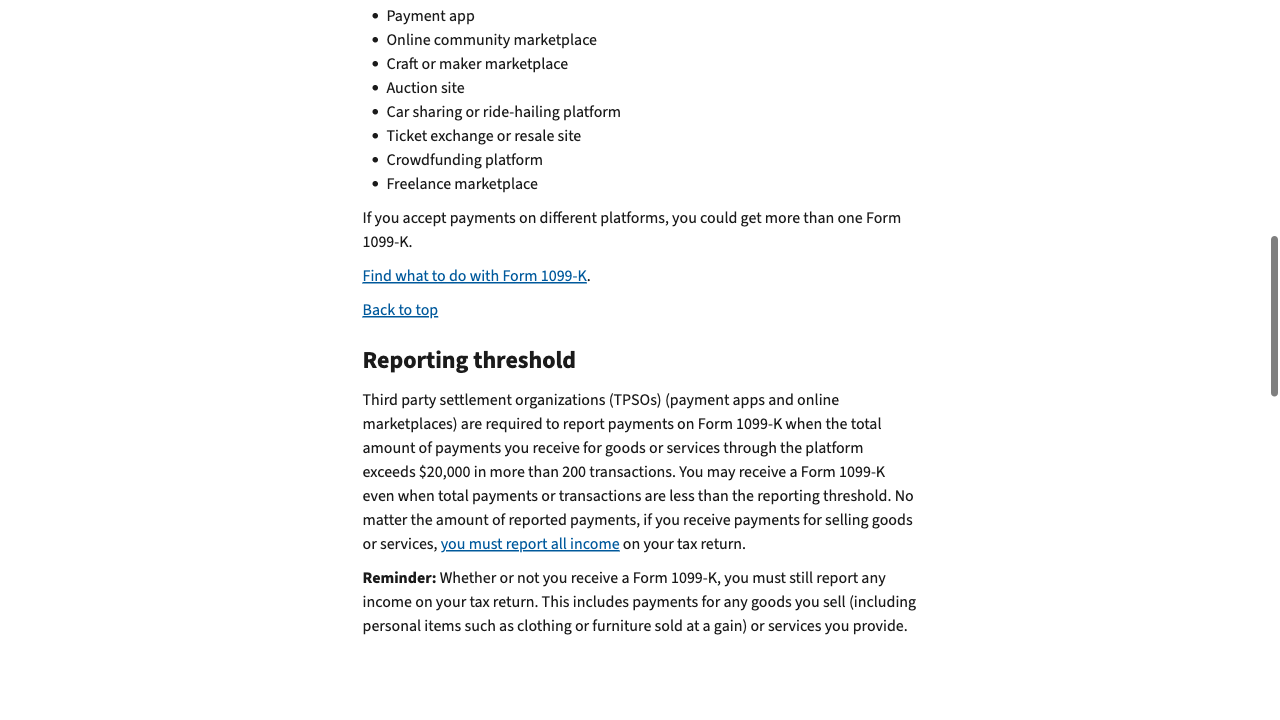
The IRS’s own guidance page spells out the current rule in plain terms: a payment app or marketplace has to send you a Form 1099-K once your payments for goods or services exceed $20,000 and 200 transactions in a year, and the reminder underneath it is the whole point of this post.
The table below lays out the schedule that was written into law against what is in force now.
| Tax year | Originally scheduled threshold | Actual threshold in force |
|---|---|---|
| 2022 to 2023 | $600 (ARPA) | $20,000 and 200+ transactions |
| 2024 | $600 | $20,000 and 200+ transactions (IRS used $5,000 as transitional relief) |
| 2025 | $2,500 | $20,000 and 200+ transactions |
| 2026 and beyond | $600 | $20,000 and 200+ transactions (OBBBA, permanent) |
A 1099-K was never your bookkeeping system
Here is the part that gets lost every time this threshold makes news: getting a 1099-K, or not getting one, has never determined whether income is taxable. The IRS says this directly on its updated FAQ page: “Whether or not you receive a Form 1099-K, you must still report any income on your tax return.” A $600 threshold was never going to create new income. It was only ever going to create more paperwork telling the IRS about income that was already reportable.
The reverse is just as true now that the threshold is back at $20,000. If you invoice a client for $8,000 across the year and no platform ever sends you a form, that $8,000 is exactly as taxable as it was the day before this news broke. No form arriving does not mean no income to report. Treating a missing 1099-K as a green light is the single most common and most expensive misunderstanding freelancers have about this rule.
What to track, regardless of any threshold
A 1099-K, when one shows up, is a summary a platform sends you. It is not a record you built, and it will not match your own numbers if a client pays you partly through a marketplace and partly by direct transfer, or if a platform’s reporting period does not line up with your fiscal year. Relying on it as your books means your books are only as complete as whatever a third party decided to report.
The invoices you send yourself are the record that protects you. Every invoice, every payment received, every client name and amount, whether it came through a payment app, a bank transfer, or a card, adds up to the income figure you should be reporting regardless of what any 1099-K says. That record exists the moment you send the invoice, not the moment a platform decides to report your year to the IRS.
Keeping that trail clean does not take much. A BillyPaid receipt attached to every payment you collect gives you a dated, itemized record independent of any 1099-K, so your own numbers are ready whenever tax season or a client dispute puts them under a light.
![How Small Businesses Prefer to Get Paid [2026 Data]](/_astro/how-small-businesses-prefer-to-get-paid-2026.YCaeH9Cw_sETpX.webp)
![Small Business Payment Method 2026: 26% Still Pay by Check [Data]](/_astro/small-business-payment-method-statistics-2026.CVRcTZ0T_Z28I3VD.webp)
![Duplicate Payment 2026 [Full Data Report]](/_astro/duplicate-payment-statistics-2026.Bw7v68Ma_Z2wyPsj.webp)