If you heard that the EU capped every commercial payment term at 30 days, you heard about a proposal, not a law. In September 2023 the European Commission put forward a new Late Payment Regulation that would have done exactly that, replacing the older directive’s more flexible framework with one strict 30-day ceiling for every contract, public and private. By mid-2026 that proposal has stalled out. Member states blocked it in Council negotiations, watered-down compromise versions were rejected too, and there is no realistic path to it becoming law.
That matters if you invoice EU clients, because the actual rule on the books today is looser than the one that was proposed. If you have been assuming a 30-day cap already applies across the bloc, you have been operating on a rule that never took effect.
What the 2023 proposal would have changed
The proposed regulation targeted one specific problem: the 2011 Late Payment Directive lets B2B contracts agree to terms as long as 60 days, and some large buyers used that flexibility to push payment terms as far out as the law would allow. The 2023 proposal would have closed that gap entirely, setting a flat 30-day maximum for both public and private contracts with no negotiated extension. For a freelancer or small business waiting on a client, that would have meant a hard, EU-wide ceiling roughly half the length of what many contracts currently allow.
The rule actually in force right now
Directive 2011/7/EU is still the operative law across every EU member state, unchanged since 2011. The default payment term, when a contract does not specify one, is 30 calendar days. A B2B contract can agree to a longer term, up to 60 days, and terms past 60 days are only valid if they are not grossly unfair to the creditor. Payments owed by public authorities are held to a firmer standard: a flat 30-day cap with no contractual extension.
| Proposed regulation (2023, failed) | Actual law in force (2011 Directive) | |
|---|---|---|
| B2B payment term | 30 days, no extension | Up to 60 days by agreement |
| Public sector payment term | 30 days | 30 days, firm |
| Status in 2026 | Blocked in Council | Fully in force since 2011 |
Why the tighter cap keeps failing
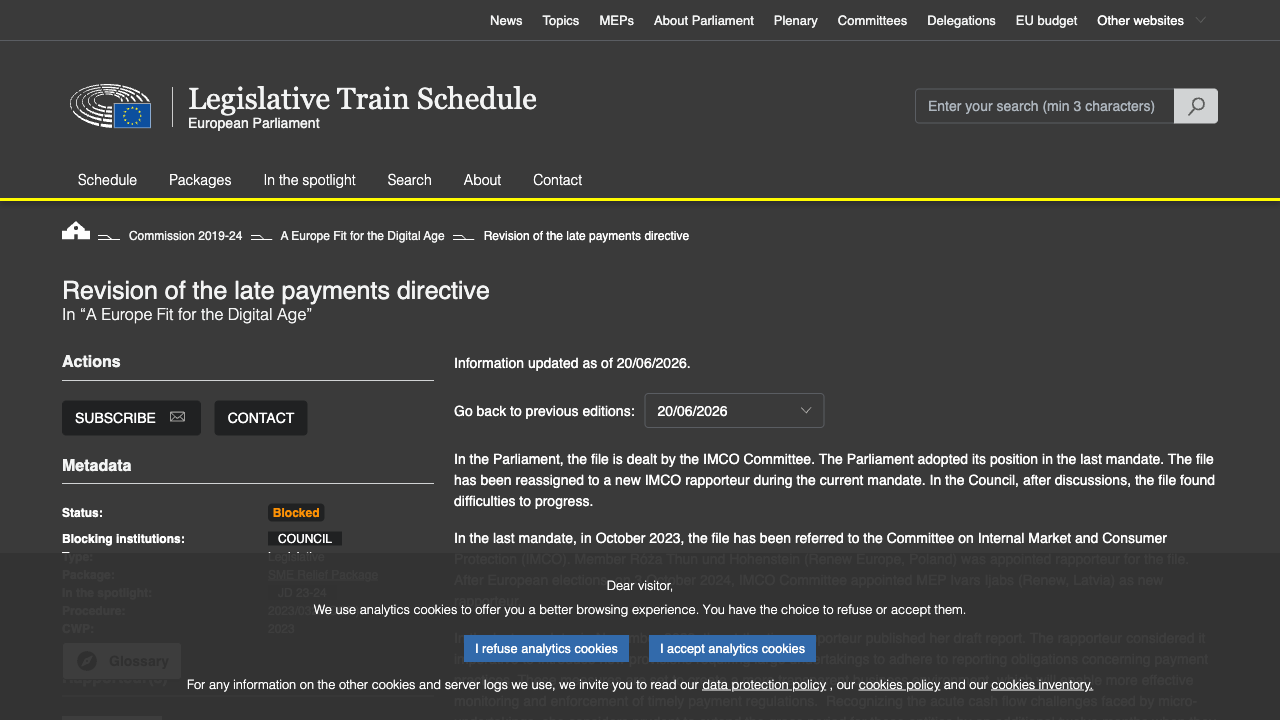
Council negotiations require broad agreement among member states, and several pushed back on a flat 30-day rule for the same reason large buyers liked the 60-day option in the first place: it gives bigger companies room to hold cash longer before paying suppliers. Compromise drafts that split the difference or carved out exceptions by sector were floated and also failed to gain enough support. The European Parliament’s own Legislative Train Schedule, the tracker it uses to report a bill’s status in plain terms, lists the file’s status as blocked with the Council as the blocking institution.
None of that changes what the law says today. It just means the law you are working under is the 2011 one, not the one that made headlines in 2023.
What this means for your own invoices
Because the strict cap did not happen, the ceiling most EU freelancers and small businesses actually operate under is 60 days for a private client and 30 for a public one, not 30 across the board. The chart below shows the gap between what was proposed and what you can actually count on.
A 60-day legal ceiling is not the same as a 60-day payment promise. The law sets the outer limit a client’s contract terms are allowed to reach. It does not require anyone to pay you in 30, or in 60. If you want shorter terms, Net 15 or Net 30, that is still a choice you have to write into your own contracts and invoices, and then enforce once the due date passes.
Set the terms you actually want on the invoice itself, and use a payment reminder that goes out automatically the moment a due date is close or has passed. The regulation that would have shortened every EU payment term for you did not happen. Shortening your own is still on you.
![How Small Businesses Prefer to Get Paid [2026 Data]](/_astro/how-small-businesses-prefer-to-get-paid-2026.YCaeH9Cw_sETpX.webp)
![Small Business Payment Method 2026: 26% Still Pay by Check [Data]](/_astro/small-business-payment-method-statistics-2026.CVRcTZ0T_Z28I3VD.webp)
![Duplicate Payment 2026 [Full Data Report]](/_astro/duplicate-payment-statistics-2026.Bw7v68Ma_Z2wyPsj.webp)