If you do platform gig work anywhere in the EU, you have probably heard some version of “the EU is making platform workers employees in December.” That is close, but it is not quite what is happening. Directive (EU) 2024/2831 does not flip a single EU-wide switch on December 2, 2026. It sets a deadline for each member state to write its own version of the rules into national law, and how far along that process is depends on which country you are in.
What the directive requires
Adopted on October 23, 2024 and published in the Official Journal on November 11, 2024, the Platform Work Directive gives every EU member state until December 2, 2026 to transpose it into domestic law. Its core mechanism is a rebuttable presumption of employment: a platform worker under “de facto managerial control”, meaning the platform’s algorithm effectively directs and supervises how the work gets done, is presumed to be an employee rather than a contractor, unless the platform can prove otherwise. Where that presumption holds, it can bring minimum wage, paid leave, and collective-bargaining rights. The directive also sets binding rules on algorithmic management transparency, requiring platforms to disclose how automated systems make decisions that affect a worker’s pay, hours, or standing.
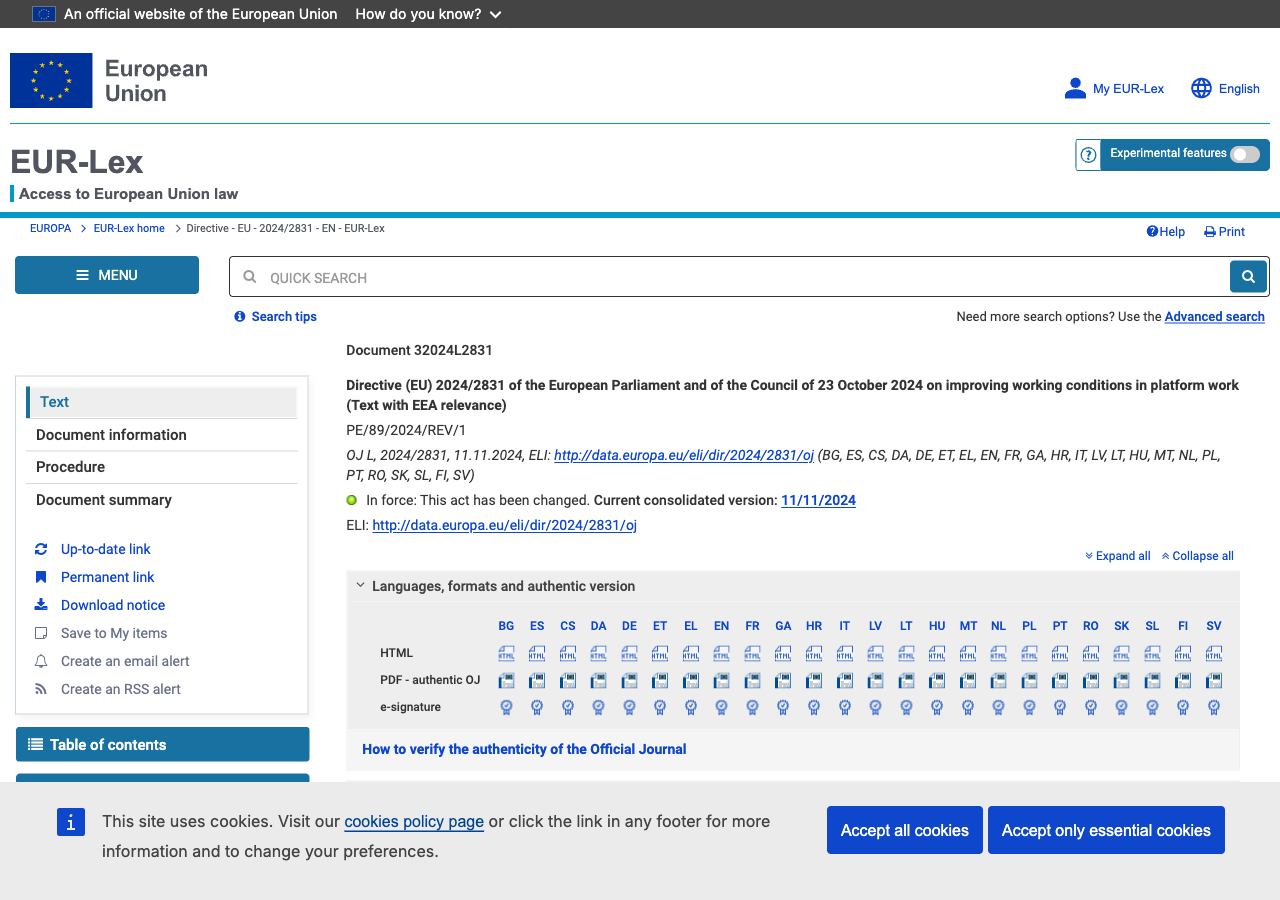 Source: EUR-Lex, Official Journal of the European Union, Directive (EU) 2024/2831
Estimates cited around the directive’s adoption put the number of platform workers who could see their status reclassified as high as 5.5 million across the EU. That is a ceiling, not a headcount of everyone who drives, delivers, or does task work through an app. The presumption is rebuttable, and it applies only once a country’s own transposing law is in force.
A country-by-country rollout, not one EU-wide switch
As of mid-2026, France, Italy, the Netherlands, and Belgium are furthest along in drafting their national implementations. Most other member states have not finished the process. That gap matters more than the December date itself. A platform worker in a country that has already transposed the directive is operating under real, enforceable rules right now. A platform worker in a country still drafting its version is not, no matter what the directive itself says on paper. The practical question for anyone doing platform work in the EU is not “does this apply to me on December 2,” it is “what has my own country passed.”
This is the same shape of story BillyPaid covered when New Jersey reclassified gig drivers earlier this year: a real legal change with a real effective date, that still only reaches as far as the jurisdiction that passed it.
Two income streams under one directive
Most EU freelancers doing platform gig work also invoice direct clients on the side, or the reverse: someone building a client business who picks up platform work between jobs. The directive touches only one of those two income streams, and only where a country has transposed it.
| Dimension | Platform work (directive applies, country-dependent) | Direct client work (unaffected) |
|---|---|---|
| Employment status | Presumption of employment where transposed and rebuttal fails | Still self-employed, no change |
| Who sets the terms | The platform’s algorithm and its published transparency rules | You, in your own quote or contract |
| What BillyPaid document applies | None, this is a platform relationship | An invoice for every job, with a payable link |
The part of your business this leaves alone
None of this changes what a direct client owes you. If you quoted a business for a project, agreed the scope, and did the work, that invoice is still yours to write, send, and chase, regardless of what happens to your platform income or which country’s transposition timeline you are watching. Reclassification is a platform-and-worker question. Invoicing a client you found yourself has never been part of it.
The safest move before December is not guessing at your own status. It is checking your own country’s transposition status directly, and keeping your direct client invoicing running exactly as it already does. A BillyPaid invoice keeps that side of your business in its own clean, numbered record no matter what changes on the platform side.
![How Small Businesses Prefer to Get Paid [2026 Data]](/_astro/how-small-businesses-prefer-to-get-paid-2026.YCaeH9Cw_sETpX.webp)
![Small Business Payment Method 2026: 26% Still Pay by Check [Data]](/_astro/small-business-payment-method-statistics-2026.CVRcTZ0T_Z28I3VD.webp)
![Duplicate Payment 2026 [Full Data Report]](/_astro/duplicate-payment-statistics-2026.Bw7v68Ma_Z2wyPsj.webp)