Illinois’s Freelance Worker Protection Act has been in effect since July 1, 2024, and a lot of freelancers and the businesses that hire them still operate as if it does not apply to them. It covers more relationships than most people assume, and the written contract it requires is not a new form to fill out. It is mostly what a properly detailed estimate already contains.
Who the FWPA covers
The Act applies to independent contractor work worth $500 or more from a single hiring entity, counted over a rolling 120-day period, either performed in Illinois or for a hiring entity based in Illinois. That threshold is cumulative, not per job. Three small projects for the same client that add up to $600 across two months trigger the same protections as one $600 invoice.
Once a relationship crosses that line, the freelance worker is entitled to a written contract, full payment on the schedule that contract specifies (or within 30 days of finishing the work if it does not specify one), and protection from retaliation for exercising rights under the Act.
What the written contract has to include
The Illinois Department of Labor lists five required elements for the contract, and every one of them maps onto information a real estimate already asks for.
| FWPA requires | What that means | Covered by a detailed estimate |
|---|---|---|
| Name and contact info for both parties | Mailing address, not just an email | Yes, both profiles are filled in |
| Itemization of products and services | Line-item scope, not a lump sum | Yes, if the estimate is itemized |
| Rate and method of compensation | How much, and how it gets paid | Yes |
| Date of compensation due | A specific date, or it defaults to 30 days | Only if you write one in |
| Dates services are to be provided | When the work happens | Yes, if the estimate states it |
The gap is small but it matters. An estimate that just says “web design, $2,400” with no payment date and no itemization satisfies almost none of this. One that breaks the work into line items, states when each part happens, and gives a real due date instead of leaving it open covers four of the five requirements before you have written a single extra sentence.
The one line most people skip
The due date is where most contracts fall short, and it is also the one line the law will fill in for you if you leave it blank: 30 days after the work is done. That default is not a penalty. It is what happens automatically the moment you skip specifying a date, and it may be longer than the terms you wanted. Writing a real due date into the estimate, and getting it accepted before work starts, is the difference between choosing your payment terms and inheriting Illinois’s fallback.
An accepted estimate is the contract
The FWPA does not require a separate legal document. A written contract can be provided physically or electronically, and an estimate that a client reviews and accepts before you start work functions as exactly that, provided it contains the five elements above. The mistake is treating the estimate as a formality you send after a verbal agreement, then starting the work before it comes back signed. If the contract has to exist before the work does, it needs to be sent, and accepted, first.
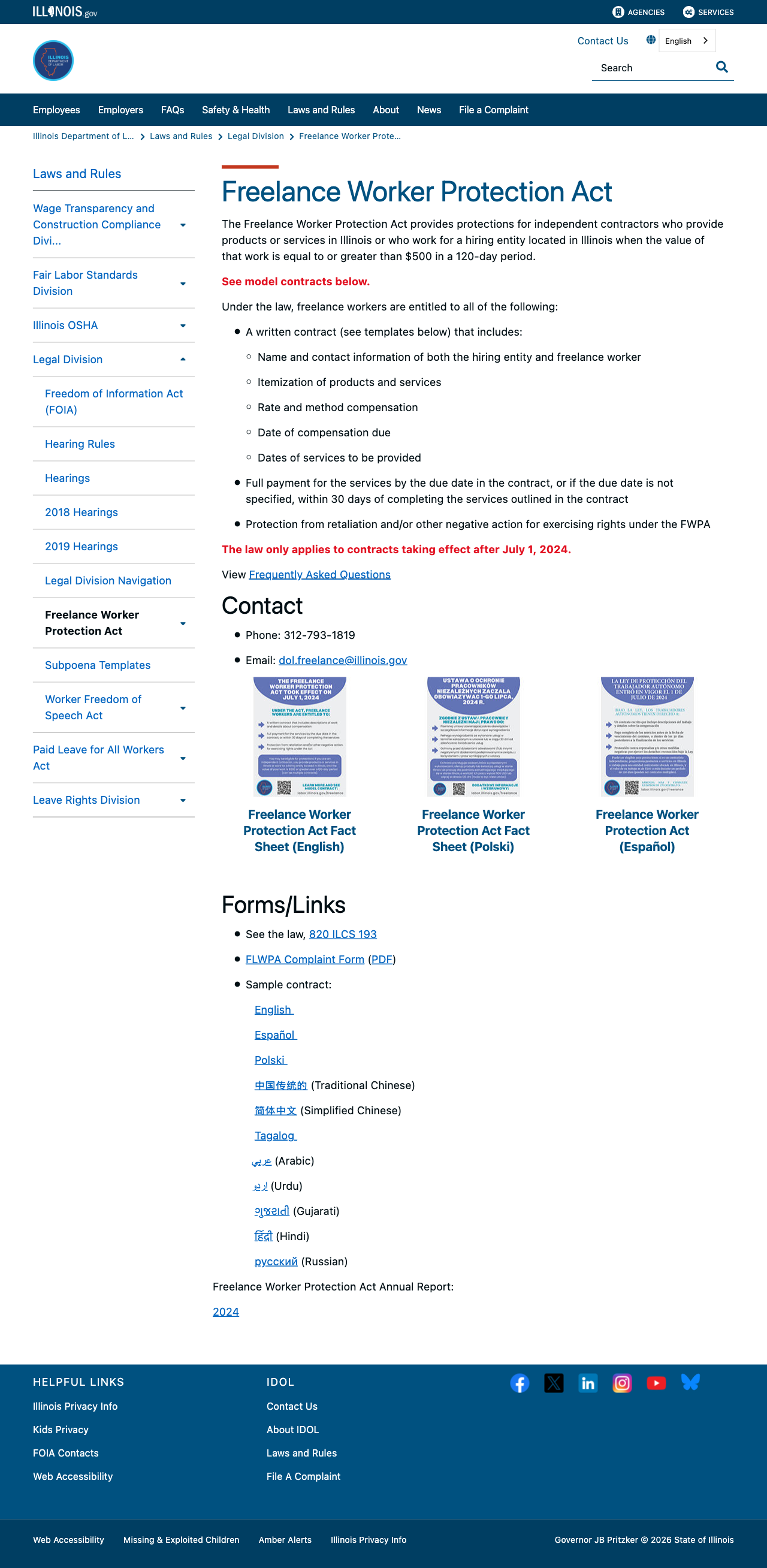
If you send work in or for Illinois, or work with clients based there, it is worth checking whether your last few jobs for any one client crossed $500 in a 120-day window. If they did, the paperwork the Act wants from you is close to what a BillyPaid estimate already produces. Fill in the itemized scope, the dates, and a real due date, get it accepted before you start, and most of the compliance work is already done.
![How Small Businesses Prefer to Get Paid [2026 Data]](/_astro/how-small-businesses-prefer-to-get-paid-2026.YCaeH9Cw_sETpX.webp)
![Small Business Payment Method 2026: 26% Still Pay by Check [Data]](/_astro/small-business-payment-method-statistics-2026.CVRcTZ0T_Z28I3VD.webp)
![Duplicate Payment 2026 [Full Data Report]](/_astro/duplicate-payment-statistics-2026.Bw7v68Ma_Z2wyPsj.webp)