Most freelancers who drive for a rideshare app do not think of themselves as employees, and until now New Jersey mostly agreed with them. On May 5, 2026, the New Jersey Department of Labor and Workforce Development finalized rules that make that agreement much harder to reach. The new standard takes effect statewide on October 1, 2026, and it is expected to push many platform drivers out of independent contractor status and into a payroll W-2 relationship with the company that assigns their work.
If you drive for a platform in New Jersey, or you are watching your own state debate the same question, this changes how your platform income arrives. It does nothing to the invoicing you do for your own direct clients.
What New Jersey actually changed
The new rules formalize how the state applies its existing ABC test, the same three-part standard New Jersey has used for decades to decide who counts as an employee under its unemployment, wage and hour, and wage payment laws. Under that test, a worker is presumed to be an employee unless the company can show all three: the worker is free from the company’s control, the work happens outside the company’s usual line of business, and the worker runs an independently established trade of their own.
Ride-hailing work rarely clears that second prong. Driving is the platform’s own business, not a side service, so a driver using the company’s app is now far more likely to be classified as an employee rather than a contractor. New Jersey had already collected on this theory before the rule existed: Uber paid the state $100 million in 2022 over driver misclassification claims covering 2014 to 2018, and Lyft paid $19.4 million in 2025 to close a similar dispute.
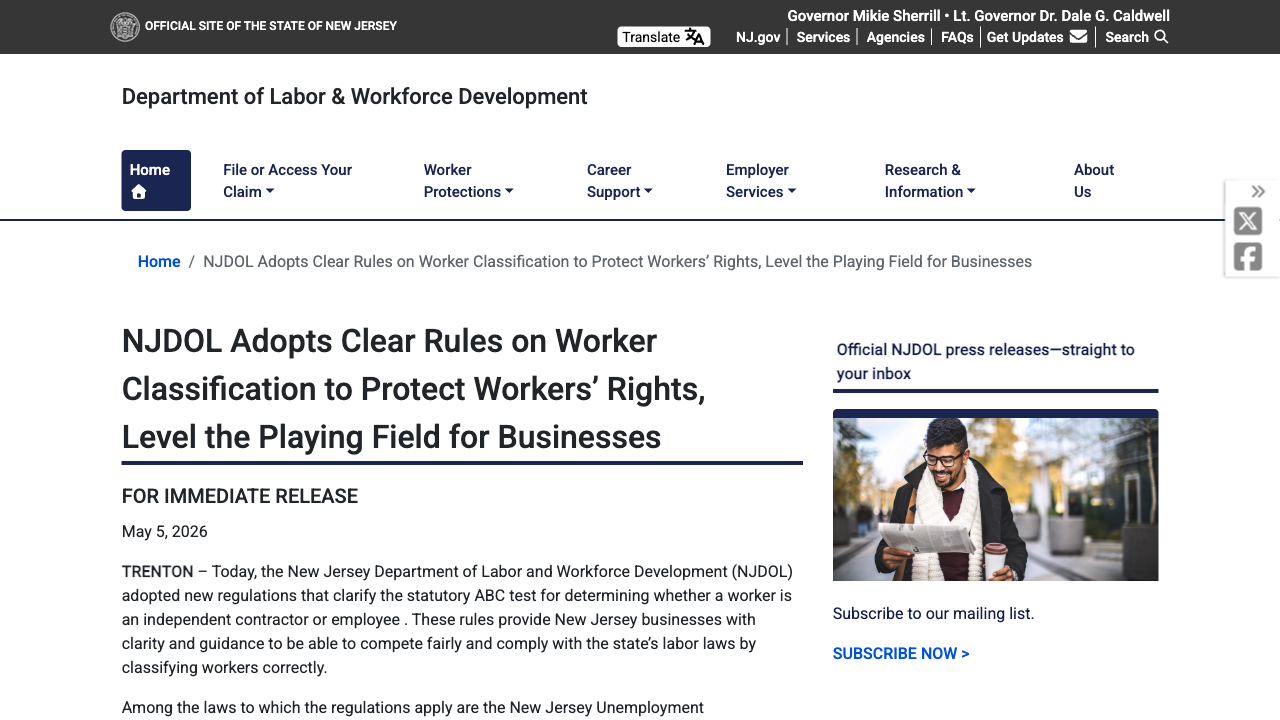 Source: New Jersey Department of Labor and Workforce Development, press release dated May 5, 2026
A state-by-state patchwork, not a national shift
New Jersey is not acting alone, but it is not acting in one direction either. California modified some of its own ABC-test exemptions through AB 1514, effective January 1, 2026. At the federal level, the Department of Labor is moving the opposite way: a proposed rule released February 26, 2026 would make it easier to classify workers as independent contractors nationwide, reviving a control-and-profit-opportunity test closer to one used in 2021. Its public comment period closed April 28, 2026, and no final version has been issued as of late August.
That means whether you count as a contractor or an employee for platform work in 2026 depends heavily on which state you are in and which test applies there, not on a single federal answer. If you split time across platforms in different states, or you are watching to see whether your own state follows New Jersey or waits on Washington, that patchwork is the real story, not a nationwide reclassification.
Two income streams, two different tax pictures
Reclassification does not mean a driver stops freelancing. Most people doing platform gig work also pick up direct client jobs on the side, and the reverse is just as common: a freelancer who drives a few shifts a week to smooth out a slow month. Those two income streams are about to look very different on paper.
| Dimension | Platform income (reclassified as W-2 in NJ) | Direct client income (still self-employed) |
|---|---|---|
| Tax withholding | Employer withholds and remits payroll tax for you | You set aside and pay estimated tax yourself |
| Who tracks it | The platform, through pay stubs and a W-2 | You, through your own invoices and records |
| What BillyPaid document applies | None, this is payroll now | An invoice for every job, with a payable link |
The part of your business this does not touch
None of this changes what you owe a client who hired you directly for a job. If you quoted a homeowner for a fence repair, designed a logo for a local shop, or did a weekend of bookkeeping for a small business, that relationship is still yours to invoice, still yours to chase if payment runs late, and still self-employment income at tax time no matter what happens to your platform work.
The risk for mixed-income freelancers is not the reclassification itself. It is letting the two income streams blur together in your own records once one of them starts arriving with taxes already withheld and the other does not. Keep them separated from the start and neither side surprises you in April.
A BillyPaid invoice keeps your direct client work in its own clean record, numbered and dated, with a payable link your client can use no matter what is happening with your platform income on the other side of your business.
![How Small Businesses Prefer to Get Paid [2026 Data]](/_astro/how-small-businesses-prefer-to-get-paid-2026.YCaeH9Cw_sETpX.webp)
![Small Business Payment Method 2026: 26% Still Pay by Check [Data]](/_astro/small-business-payment-method-statistics-2026.CVRcTZ0T_Z28I3VD.webp)
![Duplicate Payment 2026 [Full Data Report]](/_astro/duplicate-payment-statistics-2026.Bw7v68Ma_Z2wyPsj.webp)