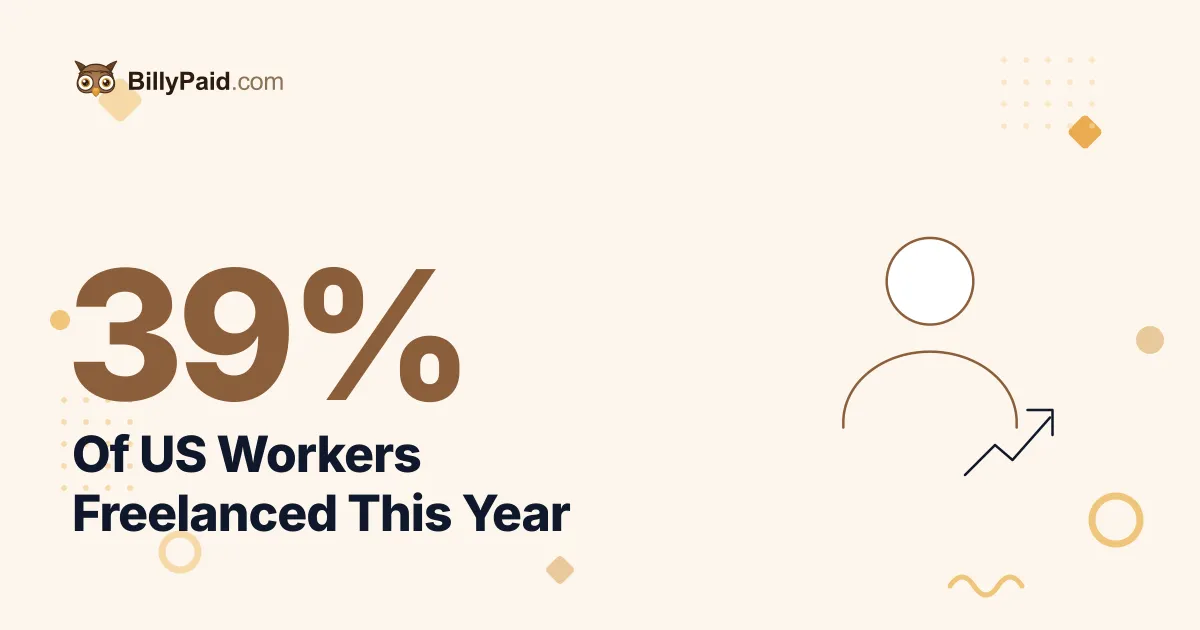
Upwork’s Future Workforce Index 2026 found that 39% of US workers freelanced in the past 12 months, up from 35% the year before. That is not a small platform doing niche research. It is one of the largest freelance marketplaces in the country tracking the same question year over year, and the number keeps climbing.
What the 39 percent figure measures
The number is broader than it sounds. It counts anyone who did any freelance work in the past year, not just people who freelance full time. A nurse who picked up a side project building a friend’s website counts the same as someone running an independent consultancy as their only income. Industry estimates put the total US independent workforce at somewhere between 73 and 76 million people, contributing an amount that different sources place anywhere from 1.3 to 1.77 trillion dollars to the economy each year. The range is wide because nobody agrees on exactly who counts, but the direction is not in question. On the current growth trend, freelancers are on track to make up close to half the US workforce by 2027.
The newest freelancers are also the least prepared
Every year this number grows, a chunk of that growth is people doing freelance or side work for the first time. If this was your first year taking on a client project outside a regular job, you are part of the newest and least experienced slice of that 39%. Nobody hands you an invoicing system when you take on your first freelance client. You figure it out as you go, usually after the first payment gets awkward.
Most first-time freelancers start the same way. A client agrees to pay for something, and the easiest next step feels like sending a Venmo request or a text with a dollar figure in it. It works, until it doesn’t. There is no record of what was agreed to, no due date either side can point back to, and no way to tell at a glance who still owes you money once you have more than one client.
The gap between an informal request and a real invoice
| Venmo request or text | Real invoice | |
|---|---|---|
| Record of what was agreed | None | Dated, numbered, and saved |
| Payment terms | Assumed | A stated due date |
| Following up | An awkward text | A built-in reminder |
| Looks like | A favor | A professional bill |
None of this takes more time once it is set up. It takes more time the first time you have to reconstruct what a client owes you from a string of old text messages, which is usually the moment a first-time freelancer starts looking for a better system.
Build the habit from your first invoice, not your tenth
The freelancers who struggle with getting paid later are rarely the ones who started with a clear invoice, a stated due date, and a way to track who has paid. They are the ones who treated the first few jobs as informal and only built real habits once unpaid invoices started piling up. If this is the year you started freelancing, this is the year to start with the invoice, not the Venmo request.
A BillyPaid estimate gives a first-time client something real to approve before you start, and it turns into a proper invoice with one click once the work is done. You get the habits the growing freelance workforce is short on, without having to build them from scratch.
![How Small Businesses Prefer to Get Paid [2026 Data]](/_astro/how-small-businesses-prefer-to-get-paid-2026.YCaeH9Cw_sETpX.webp)
![Small Business Payment Method 2026: 26% Still Pay by Check [Data]](/_astro/small-business-payment-method-statistics-2026.CVRcTZ0T_Z28I3VD.webp)
![Duplicate Payment 2026 [Full Data Report]](/_astro/duplicate-payment-statistics-2026.Bw7v68Ma_Z2wyPsj.webp)