Australian invoices with an online payment option get paid up to twice as fast as invoices without one, according to Xero, and 92% of Australian construction and trade firms carried at least one overdue invoice in the past 12 months, per CreditorWatch. Below is the full 2026 picture of what actually gets a tradie paid faster: deposits, progress payments, payable links, PayID, and automated reminders, ranked against the real data behind each one.
Does asking for a deposit before starting actually reduce a tradie’s payment risk?
Yes, and it is the only method on this list that removes collection risk entirely, at least for the portion covered. A deposit is money in the account before a spanner touches anything, which is why it sits ahead of every other tactic here. What a tradie can legally ask for depends on the state and the licensing category of the work. Under the NSW Home Building Act 1989, a licensed contractor cannot require or accept a deposit exceeding 10% of the contract price on residential building work over $20,000. Victoria’s Domestic Building Contracts Act 1995 is stricter again above that same threshold, capping the deposit at 5% for contracts of $20,000 or more, and allowing up to 10% below it.
Figure 1: Maximum deposit a licensed contractor can legally request on a $20,000-plus home building contract, by state. Source: NSW Fair Trading (Home Building Act 1989); Consumer Affairs Victoria (Domestic Building Contracts Act 1995).
Those caps apply specifically to licensed residential building work. A day-to-day trade job outside that licensing regime, such as a callout, a repair, or a smaller install, is not bound by the same statutory ceiling, and a 10-20% deposit is common industry practice rather than a legal requirement. Either way, the principle holds: the more of a job’s value a tradie collects before starting, the less exposure sits on the invoice waiting to be chased once the work is done.
Why does deposit timing matter so much for trades specifically?
Because the trades and construction sector carries the worst overdue-invoice numbers in the Australian economy. 92% of Australian construction and trade firms reported at least one overdue invoice in the past 12 months, and 39% had invoices overdue by more than 30 days at a time, according to CreditorWatch, the highest rate of any industry the credit reporting agency tracks.
Figure 2: Share of Australian construction and trade firms with at least one overdue invoice, past 12 months. Source: CreditorWatch.
That exposure compounds down a subcontractor chain: a client or head contractor paying late doesn’t just delay one invoice, it delays every subcontractor and supplier further down the same job. It also sits inside a wider national picture: Australian invoices settled an average of 6.9 days past their due date in the March quarter of 2026, according to the full 2026 Australian late-payment data, with construction consistently the worst-affected sector of any industry that data tracks. A deposit is the one lever a tradie controls before the work even starts, which is part of why it consistently outperforms anything attempted after the invoice has already gone out.
Do progress payments get tradies paid faster on bigger jobs?
For anything too large to cover with a single deposit, yes, and Australian law backs it up. Every state and territory has its own Security of Payment Act giving a contractor or subcontractor a statutory right to progress payments tied to work completed, rather than waiting on one lump sum at the end. In Western Australia, the Building and Construction Industry (Security of Payment) Act 2021 sets a statutory maximum of 20 business days for a principal to pay a head contractor, and 25 business days for a head contractor to pay a subcontractor. Breaking a job into milestone invoices means a tradie is never carrying the full value of a long project as a single, all-or-nothing collection risk. The trade-off is retention: it is common practice on larger jobs for a client or head contractor to hold back roughly 5% of each progress claim, sometimes up to 10%, as security until the job reaches practical completion, which is worth factoring into cash-flow planning even when progress payments themselves are landing on time.
Does adding a payable link get an Australian tradie paid faster?
This is the single strongest lever available on a job that’s already been invoiced. Xero reports that customers using an online “pay now” option on their invoices get paid up to twice as fast as those relying on a standard bank transfer request, and separately that customers using online payment options spend around half as much time chasing payments. The mechanism is simple: a payable link removes every point of friction between a client opening the invoice and the money actually moving, whereas a bank transfer request depends on the client remembering to log into their own banking app later.
Figure 3: Share of invoices paid within their own payment term, by term length. Source: FreshBooks, analysis of 1M+ invoices.
Term length compounds the same effect. FreshBooks’s analysis of more than 1 million invoices found that invoices on 7-day terms are paid within that 7-day window 58.05% of the time, versus just 40.22% for invoices on 30-day terms. A shorter term paired with a payable link on the invoice itself gives a client both the reason and the means to pay immediately rather than putting it on a to-do list for later in the month.
Is PayID a faster way for a tradie to get paid than a standard bank transfer?
PayID runs on the same near-instant New Payments Platform rails as a standard bank transfer, so raw settlement speed is comparable between the two. What PayID actually removes is friction on the client’s side: instead of hunting down a BSB and account number, they pay to a phone number, email address, or ABN they already recognize. More than 34 million PayIDs had been registered across Australia by 31 December 2025, according to Australian Payments Plus, more than the country’s entire population, which means most clients a tradie invoices already have one set up and ready to use.
Figure 4: PayID registrations across Australia, 2020 to 2025. Source: Australian Payments Plus.
For a deeper look at how PayID compares to the newer PayTo rail, and what the 2026 card surcharge ban means for both, the full 2026 PayID and PayTo data for Australia covers that ground on its own.
Do automated payment reminders actually get tradies paid faster once an invoice is already overdue?
Yes, and consistency matters more than any single reminder’s wording. Businesses that follow up on 100% of their overdue invoices get paid within a week 28% of the time, versus just 16% for businesses that leave some invoices uncontacted, a 76% relative improvement from consistency alone, according to Chaser’s 2026 Accounts Receivable Report.
Figure 5: Share of invoices paid within a week of the due date, by follow-up consistency. Source: Chaser, 2026 Accounts Receivable Report.
Wording adds a second, smaller lift on top of that: FreshBooks found that invoices carrying a stated late-fee or interest note are ultimately paid 92.15% of the time, versus a 78.62% baseline for invoices with no such note. A tradie chasing invoices manually between jobs is the most common reason that follow-up rate slips below 100% in the first place, which is the gap an automated reminder sequence is built to close. A closer look at reminder data specifically for tradies covers cadence and timing in more depth.
How the methods stack up
No single method here replaces the others; the fastest-paying tradies stack several of them on the same job.
| Method | What it does | Data point | Source |
|---|---|---|---|
| Deposit before starting | Removes collection risk on that share of the job | NSW caps deposits at 10% of contract price on jobs over $20,000 | NSW Fair Trading, Home Building Act 1989 |
| Progress payments | Ties payment to milestones on longer jobs | WA sets a 25-business-day statutory maximum for paying a subcontractor | WA Security of Payment Act 2021 |
| Payable link on the invoice | Lets a client pay the moment they open it | Invoices with an online payment option get paid up to twice as fast | Xero |
| Shorter payment terms | Gives a client less room to defer payment | 7-day terms paid within term 58.05% of the time vs 40.22% for 30-day terms | FreshBooks, 1M+ invoices |
| PayID | Removes the BSB/account lookup step | 34M+ PayIDs registered across Australia, more than the population | Australian Payments Plus |
| Automated reminders | Replaces manual, inconsistent chasing | 100% follow-up gets paid within a week 28% of the time vs 16% partial | Chaser, 2026 AR Report |
Table 1: How each method changes the odds of getting paid faster. Figures come from different named studies and are not directly additive.
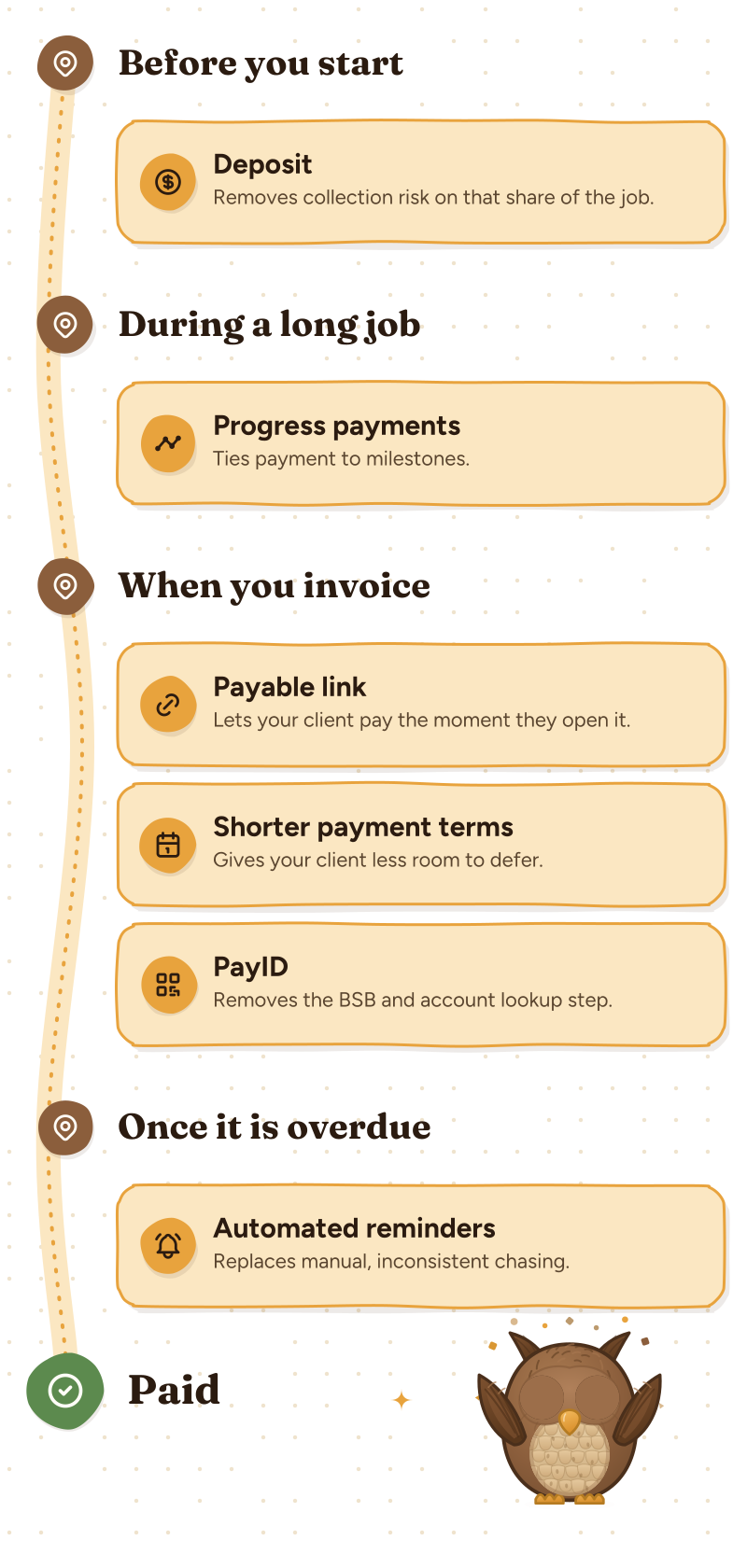
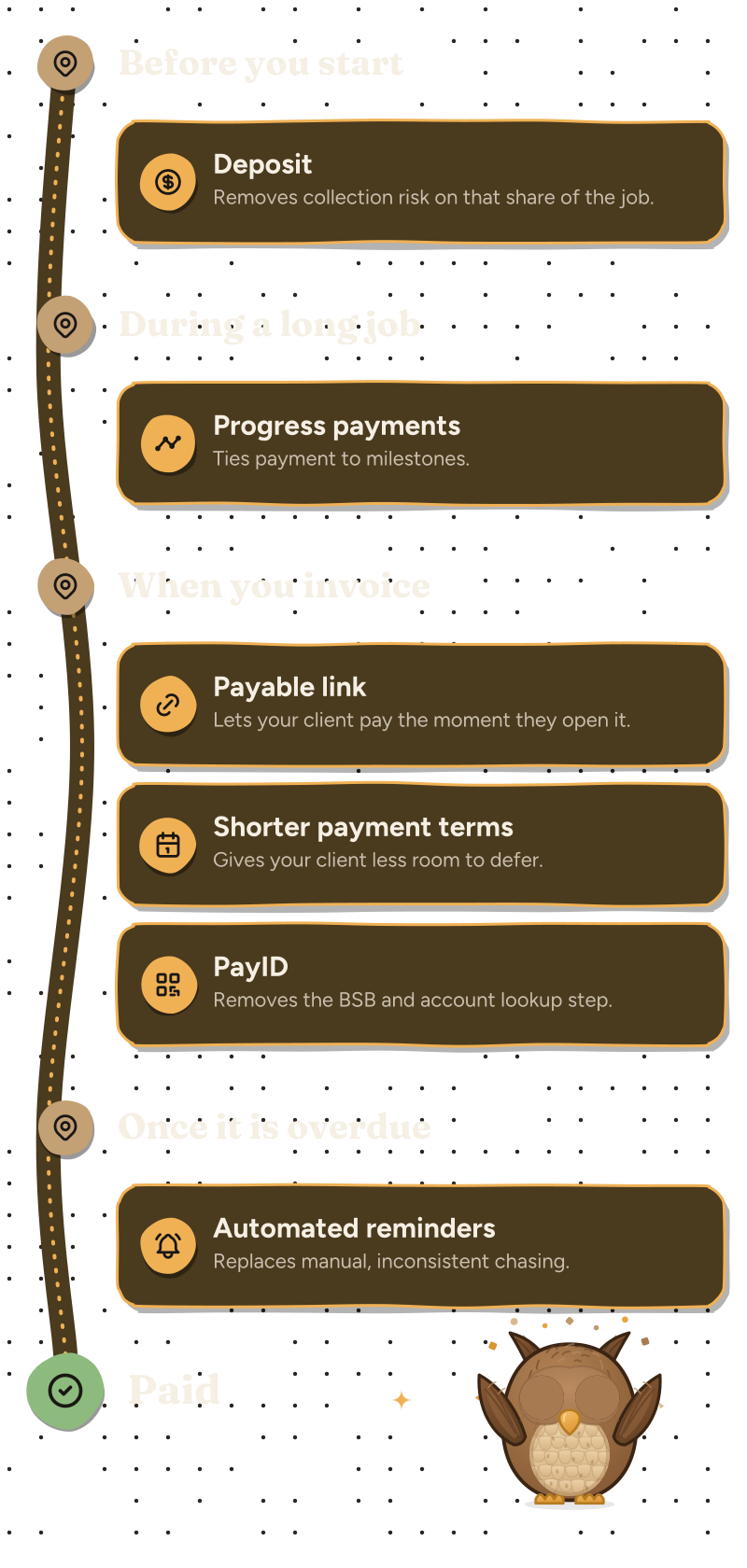
This diagram shows where each of those levers sits in the life of a job.
The Bottom Line
There is no single best way for an Australian tradie to get paid; there is a stack, and it starts before the job does. A deposit, capped at 10% in NSW and 5% in Victoria on larger licensed contracts, removes risk on that share of the value immediately. Progress payments carry the same logic through a longer job, backed by a statutory right to be paid within a set number of business days in every state. Once an invoice is actually issued, the data is consistent across every source in this report: a payable link and a shorter term change the odds of fast payment more than almost anything else a tradie controls, and PayID removes the one manual step, the BSB lookup, standing between a client and paying instantly. With 92% of construction and trade firms carrying at least one overdue invoice, the businesses beating that number are the ones stacking these methods rather than relying on any single one. BillyPaid’s invoice generator builds a payable link into every invoice by default, and its reminder sequence keeps follow-up at 100% without a tradie having to remember to chase anything between jobs.
Frequently Asked Questions
What is the fastest way for an Australian tradie to get paid?
Sending an invoice with an online payment option built in. Xero reports that invoices with an online “pay now” option get paid up to twice as fast as invoices without one, and customers using an online payment link spend roughly half as much time chasing payments. A deposit before starting work removes the collection risk on that portion of the job entirely, which is the closest thing to instant.
How much deposit can a tradie legally ask for in Australia?
It depends on the state and the job. In NSW, a licensed contractor cannot request more than 10% of the contract price as a deposit on residential building work over $20,000, under the Home Building Act 1989. In Victoria, the Domestic Building Contracts Act 1995 caps deposits at 5% for contracts of $20,000 or more, and 10% below that threshold. These caps apply to licensed building work specifically; day-to-day trade jobs outside that licensing regime commonly run a 10-20% deposit as industry practice rather than a legislated limit.
Does PayID get a tradie paid faster than a bank transfer?
PayID uses the same near-instant New Payments Platform rails as a standard bank transfer, so the settlement speed itself is comparable, but PayID removes the step where a client has to look up and correctly key in a BSB and account number. More than 34 million PayIDs had been registered across Australia by 31 December 2025, according to Australian Payments Plus, more than the country’s entire population, which makes it a payment method most clients already have set up.
Do automated payment reminders actually work for tradies?
Yes. Businesses that follow up on 100% of their overdue invoices get paid within a week 28% of the time, versus 16% for businesses that leave some invoices uncontacted, a 76% relative improvement from consistency alone, according to Chaser’s 2026 Accounts Receivable Report. Wording matters too: invoices carrying a stated late-fee or interest note are ultimately paid 92.15% of the time, versus a 78.62% baseline, per FreshBooks’s analysis of more than 1 million invoices.
Sources and References
- Xero : How to accept online payments for faster cash flow
- Build-it : Construction cash crunch as late payments hammer tradies, citing CreditorWatch
- NSW Fair Trading : Home Building Act 1989, deposit and contract requirements
- Consumer Affairs Victoria : Deposits and payments for domestic building
- Government of Western Australia : Building and Construction Industry (Security of Payment) Act 2021
- FreshBooks : Invoice payment terms and late-fee wording analysis, 1M+ invoices
- Chaser : The 2026 Accounts Receivable Report
- Australian Payments Plus : PayID registration data, December 2025
Note: All figures verified as of November 2026.