California signed a new prompt payment law on August 27, 2026. AB 2272 does not add a new payment deadline. It gives subcontractors on state contracts a way to check whether money the state already sent to a prime contractor reached them, and it forces the prime to answer when asked.
For anyone who invoices through BillyPaid, the AB 2272 story is not really about California specifically. It is about where lawmakers keep pointing: the gap between when a payer’s clock starts and what a subcontractor can prove about it.
AB 2272, in plain terms
California already has a state Prompt Payment Act. State agencies must pay a contractor by the date written into the contract, or they owe a late penalty. Existing law also told agencies to encourage prime contractors to pass that money down to subcontractors and suppliers promptly, small businesses most of all. Encourage was the entire mechanism. A sub had no formal way to check.
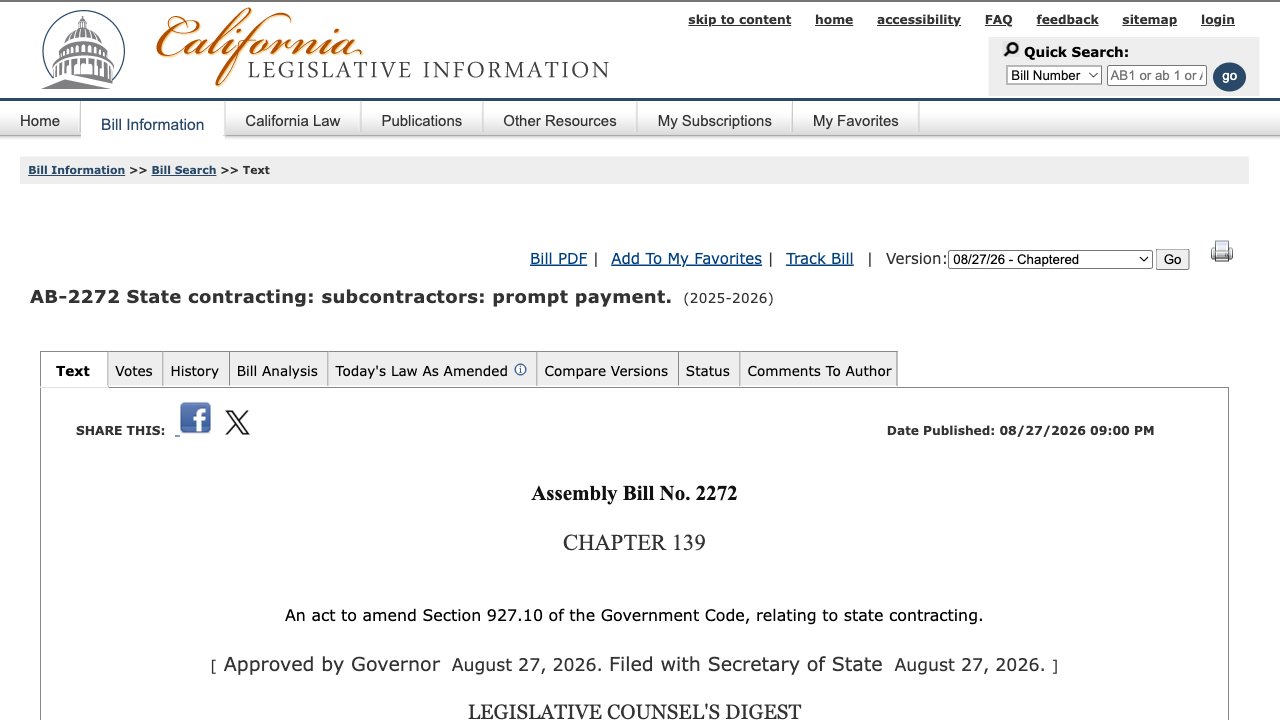
AB 2272 amends Government Code Section 927.10 to close that gap. A subcontractor or supplier working under a state contract can now ask the awarding agency directly for the payment status of invoices the prime submitted for that work. If the agency asks the prime to confirm what it paid its subs, the prime has to answer. The bill (authored by Assemblymember Caloza) was approved by the Governor and filed with the Secretary of State on August 27, 2026, as Chapter 139.
The clock only starts on a proper invoice
Every prompt payment law, state or federal, runs on the same trigger. Federal agencies must pay a small business contractor within 15 days of receiving a proper invoice under the federal Prompt Payment Act, and prime contractors holding federal subcontracts have to pass a version of that same 15-day clock down to their subs under FAR 52.232-40. California’s state Prompt Payment Act works off the date written into the contract rather than a fixed number of days, but the trigger is identical: no proper invoice, no clock.
| Law | Who it covers | When the clock starts | Payment window |
|---|---|---|---|
| Federal Prompt Payment Act | Federal agencies and their prime contractors | A proper invoice is received | 15 days for the agency; FAR 52.232-40 flows a matching term to subs |
| California Prompt Payment Act | State agencies paying contractors | A proper invoice, per the contract date | Whatever the contract specifies, or a late penalty applies |
| AB 2272 (2026) | Subcontractors on CA state contracts | Same clock as above, unchanged | Subs can request payment status from the agency; primes must confirm what they paid subs |
AB 2272 is worth reading even though it does not touch your own payment deadline. Lawmakers did not add a new window this year. They added a way to check whether the existing ones were honored, and the only thing a subcontractor can point to when asking that question is their own invoice.
Your invoice is the proof, not just the request
A proper invoice needs an issue date, a description of the work that matches what was agreed, and payment terms that are not open to interpretation. That is what starts the legal clock under every one of these laws, and it is also what you would hand over if a state agency, a prime contractor, or a court needed to check when you were owed money.
A vague invoice, or one sent weeks after the work wrapped, gives everyone above you in the chain room to argue about when the clock should have started. AB 2272 gives California subcontractors a new way to ask where their payment went. It does nothing for you if your own paperwork cannot answer when you were owed it.
Set your reminders to the window, not a guess
Once you know your actual payment window, whether it is 15 days on a federal contract, a specific date on a state contract, or 30-day terms with a private client, there is no reason to guess when to follow up. A BillyPaid recurring invoice lets you set the reminder cadence once, tied to the date you sent the invoice, so the follow-up goes out the day the client crosses the line instead of whenever you happen to remember.
![How Small Businesses Prefer to Get Paid [2026 Data]](/_astro/how-small-businesses-prefer-to-get-paid-2026.YCaeH9Cw_sETpX.webp)
![Small Business Payment Method 2026: 26% Still Pay by Check [Data]](/_astro/small-business-payment-method-statistics-2026.CVRcTZ0T_Z28I3VD.webp)
![Duplicate Payment 2026 [Full Data Report]](/_astro/duplicate-payment-statistics-2026.Bw7v68Ma_Z2wyPsj.webp)