For tax year 2026, the Form 1099-NEC reporting threshold moves from $600 to $2,000 per contractor, per year. If you pay someone for services and the total for the year lands under $2,000, you no longer have to issue them a 1099-NEC. Through 2025, that line sat at $600, a number that had not moved since the 1950s.
A second, less talked about change lands at the same time. The IRS e-file threshold, the point where you are required to file electronically instead of on paper, drops from 250 forms to 10. That count is not per form type. It adds up every 1099, W-2, and 1098 you file across the year. A business that used to mail a handful of paper 1099s because it stayed well under 250 will likely have to e-file starting with 2026 returns.
The threshold change does not touch what a contractor owes
A contractor paid $1,200 for the year used to get a 1099-NEC. Under the new rule, they will not. That does not make the $1,200 tax-free. Self-employment income is reportable whether or not a form arrives for it, and a contractor who assumes no 1099 means no filing obligation is setting up next April’s surprise. The form is a reporting mechanism for the payer, not the determination of what is taxable.
This is the same principle behind the 1099-K reporting changes of the past few years, applied to a different form. The dollar threshold for when a business has to tell the IRS moves. What a person owes on income they received does not.
Where this changes your workload
If you pay two or three contractors a modest amount each year, this threshold jump likely means fewer forms to prepare in January. That is the upside most coverage leads with.
The part worth sitting with is what it takes to know that with confidence. The old assumption was simple: pay someone more than a few hundred dollars for work, plan to send a 1099-NEC. The new assumption requires an actual number. You need to know, per contractor, what you paid them across the full year, because the difference between $1,900 and $2,100 now determines whether a form is required at all.
That number does not show up on its own. It comes from having every payment to that contractor recorded somewhere, tied to their name, adding up automatically as the year goes on.
| Before 2026 | Tax year 2026 | |
|---|---|---|
| 1099-NEC threshold, per contractor per year | $600 | $2,000 |
| E-file required at | 250+ information returns | 10+ information returns (all types combined) |
| Paper filing allowed | Under 250 forms | Under 10 forms |
A running total is the whole solution
If you are already invoicing contractors for the work they do for you, or recording their invoices to you as payments, you already have a dated, per-contractor record of every dollar that changed hands. Add it up at any point in the year and you have your answer on whether that contractor is trending toward $2,000 or nowhere near it.
That beats reconstructing twelve months of bank transfers and Venmo payments in January, which is how a lot of businesses used to handle 1099 prep under the old $600 line, when almost everyone crossed it anyway. With the threshold at $2,000, guessing gets more expensive: miss someone who crossed the line and you risk a penalty for a form you should have filed; assume everyone crossed it and you file forms you did not need to.
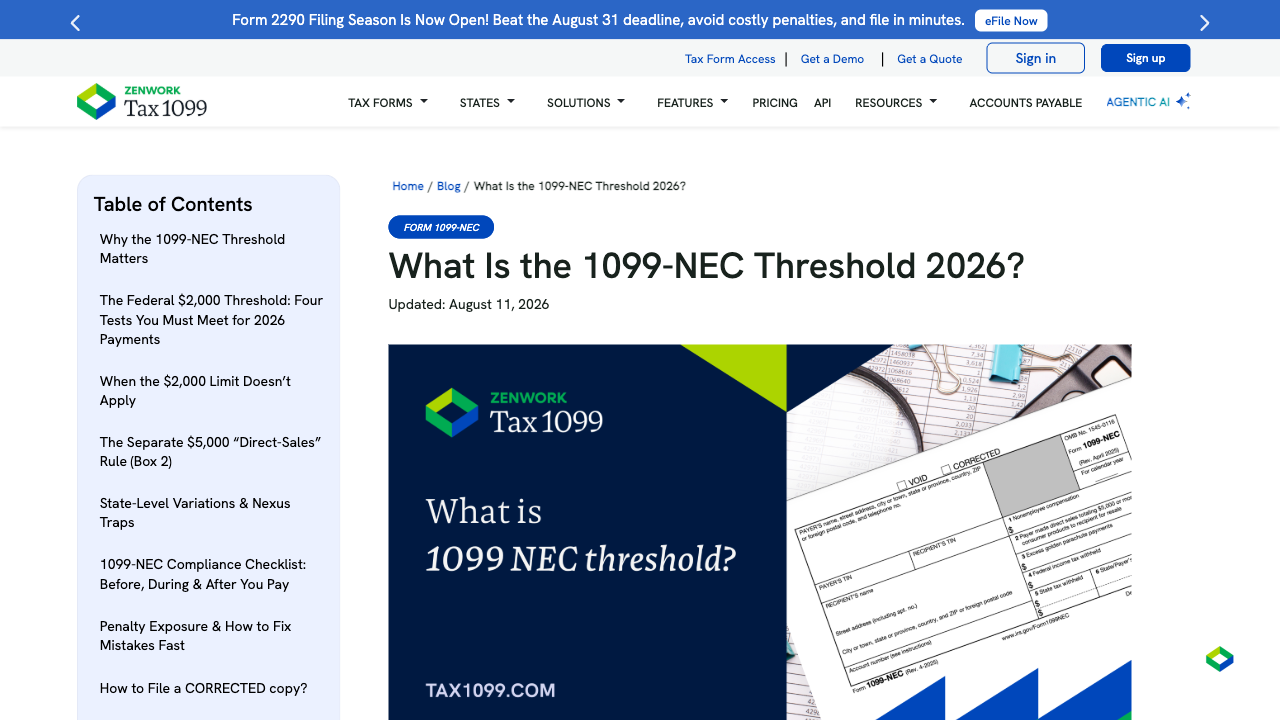
Screenshot below is from Tax1099’s August 2026 guide to the new threshold, one of several accounting-industry writeups tracking the change alongside the IRS’s own filing-season guidance.
Every BillyPaid invoice you send or receive is already dated and tied to a contractor by name, which means your running per-contractor total is sitting there the moment you need to check it against the new $2,000 line.
![How Small Businesses Prefer to Get Paid [2026 Data]](/_astro/how-small-businesses-prefer-to-get-paid-2026.YCaeH9Cw_sETpX.webp)
![Small Business Payment Method 2026: 26% Still Pay by Check [Data]](/_astro/small-business-payment-method-statistics-2026.CVRcTZ0T_Z28I3VD.webp)
![Duplicate Payment 2026 [Full Data Report]](/_astro/duplicate-payment-statistics-2026.Bw7v68Ma_Z2wyPsj.webp)