Upwork spent years charging freelancers a flat 10 percent fee on every contract. That structure is gone. The new rate is variable and runs as high as 15 percent on many common service categories, and Upwork now also charges clients a one-time Contract Initiation Fee of $0.99 to $14.99 on every new contract, stacked on top of its own client-side marketplace fee (5 percent standard, 3 percent for eligible US clients on the Basic plan paying by bank transfer). Connects, the credits freelancers spend to bid on jobs, cost more too, and the increase is steepest in high-demand categories.
Fiverr’s freelancer fee was never lower to begin with. It takes a flat 20 percent of every order and every tip. Buyers pay their own 5.5 percent service fee plus $3.50 on orders under $100. Between the two platforms, more of what a client pays is going to fees, not to the person doing the work.
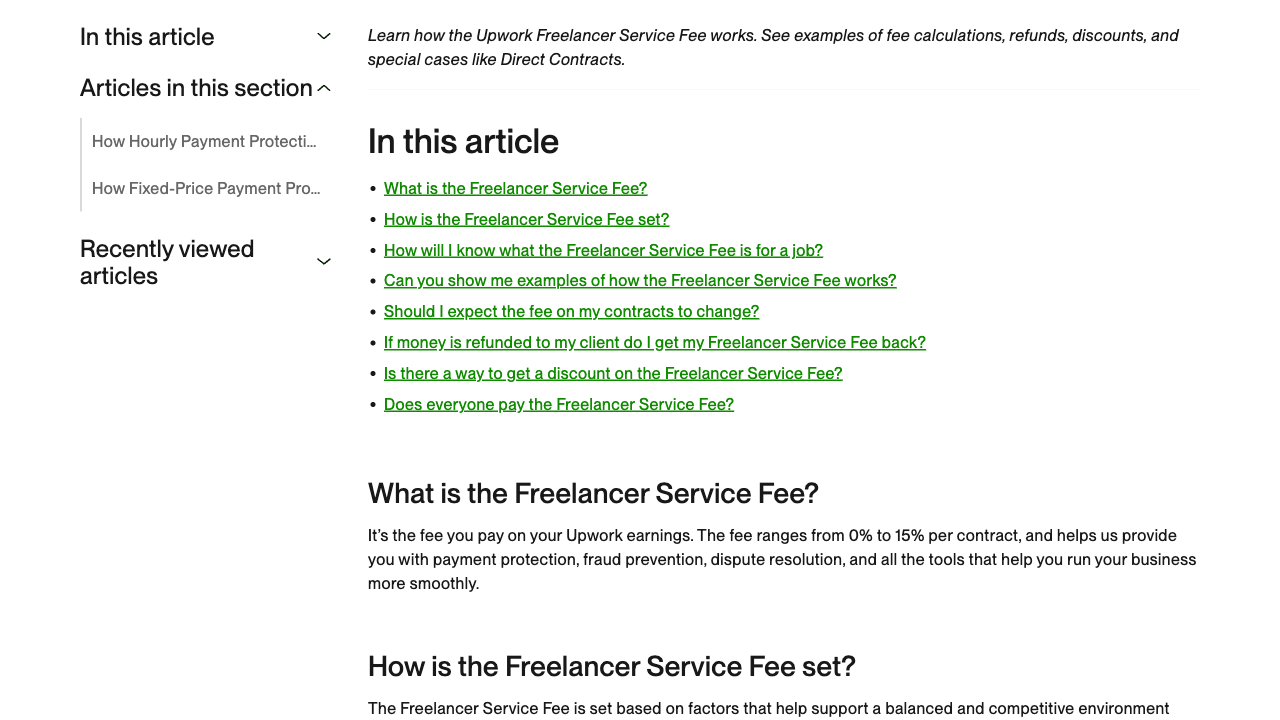 Source: Upwork Help Center, “Learn about the Freelancer Service Fee”
The client bases are shrinking at the same time
Upwork closed 2025 with about 785,000 active clients, down from roughly 832,000 the year before, a drop of about 6 percent, and the count stayed flat to lower into early 2026. Fiverr’s active buyers were down about 13.6 percent year over year in late 2025. Trade press has picked up on the same pattern: freelancers openly weighing whether the cut these platforms take is still worth what they get back.
Whether to leave a platform, cut back on it, or stay put is a decision every freelancer makes with their own numbers. What’s worth planning for either way is what changes the moment you start invoicing a client directly instead of working inside Upwork’s or Fiverr’s system.
The platform was doing more than taking a cut
A lot of what a marketplace fee pays for is invisible until it’s gone. Proposing a budget in Upwork’s messaging is a rough version of an estimate, but the platform never asks you to send a real one, track whether the client agreed to it, or turn it into an invoice later. Escrow holds the client’s money and releases it to you, which means you never had to build your own step for collecting payment. Status updates and built-in messaging double as a record of what was agreed to, without either side keeping a paper trail on purpose.
| Step | On the platform | Going direct |
|---|---|---|
| Estimate | A budget proposed in chat | A written, itemized estimate the client approves |
| Invoice | Generated from the accepted proposal | Something you build and send yourself |
| Payment collection | Held and released by escrow | A payment link or account you set up |
| Reminders | Platform notifies both sides | You track and follow up |
Start with the estimate
The estimate is the first piece to rebuild, since it’s the first thing that happens once a client isn’t inside a platform’s proposal flow. A direct client has no built-in place to see what you’re proposing to do, what it will cost, and what happens if the scope changes. Without a real estimate, you’re negotiating the same details over email or text, with nothing either side can point back to if the scope shifts later.
Then invoicing and collection follow
Once the estimate is approved, you still need a professional invoice, a way to accept payment that doesn’t depend on a client’s goodwill, and a system for following up on anything that goes unpaid past the due date. None of that has to be built from scratch. A BillyPaid estimate turns into an invoice with one click once a client approves it, so the step that used to happen automatically inside a platform’s proposal flow still happens, just under your own name.
![How Small Businesses Prefer to Get Paid [2026 Data]](/_astro/how-small-businesses-prefer-to-get-paid-2026.YCaeH9Cw_sETpX.webp)
![Small Business Payment Method 2026: 26% Still Pay by Check [Data]](/_astro/small-business-payment-method-statistics-2026.CVRcTZ0T_Z28I3VD.webp)
![Duplicate Payment 2026 [Full Data Report]](/_astro/duplicate-payment-statistics-2026.Bw7v68Ma_Z2wyPsj.webp)