Every quarter, the IRS resets the interest rate it charges on underpaid tax. The formula is fixed by law: the federal short-term rate plus 3 percentage points, under Internal Revenue Code Section 6621. For 2026, that puts the rate at 7% for the first, third, and fourth quarters, and 6% for the second quarter. This is the same rate used to calculate the penalty for underpaying quarterly estimated tax on Form 2210, and it reaches anyone who pays their own tax instead of having an employer withhold it.
The rate resets four times a year, and it does not sit still
The federal short-term rate moves with short-term Treasury yields, and the IRS republishes the underpayment rate each quarter to track it. A rate that held steady for a stretch can still move mid-year, which is why the number worth knowing is not “the 2026 rate” as one figure but the rate for whichever quarter your shortfall sat uncorrected in.
A shortfall costs slightly more in three quarters than in one
Underpayment interest accrues against whatever the rate is during the period the shortfall exists. A gap that sits open through Q1, Q3, or Q4 accrues at 7%. The same gap sitting open during Q2 accrues at 6%. The difference on any single quarter’s shortfall is small, but it means the exact cost of guessing wrong depends on when the miss happened, not only on how large it was.
The safe harbor rule decides whether you owe a penalty at all
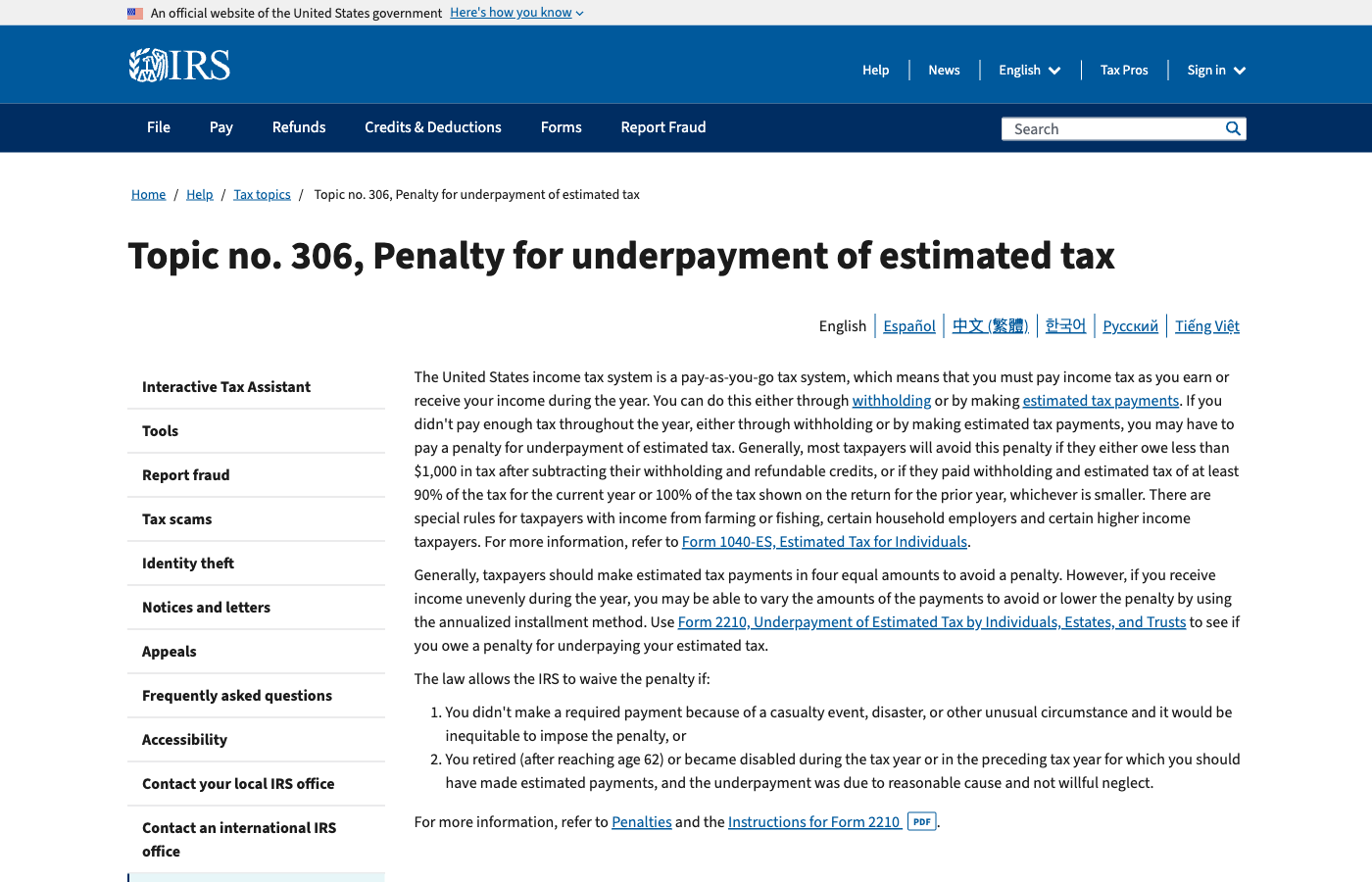
Most freelancers never see this penalty, because the IRS builds in a safe harbor. Per IRS Topic 306, you generally avoid the underpayment penalty if you owe less than $1,000 after subtracting withholding and credits, or if you paid at least 90% of the current year’s tax (or 100% of last year’s, whichever is smaller) through withholding and estimated payments over the year.
| Safe harbor path | Threshold | Applies to |
|---|---|---|
| Small-balance exception | Owe under $1,000 after withholding and credits | Anyone |
| Current-year target | Paid at least 90% of this year’s total tax | Standard safe harbor |
| Prior-year target | Paid at least 100% of last year’s total tax | Most filers |
| Prior-year target, higher earners | Paid at least 110% of last year’s total tax | Prior-year AGI above $150,000 ($75,000 married filing separately) |
Hitting the target means knowing a real number, not a year-end guess
A 90% target only means something if you know 90% of what. That number comes from your income for the year so far, and the only reliable way to have it on hand in June or September is to have it recorded as it happens, not reconstructed from bank statements after the fact.
If you are already invoicing clients through BillyPaid, that running total already exists. A BillyPaid statement of account rolls up every invoice and payment for a period into one dated figure, so checking your income against the 90% or 100% target is a lookup instead of a reconstruction project.
![How Small Businesses Prefer to Get Paid [2026 Data]](/_astro/how-small-businesses-prefer-to-get-paid-2026.YCaeH9Cw_sETpX.webp)
![Small Business Payment Method 2026: 26% Still Pay by Check [Data]](/_astro/small-business-payment-method-statistics-2026.CVRcTZ0T_Z28I3VD.webp)
![Duplicate Payment 2026 [Full Data Report]](/_astro/duplicate-payment-statistics-2026.Bw7v68Ma_Z2wyPsj.webp)