When you pay with a card and the charge turns out to be fraudulent, federal rules give you a clear path to dispute it. When you send or receive money on Zelle, that same protection mostly does not exist, and nobody in Washington has finished deciding what should replace it.
That gap is not hypothetical for a freelancer or small business paid by client transfer. If a client’s Zelle payment turns out to be tied to a scam, or you get talked into “refunding” an overpayment that was never really there, the rulebook for who eats the loss is thinner than it is for a card charge. Right now, state courts are doing more to define that rulebook than any federal regulator.
A federal case that started and stopped
In December 2024, the Consumer Financial Protection Bureau sued Early Warning Services, the company that operates Zelle, along with several of its largest owner banks. The suit alleged that customers lost more than $870 million to fraud and scams on the platform over roughly seven years. In March 2025, following a change in federal administration, the CFPB dropped the case. No replacement federal rule followed.
A state case picked up where it left off
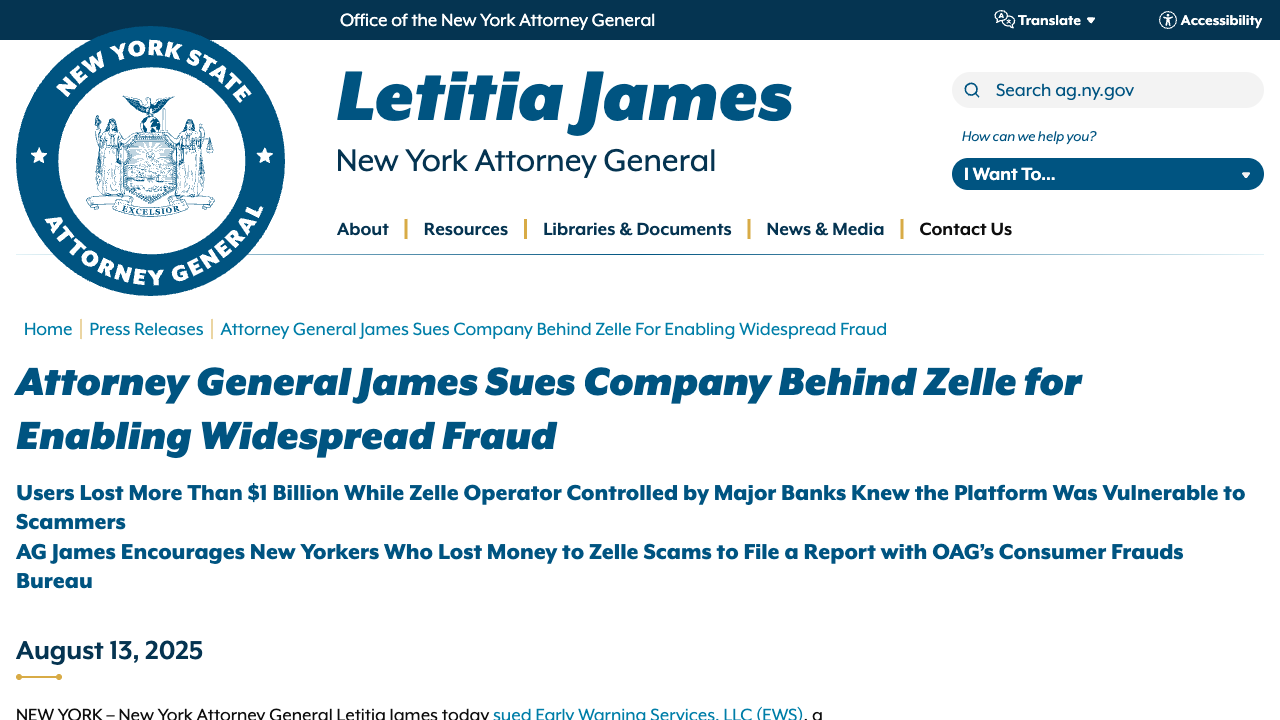
In August 2025, New York Attorney General Letitia James filed her own lawsuit against Early Warning Services, the company owned by JPMorgan Chase, Bank of America, Capital One, and Wells Fargo that built and runs Zelle. Her office’s complaint alleges that weak identity verification and a rushed launch let scammers exploit the platform, causing more than $1 billion in losses to users between 2017 and 2023.
Filed as the CFPB’s case was withdrawn, the New York suit is now one of the more concrete efforts anywhere in the country to establish what a payment platform like Zelle owes its users when fraud happens. FedNow, the newer real-time payment rail run by the Federal Reserve, still has no anti-fraud liability model settled either, so this state-level litigation is effectively where the practical rules are being written for now.
Why the underlying law treats this differently
Federal Regulation E gives consumers a 60-day window to dispute a transaction they did not authorize, and banks generally have to make that right. The gap opens with what is called authorized push payment fraud: a victim who is tricked into sending the money themselves, believing they are paying a real bill, a real vendor, or a real client. Because the account holder technically authorized the transfer, the strongest consumer protections do not automatically apply, even though the money left just as wrongfully.
| Card payment | P2P transfer, e.g. Zelle | Invoice-linked payable link | |
|---|---|---|---|
| Unauthorized-charge dispute rights | Strong, Reg E and card network rules | Limited | Same as card, when a card or bank rail is used |
| Protection if you were tricked into sending it | Chargeback process usually available | Weak, transfer is often irreversible | Documented request tied to a specific invoice, easier to dispute or prove |
| Transaction record | Itemized, tied to merchant and order | Bare transfer with a memo line | Dated invoice, line items, and payment status in one record |
What this means for how you get paid
None of this is about distrusting a client who pays you on Zelle. Most of those payments are exactly what they look like. The issue is what happens on the rare occasion something goes wrong, whether that is a fraudulent payment routed through your account or a scam that targets you directly by asking you to send money back.
A bare peer-to-peer transfer with a memo line gives you very little to point to afterward. A payable link tied to a specific, itemized invoice gives you a dated record of exactly what was billed, to whom, and when it was paid, which is a much easier thing to dispute or prove if a payment is ever challenged.
Screenshot below is from the New York Attorney General’s August 2025 press release announcing the lawsuit against Zelle’s operator.
Sending an invoice with a payable link attached gives every client payment the same kind of paper trail a card charge already has, well before you ever need it.
![How Small Businesses Prefer to Get Paid [2026 Data]](/_astro/how-small-businesses-prefer-to-get-paid-2026.YCaeH9Cw_sETpX.webp)
![Small Business Payment Method 2026: 26% Still Pay by Check [Data]](/_astro/small-business-payment-method-statistics-2026.CVRcTZ0T_Z28I3VD.webp)
![Duplicate Payment 2026 [Full Data Report]](/_astro/duplicate-payment-statistics-2026.Bw7v68Ma_Z2wyPsj.webp)