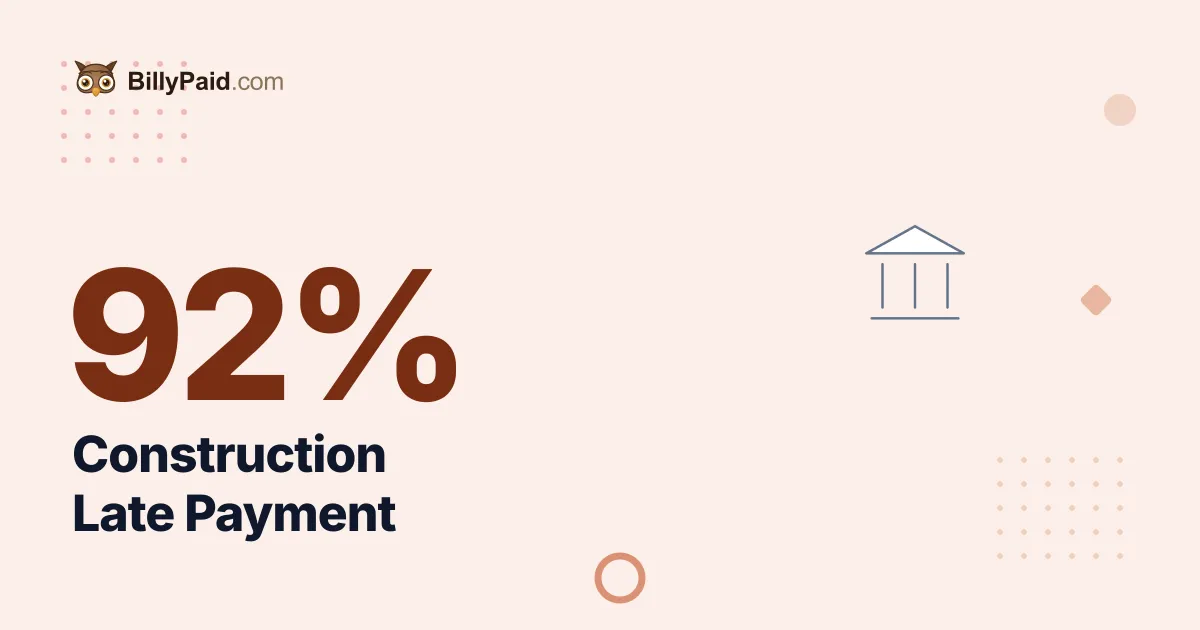
92% of Australian construction firms had at least one overdue invoice in the past 12 months, and 39% carried invoices more than 30 days past due, according to CreditorWatch. That is the highest overdue-invoice rate of any industry the credit reporting agency tracks, and it sits alongside a sector that also posts the country’s second-highest business failure rate and its single largest share of corporate insolvencies. Below is the 2026 picture of what late payment is doing to Australian construction, and where Security of Payment law is meant to, and sometimes fails to, step in.
How many Australian construction firms actually have overdue invoices?
92% of construction firms reported at least one overdue invoice in the past 12 months, and 39% had invoices overdue by more than 30 days at a time, according to CreditorWatch. Attempts to reach CreditorWatch’s own report page for this specific figure returned 403 and 404 errors during fact-checking for this article, the same dead end an earlier BillyPaid report on Australia’s late-payment numbers hit. The number itself is corroborated independently, however: it is attributed to CreditorWatch by name in Australian construction trade coverage, most directly Build-it’s reporting on the industry’s cash crunch, so it is used here as CreditorWatch data reported via that trade press, not a figure this article can trace to a CreditorWatch page directly.
Figure 1: Overdue invoices at Australian construction firms, past 12 months. Source: CreditorWatch, via Build-it.
The exposure runs down the contract chain, not just to one business. A head contractor paying late does not just delay itself, it delays every subcontractor and supplier waiting on the same job, and smaller trades and sole operators feel it hardest since they rarely have the cash reserves to absorb a 30, 60, or 90-day gap. That chain effect is a big part of why every Australian state and territory has its own Security of Payment legislation specifically for building and construction, covered in more detail further down.
Is construction actually worse off than the rest of the Australian economy?
Construction’s overdue-invoice problem sits on top of an economy that is already under real pressure. Nationally, Australian small businesses were paid an average of 24.1 days after invoicing and settled an average of 6.9 days past their due date in the March quarter of 2026, according to Xero Small Business Insights. Construction does not report a directly comparable overdue-days figure, but every other measure available points the same direction: it is the industry CreditorWatch flags as having the highest share of firms carrying overdue invoices, and, as the next section shows, it also carries a business failure rate well above the national average. A payable link that gets an invoice paid faster matters more in a sector already absorbing the country’s slowest, most concentrated payment risk.
How does late payment translate into actual business failure in construction?
Construction’s 12-month business failure rate was 5.3% as of November 2024, according to CreditorWatch data reported by ABC News, the second-highest of any industry after hospitality’s 8.5%, and above the 5.04% national average across all industries at the time. Both hospitality and construction share the same underlying pressure: thin margins, long payment chains, and rising costs that leave little buffer once a client or head contractor pays late.
Figure 2: 12-month business failure rate by industry, November 2024. Source: CreditorWatch, via ABC News.
Construction is not just proportionally risky, it is the single largest contributor to Australia’s insolvency count in absolute terms. “External administration” is ASIC’s umbrella term for a company placed into liquidation, voluntary administration, or receivership once it can no longer pay its debts as they fall due, and of the 7,742 Australian companies that entered one in the nine months to March 2024, construction accounted for 2,142 of them, or 27.7% of the total. That is more than double the next-largest industry, accommodation and food services, at 15.2%, according to ASIC’s own insolvency data release. The pattern holds no matter which slice of the data is used: whether measured by 12-month failure rate against every other industry, or by the raw count of businesses that actually went under, construction sits at or near the top of every list ASIC and CreditorWatch publish. For a subcontractor waiting on a payment, that scale matters beyond the headline number: a head contractor’s own insolvency is one of the few outcomes even a fast Security of Payment adjudication cannot fully fix, since a debt owed by a company that no longer exists is far harder to recover than one that is merely late.
Figure 3: Construction’s share of all Australian company failures, nine months to March 2024. Source: ASIC, Media Release 24-077MR.
Is the construction insolvency wave getting worse or easing off?
Set next to the 5.3% failure rate and 27.7% failure share above, the year-over-year insolvency count is the closest thing to a trend line this report can offer. Through FY2025 (the year to 30 June 2025), it was still climbing: construction recorded 3,595 insolvencies that year, nearly one in four of the 14,716 Australian companies that became insolvent nationally, itself a 33% jump for the whole economy on the year before, according to CreditorWatch’s own insolvency index, one of the few CreditorWatch pages this article was able to reach and quote directly rather than via a secondary reprint. That same report described construction as only “tentatively” stabilizing even as the raw count kept climbing, a deliberately cautious call that reads as accurate in hindsight. The most recent full-year figure available for this article, covering FY2026 (year to 30 June 2026), shows a modest pullback: 3,472 construction companies entered external administration or had a controller appointed that year, according to ASIC data reported in July 2026, a roughly 3% easing from FY2025 rather than a reversal of the underlying pressure.
Figure 4: Construction company insolvencies, FY2025 vs FY2026. Source: CreditorWatch (FY2025); ASIC, via Accountants Daily (FY2026).
How long do construction firms actually wait to be paid, and does the law limit it?
Every Australian state and territory has its own Security of Payment Act, designed specifically to help contractors, subcontractors, and suppliers in the building and construction industry recover money they are owed faster than a standard contract dispute would allow, including an adjudication process that sits outside the court system. In Western Australia, the Building and Construction Industry (Security of Payment) Act 2021 sets a statutory maximum of 20 business days for a principal to pay a head contractor and 25 business days for a head contractor to pay a subcontractor, with a payment schedule due well before that if the amount is disputed. “Pay when paid” clauses, where a subcontractor’s payment is made conditional on the head contractor first being paid by someone further up the chain, are invalid under Security of Payment law across the country.
Those statutory maximums are a legal floor, not what actually happens on site. One industry analysis, citing CreditorWatch and the Australian Constructors Association, puts average construction payment times at 32 to 50-plus days, well beyond the 25-business-day maximum a subcontractor is legally owed.
Figure 5: Construction payment times, statutory maximum vs industry-reported actual. Source: WA Building and Construction Industry (Security of Payment) Act 2021; CreditorWatch and Australian Constructors Association, via Zalbasi RE PM.
Retention money adds another layer of delay on top of the payment terms themselves. Retention is typically withheld at around 5% of each progress payment, capped at roughly 5% of the total contract value, with part released at practical completion and the balance held until the end of the defects liability period, commonly six to twelve months later, according to Procore’s construction retention guide. Because that money sits with the party holding it rather than the subcontractor who earned it, several states have moved to require it be held in trust rather than in a business’s general accounts: New South Wales requires retention trust accounts on projects over $20 million, Queensland has been phasing in project trust accounts since 2022, and Western Australia introduced a retention trust requirement for eligible contracts of at least $20,000, effective 1 February 2024. How exactly each state’s Security of Payment Act differs on timeframes, adjudication, and retention rules is enough of its own topic to warrant a dedicated state-by-state breakdown.
What does this mean for a construction business trying to get paid on time?
Everything above sits on top of the general challenge every Australian trade business already knows: chasing a slow-paying client or head contractor eats time that should go toward the next job, and the businesses least able to absorb a 30, 60, or 90-day gap are the smaller subcontractors and sole trades that make up most of the industry. A structured payment reminder sequence that starts before an invoice is even due, rather than after it has gone quiet, is one of the few levers a subcontractor controls directly regardless of what a head contractor or principal does. The wider question of invoicing conventions across specific trades, plumbers, electricians, builders, cleaners, and landscapers, is its own cluster of coverage still being built out on this site.
Construction vs the rest of the Australian economy, side by side
| Measure | Construction | Comparison | Source |
|---|---|---|---|
| Overdue invoices, any (past 12 months) | 92% of firms | Highest of any industry tracked | CreditorWatch, via Build-it |
| Overdue invoices, 30+ days | 39% of firms | CreditorWatch, via Build-it | |
| 12-month business failure rate | 5.3% | Hospitality 8.5%; all industries 5.04% | CreditorWatch, via ABC News, Nov 2024 |
| Share of all company failures | 27.7% | Accommodation and food services 15.2% | ASIC, Media Release 24-077MR |
Table 1: Construction’s late-payment and business-failure exposure compared to the two other sectors and the national baseline covered in this report.
The Bottom Line
Construction is the clearest outlier in Australia’s 2026 late-payment picture. 92% of firms had at least one overdue invoice in the past year, the sector’s 5.3% business failure rate is second only to hospitality, and construction alone accounts for more than a quarter of every company failure ASIC tracks nationally. Security of Payment legislation exists precisely because of this pattern, and it does set real statutory floors, invalid “pay when paid” clauses, fast adjudication, and, increasingly, trust-account protection for retention money. What it has not done is close the gap between those legal minimums and what actually happens on a job: a 25-business-day statutory maximum against a reported industry average of 32 to 50-plus days. Getting paid faster than that average starts with the paperwork: BillyPaid’s invoice generator produces a clean, itemized invoice with a payable link attached, so a subcontractor is not adding “chase the payment” to an already long list of reasons a job runs over.
Frequently Asked Questions
What share of Australian construction firms have overdue invoices?
92% of Australian construction firms reported at least one overdue invoice in the past 12 months, and 39% had invoices overdue by more than 30 days at a time, according to CreditorWatch. That is the highest overdue-invoice rate of any industry the credit reporting agency tracks.
Is construction the riskiest industry for business failure in Australia?
No, but it is close. Hospitality carries the highest 12-month business failure rate at 8.5%, with construction second at 5.3%, both above the 5.04% national average, according to CreditorWatch data reported in November 2024. Construction is also the single largest industry by raw insolvency count, accounting for 27.7% of the 7,742 Australian companies that entered external administration in the nine months to March 2024, per ASIC.
How long do construction contractors have to pay under Security of Payment law?
In Western Australia, the Building and Construction Industry (Security of Payment) Act 2021 sets a statutory maximum of 20 business days for a principal to pay a head contractor and 25 business days for a head contractor to pay a subcontractor. Every state and territory has its own Act with its own timeframes.
Does Security of Payment legislation stop late payment in construction?
It sets a legal floor and a fast dispute-resolution path, but it does not close the gap between statutory targets and reality: industry tracking attributed to CreditorWatch and the Australian Constructors Association puts average construction payment times at 32 to 50-plus days, well beyond the 25-business-day statutory maximum a subcontractor is entitled to.
Sources and References
- Build-it - Construction cash crunch as late payments hammer tradies, citing CreditorWatch
- ABC News - Business insolvencies reach highest level since October 2020, citing CreditorWatch (November 2024)
- ASIC - Media Release 24-077MR, insolvency data shows increase in companies failing
- CreditorWatch - Insolvencies plateau at elevated levels but sector stress persists (July 2025, FY2025 insolvency data)
- Accountants Daily - Company insolvencies climb to 14,152 for FY2025-26, citing ASIC data (July 2026)
- Zalbasi RE PM - The Cost of Slow Payments: A Comparative Analysis of the U.S. and Australian Construction Markets, citing CreditorWatch and the Australian Constructors Association
- WA Small Business Development Corporation - How WA’s new Security of Payment Act will help subcontractors get paid
- Procore - Understanding Retention in Construction Contracts: Australia’s Rules and Best Practices
- Xero - Small Business Insights, Australia, March quarter 2026
Note: All figures verified as of October 2026.