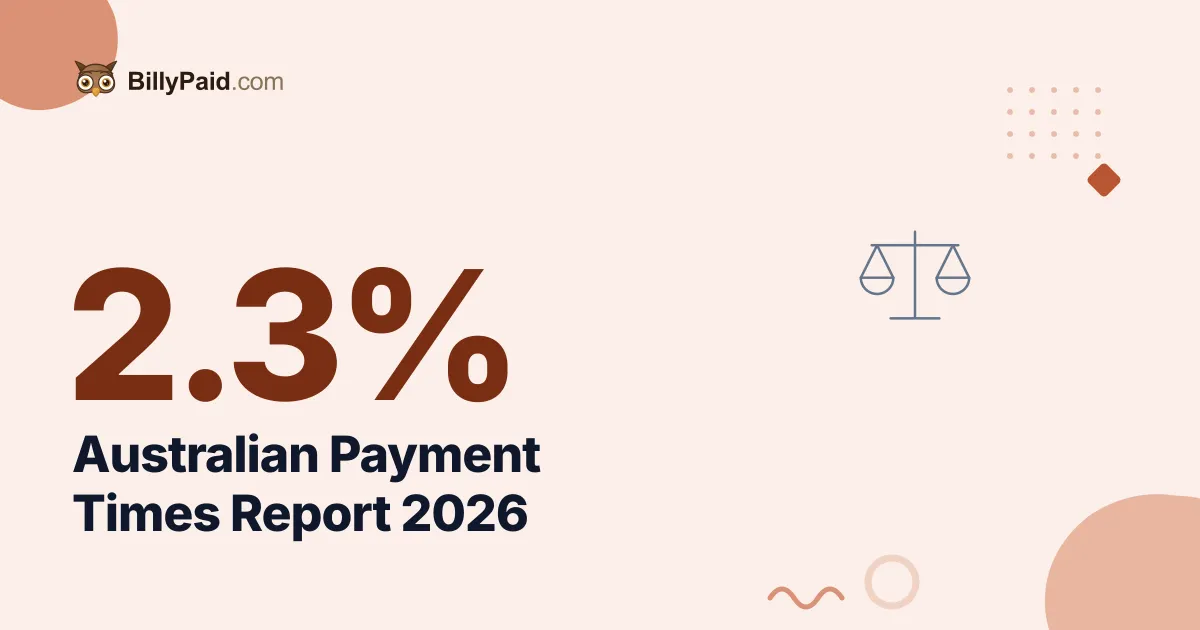
Only 2.3% of the large Australian companies required to report under the federal Payment Times Reporting Scheme currently qualify as a Fast Small Business Payer, according to the Payment Times Reporting Regulator’s January 2026 update covering Reporting Cycle 9 (1 January to 30 June 2025). That regulator dataset, the biannual disclosures roughly 100-million-dollar-plus businesses file on how they actually pay their small suppliers, is the most detailed public record of large-company payment behavior in the country. Here is what the scheme-level data says, before naming any individual business.
How rare is fast payment among Australia’s biggest companies?
Fast payment is rare enough that the regulator built a whole recognition program around it, and the program’s own numbers show why. To make the newly launched Fast Small Business Payer List, a reporting entity has to pay 95% or more of its small business invoices in 20 days or less, and it has to hit that mark for two consecutive six-month reporting periods, with the most recent period no more than 9 months old.
In the latest cycle, 134 entities cleared that bar. Set against every business reporting under the scheme, across every industry, that works out to just 2.3%.
Figure 1: Share of Payment Times Reporting Scheme entities that qualify as a Fast Small Business Payer, Reporting Cycle 9. Source: Payment Times Reporting Regulator, January 2026 update.
That is not a small-sample fluke. The scheme now covers thousands of reports a year, and the 2.3% figure is calculated across the full reporting population, all industries combined. Getting onto the list is a genuine outlier result, not a default outcome of doing business responsibly.
What is the Payment Times Reporting Scheme?
The Payment Times Reporting Scheme has run since 1 January 2021 under the Payment Times Reporting Act 2020, administered by the Payment Times Reporting Regulator. It requires reporting entities, mostly large businesses plus some government enterprises, to disclose how they pay their small business suppliers every 6 months.
Each report covers three things: standard payment terms, actual payment times, and any use of supply chain finance arrangements. The Regulator publishes every report to the public Payment Times Reports Register, where anyone, including a small business weighing up a new client, can look up how a large company actually pays. The scheme is deliberately a transparency mechanism rather than a price-fixing one: it does not set or mandate any specific payment term for large businesses. The theory is that public visibility alone shifts behavior, and the 2.3% Fast Payer figure above is one early test of whether that theory is working.
Which businesses have to report, and at what size?
The general rule is straightforward: an entity with total income of A$100 million or more in its most recent income year is a reporting entity. Corporate groups get a second layer. If a controlling corporation is incorporated in Australia, is not itself a subsidiary of another Australian-incorporated entity, and its aggregate income together with its subsidiaries exceeds A$100 million, the whole group is caught. Individual subsidiaries inside that group become reporting entities in their own right once their own income exceeds A$10 million.
Figure 2: Income thresholds that trigger a Payment Times Reporting obligation. Source: Payment Times Reporting Regulator, Information Sheet 3.
A controlling corporation that qualifies as a reporting entity has to file even in a year it earns no income at all, submitting what the scheme calls a nil report. On the other side of the ledger, an entity counts as a small business supplier under the scheme if its total income was less than A$10 million in its most recent income year, the same A$10 million line that separately marks the floor for a member entity’s own reporting obligation.
What is the difference between a payment term and a payment time?
This is the definitional split the entire scheme is built on, and it matters because the two numbers can tell very different stories. A payment term is what a business promises: the standard timeframe it states on an invoice or in a supplier contract, such as net 30 or net 60. A payment time is what actually happens: the number of days that elapsed before the payment genuinely landed.
A large business can advertise generous 30-day terms while its 95th percentile payment time, how long the slowest 5% of its invoices actually took, runs to double or triple that figure. That gap is exactly why the Regulator collects both fields separately in every report rather than trusting a business’s stated terms alone. A small business checking a prospective client’s record on the public Register should read both numbers, not just the one a large company chooses to put on its own invoices.
Is the slowest 5% of payments getting better or worse?
By the headline measure, worse. The 95th percentile payment time, the average number of days it takes a large business to pay 95% of its small business invoices, rose to 64 days in Cycle 9, up from 58 days the cycle before. The Regulator’s own reading of the shift is that average payment times stayed relatively stable across the same period, which means the slowest payments specifically are stretching out further, a change that disproportionately hits the cash flow of the small businesses waiting on that slowest 5%, and lines up with the broader Australian late payment data tracked outside this scheme.
Figure 3: 95th percentile payment time, previous cycle versus Cycle 9 (H1 2025). Source: Payment Times Reporting Regulator, January 2026 update.
The 95th percentile is not a side statistic in this scheme. It is the exact measure the Regulator uses to sort entities into the Fast and Slow Small Business Payer categories covered next, so a four-day national drift in that one number has direct consequences for how many businesses land on either list.
How does the scheme reward fast payers and flag slow ones?
The reforms that took effect from 1 July 2024 introduced two formal labels built on the 95th percentile figure. A Fast Small Business Payer is a reporting entity that pays 95% or more of its small business invoices in 20 days or less for two consecutive cycles, published on the Register’s Fast Small Business Payer List, which now updates daily.
Figure 4: Share of reporting entities that currently carry Fast Small Business Payer status. Source: Payment Times Reporting Regulator, January 2026 update.
A Slow Small Business Payer sits at the other end. An entity qualifies if it ranks in the slowest 20% of all Small Business Payers during a cycle, or in the slowest 20% within its own ANZSIC industry division. There is one built-in floor: an entity with a 95th percentile payment time of 30 days or less can never be classified a Slow Payer, no matter how it ranks relative to peers. Where a business is identified as slow for two consecutive cycles, the Minister for Small Business (or the Regulator, acting as delegate) can issue a direction forcing that business to publicly disclose its status, a disclosure that is itself then published on the Register. A companion piece looks at exactly which large Australian businesses and industries currently sit at that slow end of the Payment Times Reporting data.
How far is the national figure from the never-Slow floor?
Putting the two numbers from this report side by side is the clearest way to see how much room the system still has to close. The 30-day mark is the point below which an entity is structurally protected from ever being labeled a Slow Payer. The national 95th percentile figure for Cycle 9 sits more than double that, at 64 days.
Figure 5: The never-Slow floor against the current national 95th percentile figure. Source: Payment Times Reporting Regulator, January 2026 update; KPMG Australia, Payment Times Reporting Scheme FAQs.
That gap is a rough proxy for how far the average large reporting entity would need to move to be structurally safe from a Slow Payer classification, let alone to reach the 20-day Fast Payer bar covered above.
What happens if a business does not comply?
The Regulator holds real enforcement powers, and the reforms sharpened them. A reporting entity that fails to submit its report faces a maximum penalty of 300 penalty units for an incorporated entity. At the current Commonwealth penalty unit value of A$364, effective from 1 July 2026, that ceiling works out to roughly A$109,200. A reporting entity that files a false or misleading report faces a steeper, revenue-linked maximum: up to 0.6% of its total income for the relevant income year. The Regulator can also publish details of non-compliance, run investigations or compliance audits, and issue infringement notices or pursue civil penalties.
The mechanics of reporting itself are also changing. A new reporting portal is set to launch on 16 February 2026, replacing the current system entirely. It will not accept reports for reporting periods that began before 1 July 2024, so any business with an overdue pre-reform report needs to lodge it through the existing portal before the cutover, or work through a manual submission process with the Regulator afterward.
Where the scheme’s numbers land
| Metric | Value | Reporting period | Source |
|---|---|---|---|
| Fast Small Business Payer share | 2.3% of reporting entities | Cycle 9 (H1 2025) | Payment Times Reporting Regulator |
| Entities meeting the Fast Payer bar | 134 entities | Cycle 9 (H1 2025) | Payment Times Reporting Regulator |
| 95th percentile payment time | 64 days, up from 58 | Cycle 9 (H1 2025) | Payment Times Reporting Regulator |
| General reporting threshold | A$100 million annual income | Ongoing | Info Sheet 3 |
| Member entity threshold | A$10 million annual income | Ongoing | Info Sheet 3 |
| Small business supplier ceiling | Under A$10 million annual income | Ongoing | Payment Times Reporting Rules 2024 |
| Maximum penalty, failure to report | 300 penalty units, about A$109,200 | From 1 July 2026 | KPMG / Commonwealth penalty unit notice |
| Maximum penalty, false or misleading report | Up to 0.6% of total income | Ongoing | KPMG |
The Bottom Line
Australia’s own regulator data draws a two-speed picture of large-company payment behavior. Base-level compliance with the scheme is broad, thousands of businesses file every cycle, but genuinely fast payment stays rare at 2.3%, and the slow tail is drifting further out, not closing in, with the 95th percentile figure moving from 58 to 64 days in a single cycle. For a small business or freelancer on the receiving end of that gap, the practical response is twofold: check a prospective large client’s actual track record on the public Payment Times Reports Register before extending trade credit, and control the half of the equation that is actually yours to control, the same working-capital pressure covered in BillyPaid’s Australian SME cash flow data. BillyPaid’s invoice generator builds a clean, correctly formatted invoice in minutes, and a structured payment reminder sequence closes the gap between a generous stated payment term and how long an invoice actually sits unpaid, the exact gap this scheme’s data exists to expose.
Frequently Asked Questions
What is the Australian Payment Times Reporting Scheme?
A federal disclosure regime, in force since 1 January 2021 under the Payment Times Reporting Act 2020, that requires large businesses and some government enterprises to report every 6 months on how they pay their small business suppliers. Reporting entities file standard payment terms, actual payment times, and any use of supply chain finance to the Payment Times Reporting Regulator, and the reports are published on the public Payment Times Reports Register. The scheme does not set or mandate any payment term; it works through public transparency.
How many businesses have to report under the scheme, and what is the income threshold?
A business with A$100 million or more in annual income has to report, according to the Payment Times Reporting Regulator’s Information Sheet 3. Inside a corporate group, the head entity is caught once the group’s total aggregate income passes A$100 million, and an individual subsidiary is caught once its own income passes A$10 million. A controlling corporation that is a reporting entity must still file even in a year it earns no income, submitting a nil report.
What is the difference between a payment term and a payment time under the scheme?
A payment term is what a business promises, the standard timeframe it states for paying an invoice, such as 30 days from the invoice date. A payment time is what actually happens, the number of days a payment genuinely took to land in the supplier’s account. The Payment Times Reporting Regulator collects both figures separately in every report precisely because a generous stated term and a slow actual payment time can coexist, and a supplier only feels the second one.
What percentage of large Australian businesses pay small suppliers within 20 days?
Only 2.3% of reporting entities across all industries currently qualify as a Fast Small Business Payer, the status reserved for businesses that pay 95% or more of their small business invoices within 20 days or less for two consecutive reporting periods. In the most recent six-month cycle, 134 entities met that 95%-within-20-days benchmark, according to the Payment Times Reporting Regulator’s January 2026 update.
Sources and References
- Payment Times Reporting Regulator: Media Release: Regulator’s Update, January 2026
- Payment Times Reporting Regulator: Regulator’s Update, January 2026
- Payment Times Reporting Regulator: About the Payment Times Reporting Scheme
- Payment Times Reporting Regulator: Information Sheet 3: Who Must Report
- Payment Times Reporting Regulator: Helping Small Business
- Payment Times Reporting Regulator: Regulator’s Newsletter No. 4, January 2026
- Payment Times Reporting Regulator: Regulator’s Newsletter No. 3, January 2026
- KPMG Australia: How Payment Times Reporting May Impact Your Business (2026)
- Inside Small Business: Regulator Reveals Much Room for Improvement in Payment Times to Small-Business Suppliers (2026)
- Commercial Building Disclosure (Australian Government): Penalty Unit Increase from 1 July 2026
Note: All figures verified as of October 2026.