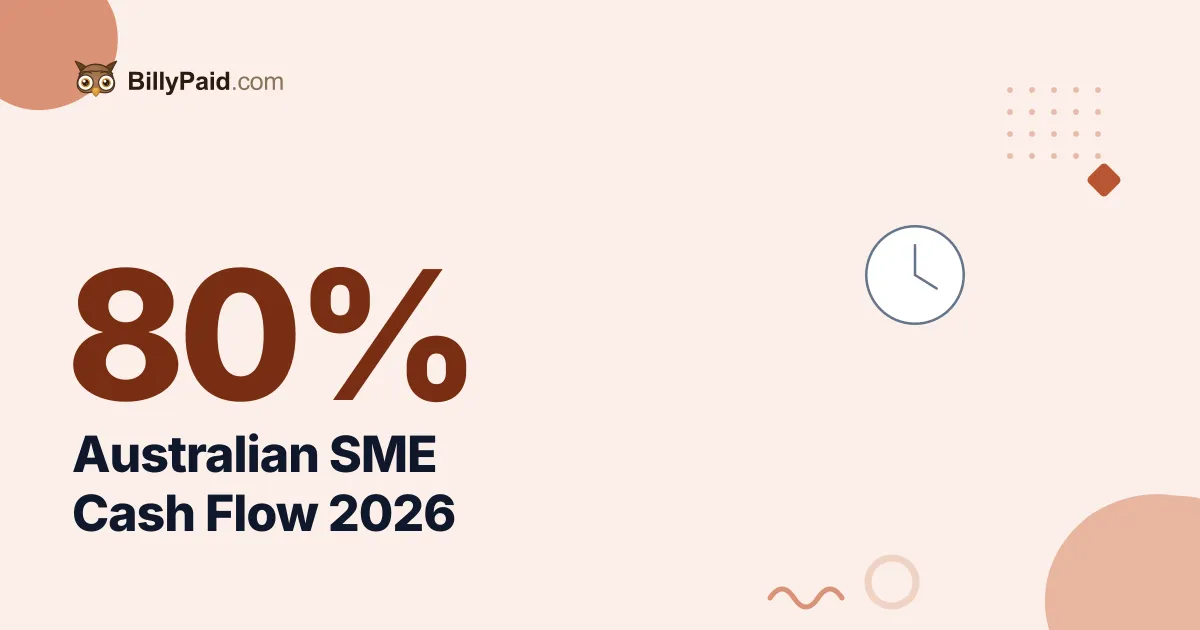
Nearly 80% of Australian small and medium businesses experienced a cash flow impact in the past 12 months, according to a CommBank and UNSW Business School survey of 507 business owners published in January 2025. Late payments, GST timing, and thin cash reserves all show up in the 2026 data as recurring pressure points, not one-off shocks. Here is what the numbers actually say about why Australian SMEs run short on cash, and how much it costs them.
How many Australian SMEs are dealing with cash flow problems in 2026?
Close to 80% of Australian small and medium businesses said their cash flow had been affected in the past year, per the CommBank and UNSW Business School survey, which reached 507 business owners between 31 October and 5 November 2024. The three most common causes were declining revenue, cited by 35% of respondents, low cash reserves at 30%, and seasonal fluctuations at 27%.
Figure 1: Nearly 80% of Australian SMBs felt a cash flow squeeze in the past year. Source: CommBank / UNSW Business School, published January 2025.
The same survey found most owners are absorbing the shock personally rather than letting it hit the business. 27% dipped into personal savings or skipped their own salary at least once in the past year, and 85% said they actively use at least one coping strategy: cutting expenses (34%), building a cash reserve (27%), finding an additional revenue stream (26%), or raising prices (25%). A companion look at how many SMEs struggle with cash flow globally finds the US figure sits lower, at 51%, once the question is asked the same narrow way, which suggests Australian SMEs are feeling this more acutely than their US counterparts, not just answering a broader survey question.
None of the three leading causes is a one-off event. Declining revenue and seasonal fluctuations are structural, they recur every trading cycle, and a thin cash reserve is the condition that turns an ordinary slow month into an actual crisis rather than a manageable dip. That is why the causes below matter more as a combination than as three separate numbers: a business with healthy reserves can absorb a seasonal dip on its own, but a business already running lean gets hit twice.
Figure 2: Declining revenue, low cash reserves, and seasonal swings are the three leading causes of cash flow pressure for Australian SMEs. Source: CommBank / UNSW Business School, January 2025.
How much do late payments cost Australian SMEs?
Late payments cost the average Australian SME AU$2,408 every month, or close to AU$29,000 a year, according to an Airwallex and Censuswide survey of 500 SME owners fielded between 23 and 29 July 2025. 84% of respondents reported losing up to AU$4,999 a month, and businesses earning more than AU$250,000 a month felt the sharpest hit, with average losses climbing to AU$3,055. Only 22% said every one of their invoices was paid on time; 59% said up to a quarter of their invoices came in late, and a further 13% reported delays on as much as half of everything they bill.
That cost is compounding, not easing. Australian small businesses waited an average of 24.1 days to be paid in the March quarter of 2026, similar to the 24.0 days recorded the quarter before, and were paid 6.9 days late on average, up from 6.7 days in the December quarter, according to Xero Small Business Insights, which tracks around 520,000 Australian small businesses.
Figure 3: The average number of days an Australian invoice sits unpaid past its due date has been ticking up, not down. Source: Xero Small Business Insights, Dec quarter 2025 vs Mar quarter 2026.
The most widely cited estimate of the total scale of the problem is older but still frequently referenced: a March 2023 report by AlphaBeta Advisors, prepared for Xero from more than 10 million invoices issued by over 150,000 Australian SMBs, put the national value of large-business late payment at $115 billion a year, with 53% of trade credit invoices paid late by an average of 23 days. Treat that figure as a 2023 estimate rather than fresh 2026 data, but it remains the most-cited industry benchmark for the overall size of the problem. It echoes a pattern seen worldwide; our global late payment data shows 55% of all US B2B invoices were overdue in 2025, so Australia’s late-payment burden is not an outlier so much as a local version of a global problem. A dedicated breakdown of Australia’s late-payment numbers, and a closer look at exactly how long Australian businesses wait to get paid, are both worth reading alongside this piece for the fuller picture.
How does GST and tax debt add to the cash flow squeeze?
Australian small businesses collect a large share of the country’s GST on the government’s behalf, and the timing of that collection is itself a cash flow lever. Net GST cash collections reached $90.2 billion in 2024-25, up 6.2% ($5.3 billion) from the prior year, according to the ATO’s GST Administration Annual Performance Report. Most of that flows through small business bank accounts before being remitted on a quarterly Business Activity Statement cycle, which means GST a business has already collected from customers can sit as working capital for weeks before it is due to the ATO, and just as easily create a shortfall if that money has already been spent covering other costs.
That gap shows up directly in the debt numbers. Small business collectable tax debt reached $35.9 billion of the ATO’s $54.2 billion total collectable debt book in 2024-25, or 66.1% of it by value, according to an Australian National Audit Office performance audit of the ATO’s debt management. That is more than double the $16.5 billion recorded in 2018-19. Across 1,338,387 small businesses carrying a balance, the average debt owed was $26,797, and around 39,000 businesses classified as disengaged, meaning debts over $100,000 and more than 90 days overdue with no active repayment engagement, collectively owed $11.3 billion.
Which Australian industries feel the cash flow squeeze hardest?
Construction carries the heaviest load. 92% of construction firms reported an overdue invoice in the past 12 months, the highest share of any sector CreditorWatch tracks, with 39% of those firms overdue by more than 30 days at a time. Long payment chains between principal contractors, subcontractors, and suppliers mean a single slow payer near the top can starve cash flow for several businesses below it before the delay is ever visible in a single company’s own books.
Figure 4: Construction has the highest rate of overdue invoices of any Australian industry CreditorWatch tracks. Source: CreditorWatch, 2025.
Small businesses across every sector are still doing most of their invoice chasing manually, which slows down exactly the cash flow relief a faster follow-up sequence would provide. Given that 97.3% of all Australian businesses are classified as small, per Australian Bureau of Statistics data reported through the Australian Small Business and Family Enterprise Ombudsman, industry-level swings like construction’s 92% overdue rate are effectively a small-business problem almost by definition. It is also a chain reaction: a principal contractor paying a subcontractor late means that subcontractor is, in turn, more likely to pay its own suppliers late, and the delay compounds at every link before a single invoice is ever formally disputed.
What happens when SME cash flow runs out?
Cash flow failure is the single most cited reason an Australian company enters external administration, and the construction sector’s overdue-invoice rate is a preview of where that risk concentrates first. Inadequate cash flow or excessive cash use was named in 52% of external administrators’ reports lodged with ASIC, ahead of other unspecified factors at 50% and trading losses at 49%. Administrators can list more than one cause per company, which is why the three figures add up to well over 100%, but cash flow’s position at the top of that list has held across multiple reporting periods.
Figure 5: Inadequate cash flow outranks every other reason administrators give for why an Australian company failed. Source: ASIC external administrators’ reports.
The pattern is consistent with what small business owners themselves report: cash flow rarely fails because of one dramatic event. It is usually the slow accumulation of late-paying customers, a GST remittance that lands at an awkward moment, and reserves that were never quite thick enough to absorb both at once.
Australian SME cash flow, at a glance
| Metric | Figure | Source | Period |
|---|---|---|---|
| SMBs hit by a cash flow impact | 80% | CommBank / UNSW Business School | 12 months to Nov 2024 |
| Average days an invoice is paid late | 6.9 days | Xero Small Business Insights | March quarter 2026 |
| Average monthly loss from late payments | AU$2,408 | Airwallex / Censuswide | July 2025 |
| Construction firms with an overdue invoice | 92% | CreditorWatch | Past 12 months |
| Insolvency reports citing inadequate cash flow | 52% | ASIC external administrators’ reports | FY2022-23 base, reaffirmed through 2025 |
| Small business collectable tax debt | $35.9 billion | ANAO / ATO | 2024-25 |
The Bottom Line
Australian SME cash flow trouble in 2026 is not one problem, it is three that compound. Customers pay slower than they used to, GST collected today is owed to the ATO on a fixed quarterly cycle regardless of what has already been spent, and reserves thin enough to survive one bad month rarely survive both at once. None of that is fixable by working harder inside a spreadsheet at 11pm. It is fixable by shortening the gap between doing the work and having the cash in hand, which starts with sending a compliant invoice the moment work is done rather than batching invoices for later, and following up automatically the day a payment is due rather than the week after. The businesses in the CommBank survey that reported building a cash reserve or increasing prices were coping; the ones closing the gap between invoice and payment fastest are the ones actually solving it.
Frequently Asked Questions
What percentage of Australian small businesses struggle with cash flow?
Nearly 80% of Australian SMBs experienced a cash flow impact in the 12 months to late 2024, according to a CommBank and UNSW Business School survey of 507 business owners published in January 2025. The most common causes were declining revenue (35%), low cash reserves (30%), and seasonal fluctuations (27%).
How much do late payments cost the average Australian small business?
AU$2,408 a month, or close to AU$29,000 a year, according to an Airwallex and Censuswide survey of 500 Australian SME owners fielded in July 2025. Only 22% of respondents said every one of their invoices was paid on time, and 59% said up to a quarter of their invoices came in late.
Is cash flow really the top cause of business failure in Australia?
It is the single most cited cause. Inadequate cash flow or excessive cash use was named in 52% of external administrators’ reports lodged with ASIC, ahead of other factors (50%) and trading losses (49%). Administrators can cite more than one cause per company, which is why the figures do not sum to 100%.
How much GST do Australian small businesses handle, and does it affect their cash flow?
Net GST cash collections reached $90.2 billion in 2024-25, according to the ATO’s GST Administration Annual Performance Report, and small businesses collect most of it on the ATO’s behalf before remitting it on a quarterly BAS cycle. That timing gap is part of why small business collectable tax debt has more than doubled since 2018-19, reaching $35.9 billion in 2024-25 according to the Australian National Audit Office.
Sources and References
- CommBank / UNSW Business School and AGSM: Small Business Cash Flow Survey (January 2025)
- Xero: Small Business Insights, Australia (March quarter 2026)
- Airwallex / Censuswide: The Cost of Late Payments Revealed (July 2025)
- AlphaBeta Advisors for Xero: Paying the Price, the Economic Impact of Big Businesses Paying Australian Small Businesses Late (March 2023)
- Australian Taxation Office: GST Administration Annual Performance Report 2024-25
- Australian National Audit Office: Australian Taxation Office Management of Small Business Collectable Debt
- CreditorWatch: The Impact of Late Payments on Cash Flow and What to Do About It (2025)
- Australian Securities and Investments Commission: Insolvency Statistics, External Administrators’ Reports
- Australian Small Business and Family Enterprise Ombudsman: Number of Small Businesses in Australia (ABS data)
Note: All figures verified as of October 2026.