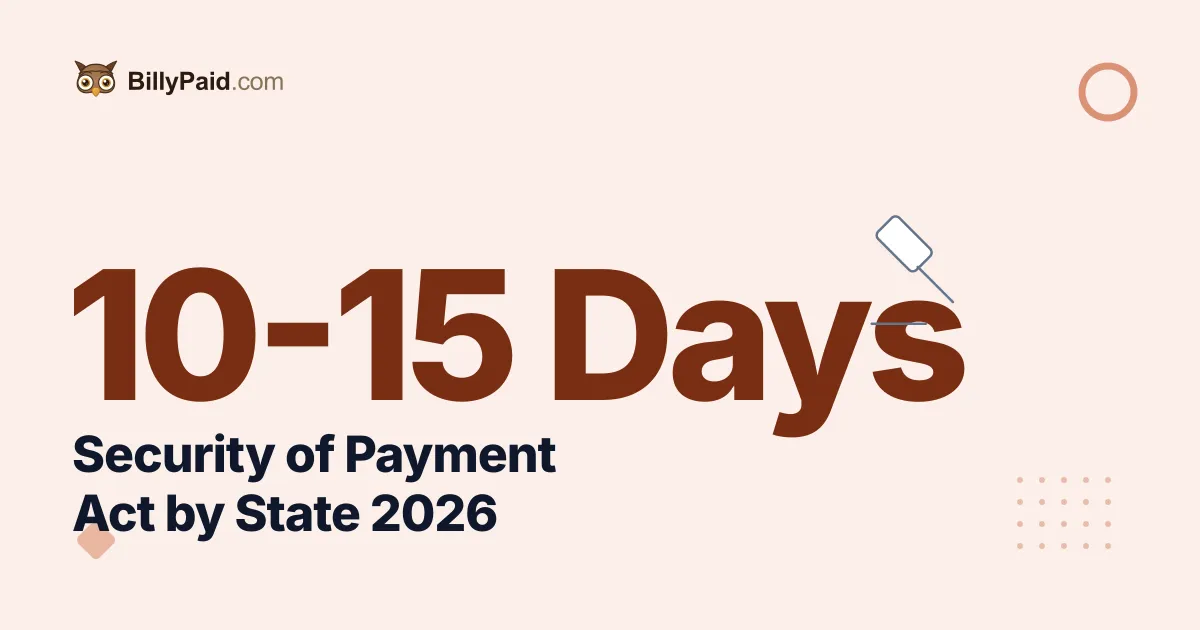
A payment schedule is due within 10 business days in New South Wales, Victoria, Tasmania and the ACT, but within 15 business days in Queensland, Western Australia and South Australia, under each jurisdiction’s own Security of Payment Act. Miss that window in any of them and the full amount claimed becomes an automatically enforceable debt. This guide walks through every state and territory’s actual statutory deadlines, how the rapid adjudication process each one provides actually works, and the practical steps a contractor takes to recover an unpaid progress claim using the Act rather than a lawsuit.
Figure 1: In four jurisdictions, a payer has only 10 business days to dispute a claim before it becomes payable in full. Sources: NSW Fair Trading; state Security of Payment Acts, 2026.
What is a Security of Payment Act and how does it work?
Every Australian state and territory except the Northern Territory runs some version of a “payment claim, payment schedule, adjudication” model, all descended from the original Building and Construction Industry Security of Payment Act 1999 (NSW). A contractor or subcontractor who has done construction work sends a payment claim; the party who owes the money has a fixed number of business days to send back a payment schedule stating what it actually intends to pay and, if less than the full claim, why. If the two sides still disagree once a payment schedule is served, either party can refer the dispute to an independent adjudicator, a private, industry-appointed decision-maker rather than a judge, who issues a binding determination on an interim basis, typically within about 10 business days of receiving both sides’ submissions.
The point of the whole structure is cash flow, not final legal certainty. An adjudicator’s determination does not stop either side from later suing in court over the underlying contract dispute; it just decides, fast, who has to pay what right now so that work on site does not stall while a multi-month legal argument plays out. That single design choice, speed over finality, is why every state’s numbers below cluster so tightly around 10 to 15 business days rather than the months a civil claim can take.
How many business days do you actually have to respond to a payment claim?
It genuinely differs by state, and the gap matters in practice: a payer with 15 business days in Queensland has 50% longer to build a defense than one with 10 business days in NSW. New South Wales, Victoria, Tasmania (for commercial, non-residential work) and the ACT all set the payment schedule deadline at 10 business days after the payment claim is served, or an earlier date if the contract specifies one. Queensland, Western Australia and South Australia all allow the longer 15 business days. Tasmania extends its own deadline to 20 business days specifically for a residential claim, recognizing that a homeowner respondent needs more time to get advice than a commercial payer typically does.
Figure 2: Payment schedule response deadline by state, in business days. Sources: NSW Fair Trading; QBCC; WA Small Business Development Corporation; SA Small Business Commission; Tasmania CBOS; ACT Planning.
The split is not random. NSW, Victoria, Tasmania and the ACT are the four jurisdictions that kept the tighter 10 business day window from the original 1999 NSW model when they each wrote their own version of the Act. Queensland, Western Australia and South Australia deliberately built in more room: Queensland’s 15 business days sits alongside separate contract-term caps of 15 business days for head contracts and 25 for subcontracts, and Western Australia’s 15 business days is paired with an even longer statutory due date of 20 to 25 business days once a payment schedule is actually served. A payer in one of the longer-window states genuinely gets more runway to build a case; a claimant working across state lines on a national contract needs to track both clocks separately rather than assuming one deadline applies everywhere.
That distinction matters most for a business that actually works across borders, which describes a large share of Australian subcontractors on multi-state builds. A trade contractor who wins jobs in both NSW and Queensland cannot run one payment-claim template and expect it to behave the same way twice: the same invoice sent under NSW’s Act gives the payer five fewer business days to respond than the identical claim would get under Queensland’s Act, and a business that only tracks one number risks either under-preparing a Queensland response or over-waiting on a NSW one that has already lapsed into an enforceable debt.
Figure 3: Four of the seven payment-claim jurisdictions land on the shorter 10-day deadline; three use 15 days. Sources: state Security of Payment Acts, 2026.
Security of Payment Timeframes: A State-by-State Comparison
| State | Act | Payment schedule deadline | Default due date if contract is silent |
|---|---|---|---|
| New South Wales | Building and Construction Industry Security of Payment Act 1999 | 10 business days | End of the month, on the relevant reference date |
| Victoria | Building and Construction Industry Security of Payment Act 2002 (amended 2026) | 10 business days | 10 business days after the earliest date the claim could be made |
| Queensland | Building Industry Fairness (Security of Payment) Act 2017 | 15 business days | 10 business days after the claim |
| Western Australia | Building and Construction Industry (Security of Payment) Act 2021 | 15 business days | 20 business days (head contract) or 25 business days (other contracts) |
| South Australia | Building and Construction Industry Security of Payment Act 2009 | 15 business days | 15 business days after the claim |
| Tasmania | Building and Construction Industry Security of Payment Act 2009 | 10 business days (20 for residential) | 10 business days after the claim (20 residential) |
| ACT | Building and Construction Industry (Security of Payment) Act 2009 (amended 2024) | 10 business days | Set by the 2024 amendments’ new maximum payment timeframes |
Table 1: Every figure is the statutory position; a contract can shorten most of these deadlines but generally cannot extend past the maximum a state sets. Sources: state Security of Payment Acts and their administering regulators, current as of October 2026.
What happens if a payer misses the deadline?
The claimed amount becomes payable in full, automatically, with no right to argue about whether the work was actually worth that much. Construction lawyers commonly call this a “smash and grab” claim: the payer’s failure to respond in time, a purely procedural lapse, is what creates the debt, not any finding about the underlying quality or value of the work. NSW’s own guidance is explicit that if a respondent fails to serve a payment schedule within the statutory window, it becomes liable to pay the full claimed amount, and every other state and territory in the table above runs the same basic mechanism. That is a genuinely severe consequence for a business that simply lets an invoice sit in an inbox over a busy fortnight, and it is the single biggest practical reason the deadlines above are worth knowing cold rather than looking up after the fact.
How fast is adjudication compared to going to court?
Fast enough that it is a genuinely different tool from litigation, not just a cheaper version of it. Once a payment schedule dispute reaches adjudication, the adjudicator’s determination is due within roughly 10 business days of receiving the respondent’s adjudication response in NSW, Victoria, Queensland, South Australia, Tasmania, the ACT and the Northern Territory, and within 10 business days, extendable to a maximum of 20 by agreement, in Western Australia. Queensland’s process is a useful illustration of the full timeline end to end: an adjudication response is typically due 10 business days after the application is lodged, and the adjudicator then has a further 10 business days to decide, putting most Queensland adjudications inside a 30 to 40 day window from application to binding determination, before accounting for any claim over $750,000 that qualifies for a longer decision period.
Figure 4: In Queensland, the statutory default due date sits well inside both contract-term caps the Act allows. Sources: QBCC; Queensland Building Industry Fairness (Security of Payment) Act 2017.
Compare that to a standard civil debt claim, where simply reaching a first court date can take months before a judgment is even possible, and the adjudication route’s appeal becomes obvious for a subcontractor whose next payroll run depends on this month’s progress claim actually landing. It is not free of downside: an adjudicator’s decision is an interim one, and either side can still pursue the same dispute through the courts afterward. But for a business whose problem is cash flow today, not who is ultimately right in six months, the 10 business day decision window is the entire point of the legislation.
How did Victoria’s April 2026 reforms change the rules?
Significantly, and the changes are already in force. Amendments to Victoria’s Building and Construction Industry Security of Payment Act 2002 commenced on 15 April 2026 and now cap the maximum payment term any construction contract can specify at 20 business days after a payment claim is served, applying retrospectively to contracts already in place (though not to payment claims served, or adjudication applications made but not yet determined, before that commencement date). Before this change, a head contract could specify a much longer contractual payment term with no statutory ceiling; the reform effectively standardizes Victoria’s outer limit closer to what Western Australia and Queensland already impose through their own contract-term caps. Victoria’s 10 business day payment schedule deadline itself has not changed, only the maximum length a contract is now allowed to push the actual due date out to.
Which states still use a genuinely different model?
Western Australia and the Northern Territory. WA ran an entirely different regime, the Construction Contracts Act 2004, until 1 August 2022, when the current Building and Construction Industry (Security of Payment) Act 2021 came into force for new contracts. The old WA Act had no statutory payment claim or payment schedule concept at all; it worked by implying contract terms only where a contract was silent, and sent disputes straight to adjudication without the claim-and-schedule step every other state uses. WA has since joined the mainstream payment-claim model described above.
The Northern Territory has not made that switch. Its Construction Contracts (Security of Payments) Act 2004 is still the older style: there is no statutory payment claim or payment schedule requirement, payment is due within 28 days by default if a contract is silent, and a payment dispute goes directly to an adjudicator, who must be appointed within 5 working days of an application and must decide within 10 working days of receiving the respondent’s response. It is faster in some respects and slower in others, but the mechanism is structurally different enough that NT contractors cannot simply follow the NSW or Queensland playbook and expect it to apply.
Figure 5: Construction is the sector with the highest overdue-invoice rate of any Australian industry, which is exactly why this legislation targets it specifically. Source: CreditorWatch, via Build-it.
How does a contractor actually use the Act to recover an unpaid progress claim?
The process is the same four steps in every payment-claim jurisdiction, only the day counts change. First, serve a payment claim that identifies the work, the amount, and states it is made under the relevant state Act, since most Acts require that reference explicitly. A tax invoice built to Australian requirements already carries most of the detail a valid payment claim needs. Second, wait out the state’s statutory window, 10 or 15 business days depending on jurisdiction, for a payment schedule. Third, if no payment schedule arrives, or the scheduled amount falls short, apply for adjudication within that state’s own deadline for doing so, commonly around 10 business days after either receiving the payment schedule or the date it was due. Fourth, once the adjudicator determines an amount, that determination is enforceable as a judgment debt if the payer still does not pay, without needing to separately prove the underlying contract case in court first.
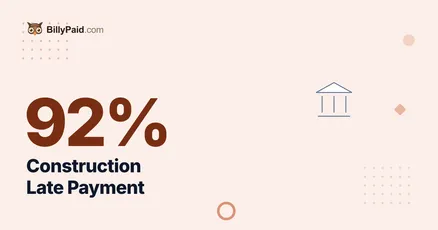
The 92% of Australian construction firms carrying at least one overdue invoice, well above the national late-payment picture of a 6.9 day average overdue window, and the industry’s 39% rate of invoices overdue by more than 30 days, is exactly the population this legislation exists for: businesses working down long subcontractor chains where a head contractor’s delay cascades to everyone below it. A deeper look at how bad that specific problem has gotten in construction specifically is available as its own report on this site. For an invoice that never reaches a dispute at all, the more direct fix is the same one that works outside construction too: a documented, professionally issued claim with a clear due date and an automated payment reminder sequence keeps more progress claims out of the adjudication queue in the first place, and gives the ones that do end up there a clean paper trail. For a contractor who has already gone the adjudication route and is still waiting on payment, small claims court becomes the next fallback once an adjudicated determination itself goes unpaid.
The Bottom Line
Every state’s Security of Payment Act runs the same basic trade: speed for finality. A payer gets 10 to 15 business days to respond to a claim, an adjudicator gets roughly another 10 business days to decide a dispute, and a business that would otherwise wait months for a court date can have an enforceable determination in about a month. The deadlines genuinely differ, 10 business days in NSW, Victoria, Tasmania and the ACT versus 15 in Queensland, Western Australia and South Australia, and Victoria’s newly capped 20 business day maximum payment term shows these rules are still actively being tightened in 2026, not settled law from decades ago. The practical takeaway for a contractor is the same regardless of state: know your jurisdiction’s exact clock before you need it, because missing a 10 or 15 business day window is what turns a disputed invoice into an automatically payable debt, or, just as easily, what turns a valid claim into one that has to start the whole process over.
Frequently Asked Questions
How many business days do I have to respond to a payment claim?
It depends on the state. New South Wales, Victoria, Tasmania (for commercial work) and the ACT give a payer 10 business days to serve a payment schedule. Queensland, Western Australia and South Australia allow 15 business days. Miss the deadline in any of these states and the full claimed amount automatically becomes a debt owed to the claimant.
What happens if I miss the payment schedule deadline?
The claimed amount becomes an enforceable debt, in full, with no right to dispute the merits of the claim later. This is the mechanism construction lawyers commonly call a smash and grab: a technical failure to respond in time, not a decision on whether the work was actually done properly, is what triggers liability for the whole claimed sum under every state Act.
How fast is adjudication compared to going to court?
An adjudicator’s determination is due within 10 business days of receiving the respondent’s adjudication response in NSW, Victoria, Queensland, South Australia, Tasmania, the ACT and the Northern Territory, and within 10 business days (extendable to a maximum of 20) in Western Australia. A construction dispute that would take months in court can reach an enforceable adjudicated decision in as little as three to four weeks.
Does every Australian state and territory have the same Security of Payment Act?
No. Six states and the ACT (NSW, Victoria, Queensland, Western Australia, South Australia, Tasmania, ACT) run a payment claim and payment schedule model, though the exact business-day deadlines differ. The Northern Territory still runs the older Construction Contracts (Security of Payments) Act 2004 model, which has no statutory payment claim or payment schedule step and instead sends unresolved disputes straight to adjudication.
Sources and References
- NSW Government, Making a payment claim under Security of Payment laws, 10 business day payment schedule deadline, reference-date claim frequency.
- NSW Government, Responding to an adjudication application, 10 business day adjudicator determination timeframe.
- Holding Redlich, Victoria’s far-reaching security of payment reforms have now commenced (2026), 15 April 2026 commencement, 20 business day maximum payment term, retrospective application.
- Adjudicate Today, Victoria, Adjudication Determination, Victorian adjudicator determination timeframe.
- Queensland Building and Construction Commission, Business days and the holiday period, Security of Payment, 15 business day payment schedule deadline, 10 business day default due date, holiday shutdown rule.
- Merlo Law, Adjudication in Queensland: A Comprehensive Guide, adjudication response and decision timeframes, 30-40 day end-to-end process, $750,000 threshold.
- Small Business Development Corporation WA, Making a claim under the Security of Payment Act, 15 business day payment schedule deadline, 20/25 business day due dates, six month claim window.
- MinterEllison, A new era for security of payment in WA, 1 August 2022 commencement, 10 business day (max 20) adjudicator determination timeframe.
- DW Fox Tucker Lawyers, Navigating the Building & Construction Industry Security of Payment Act 2009 (SA), 15 business day payment schedule deadline, adjudication process timeframes.
- Consumer, Building and Occupational Services Tasmania, Responding to a security of payment claim, 10 business day (20 residential) payment schedule deadline.
- ACT Planning, Security of payments, 10 business day payment schedule deadline, 2024 amendments.
- GoToCourt, Contractor Payment Disputes NT, Construction Contracts (Security of Payments) Act 2004 model, 28 day default payment, adjudicator appointment and determination timeframes.
- Build-it, Construction cash crunch as late payments hammer tradies, citing CreditorWatch, 92% overdue-invoice rate, 39% overdue by more than 30 days.
Note: All figures verified as of October 2026.