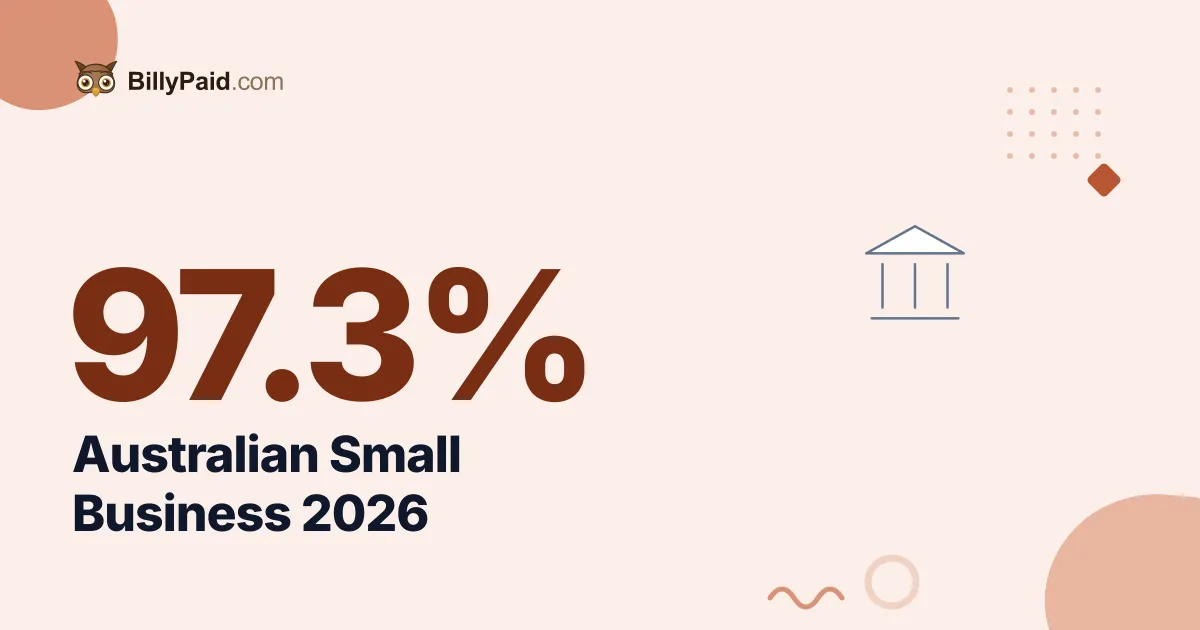
97.3% of all Australian businesses are small businesses with fewer than 20 employees, according to the Australian Bureau of Statistics and the Australian Small Business and Family Enterprise Ombudsman. As of 30 June 2026, the country had 2,814,778 actively trading businesses in total, up from 2,729,648 a year earlier. This report gathers the full 2026 picture: how many small businesses there are, where they cluster by industry, how many jobs they support, and how many actually make it past their first few years.
How many small businesses are there in Australia?
Australia counted 2,729,648 actively trading businesses as of 30 June 2025, and 2,656,469 of them, 97.3%, were small businesses with fewer than 20 employees under the Australian Bureau of Statistics’ standard definition. The freshest release since then pushes the overall business population higher still: at 30 June 2026, there were 2,814,778 actively trading businesses, of which 996,203 employed at least one person and 1,818,577 employed none at all, according to the ABS’s Counts of Australian Businesses, including Entries and Exits. Small businesses have held roughly the same 97-plus percent share across both snapshots, which is the closest thing to a constant in Australia’s business population.
Figure 1: Small businesses (fewer than 20 employees) made up 97.4% of Australia’s business population as of 30 June 2026. Source: Australian Bureau of Statistics, Counts of Australian Businesses, including Entries and Exits.
The Australian Taxation Office uses a separate, turnover-based test for its own tax concessions, an annual turnover under $10 million, rather than the ABS’s headcount test, and under that definition roughly 98% of Australian businesses qualify as small. The two definitions rarely disagree in practice: a sole trader or a five-person trade business almost always clears both bars at once. What the ATO’s test does add is a GST obligation most small businesses eventually cross: any business with GST turnover over $75,000 in a rolling 12-month period must register and start issuing GST-compliant invoices, a threshold worth knowing before assuming “small” also means “no paperwork.”
How are Australia’s small businesses split by size?
Most Australian small businesses have no staff at all. 63.6% of all Australian businesses are self-employed or non-employing operations, sole traders and single-owner entities with no one else on payroll, according to ASBFEO’s calculations from ABS Counts of Australian Businesses data for June 2025. A further 25.2% employ between one and four people, 8.5% employ five to nineteen, and the remaining roughly 2.7% are the medium and large businesses with twenty or more staff.
Figure 2: Nearly two in three Australian businesses have no employees at all. Source: ASBFEO calculations from ABS Counts of Australian Businesses, June 2025.
That skew toward zero-employee businesses matters for anything invoicing-related: a sole trader issuing their own invoices, chasing their own payments, and lodging their own Business Activity Statement is the modal Australian small business, not the exception. It is also the group most exposed to a single slow-paying client, since there is no back office to absorb the cash-flow gap while an invoice sits unpaid.
Which industries have the most Australian small businesses?
Construction is Australia’s largest industry by business count, with 462,939 firms trading as of 30 June 2025, comfortably ahead of professional, scientific and technical services at 367,085. Transport, postal and warehousing came in at 249,289 businesses and health care and social assistance at 213,177, both growing faster than the economy-wide average over the following year. Construction alone added 76,414 new businesses in the 2024-25 financial year, the highest number of new entrants of any single industry the ABS tracks.
Figure 3: Construction and professional services are Australia’s two largest industries by business count. Source: Australian Bureau of Statistics, Counts of Australian Businesses, including Entries and Exits, June 2025.
Construction’s scale also explains why it shows up so often in Australia’s late-payment data: a large population of small subcontractors, each dependent on a head contractor paying on time, is structurally more exposed to delay than an industry with fewer, larger firms. The industry mix here is the population; what happens to that population once invoices go out the door is a separate report worth reading alongside this one.
How many jobs do Australian small businesses support?
Small businesses employ more than 5 million people, 39% of Australia’s private sector workforce, according to the Australian Small Business and Family Enterprise Ombudsman’s analysis of ABS Australian Industry data for the 2023-24 financial year. That contribution is not spread evenly across the economy: small businesses account for 78% of employment in agriculture, forestry and fishing, 69% in rental, hiring and real estate services, 63% in other services such as personal care, and 62% in construction, industries where small operators are not a niche but the majority employer.
Figure 4: Small businesses employ 39% of Australia’s private sector workforce. Source: ASBFEO, Contribution to Australian Employment, based on ABS Australian Industry data, 2023-24.
Only 3% of surviving self-employed businesses actually became an employing business in 2023-24, the lowest rate on record since the ABS started tracking this transition in 2007-08. Most Australian small businesses that stay in business simply stay the same size, one or two people doing the work and doing the invoicing, rather than scaling into a business with staff.
Are more Australian businesses starting up or closing down?
More are starting than closing, and the gap widened slightly in the most recent year. Australians started 437,150 new businesses and closed 370,500 in the 2024-25 financial year, an entry rate of 16.4% against an exit rate of 13.9%. The following year kept the same shape: 460,461 entries against 375,331 exits in 2025-26, an entry rate of 16.9% and an exit rate of 13.8%, according to the ABS’s Counts of Australian Businesses release.
Figure 5: More businesses started than closed in both 2024-25 and 2025-26. Source: Australian Bureau of Statistics, Counts of Australian Businesses, including Entries and Exits.
That net positive churn is a healthier picture than a simple survival-rate figure suggests on its own, since a shrinking industry can still show a respectable survival rate for the businesses that remain, even while more businesses close than open. Australia’s 2025-26 numbers show the opposite: genuine net growth in the business population, not just survivors holding steady.
How many new Australian businesses actually survive?
Survival depends heavily on whether a business has staff. Among businesses that started in the 2021-22 financial year, 82.4% of employing businesses were still trading a year later, compared with 72.3% of non-employing businesses, a combined result close to the commonly cited “75% survive their first year” figure. By year three, the gap widens sharply: 61.0% of employing businesses from that cohort were still operating, versus just 43.3% of non-employing businesses, a 17.7 percentage point difference, according to ABS business survival data.
Figure 6: Employing businesses survive at meaningfully higher rates than non-employing businesses, both at one year and three years. Source: Australian Bureau of Statistics, Counts of Australian Businesses, including Entries and Exits, business survival data, 2021-22 entry cohort.
The pattern lines up with what Australia’s cash flow data shows separately: inadequate cash flow is the single most cited reason an Australian company enters external administration, and a sole operator with no staff and no cash buffer has less room to absorb a bad quarter than a business with the revenue base to support even one employee. Cash flow strain and business survival are two different reports on this site, but they describe the same underlying population.
Australian small business at a glance
| Measure | Figure | Source | Period |
|---|---|---|---|
| Share of all businesses that are small (fewer than 20 employees) | 97.3% | ABS / ASBFEO | June 2025 |
| Total actively trading businesses | 2,814,778 | ABS, Counts of Australian Businesses | June 2026 |
| Largest industry by business count | Construction, 462,939 businesses | ABS | June 2025 |
| Share of private sector workforce employed by small business | 39% (5M+ people) | ASBFEO, ABS Australian Industry | 2023-24 |
| Three-year survival rate, employing businesses | 61.0% | ABS business survival data | 2021-22 cohort |
Table 1: Five independently sourced measures spanning population, industry, employment, and survival for Australian small businesses.
This is a different lens than global small-business cash flow data, which focuses on US and international cash buffer days rather than Australia’s own business population, industry mix, and survival curve. Read them together for the fuller picture: this report is a census of who Australian small businesses are, while the cash-flow and late-payment reports on this site cover what happens to them once they start invoicing.
The Bottom Line
Australia’s small business sector is, in practical terms, most of the Australian economy: 97.3% of all businesses, close to 5.2 million jobs, and a business population that grew by more than 85,000 net businesses between June 2025 and June 2026. But the sector is not one uniform group. Nearly two in three of those businesses have no staff at all, survival odds differ sharply between employing and non-employing operations, and Construction alone accounts for one in six of every Australian business trading today. The practical thread running through all of it is the same one every small business eventually runs into: getting paid on time is what turns a business that survives its first year into one that survives its third. A compliant, GST-correct invoice with a payable link attached is a small piece of that puzzle, but for a sector this size, it is not a small piece for the economy overall.
Frequently Asked Questions
How many small businesses are there in Australia?
97.3% of all Australian businesses are small businesses with fewer than 20 employees, 2,656,469 out of 2,729,648 total businesses as of June 2025, according to the Australian Bureau of Statistics and the Australian Small Business and Family Enterprise Ombudsman. By June 2026, the total business count had grown to 2,814,778, with small businesses still making up roughly the same share.
Which industries have the most small businesses in Australia?
Construction, with 462,939 businesses trading as of June 2025, the largest of any industry the ABS tracks. Professional, scientific and technical services is second at 367,085 businesses, followed by transport, postal and warehousing (249,289) and health care and social assistance (213,177).
How many people do Australian small businesses employ?
More than 5 million people, or 39% of Australia’s private sector workforce, according to the Australian Small Business and Family Enterprise Ombudsman’s analysis of ABS Australian Industry data for 2023-24. Small businesses are especially dominant in agriculture (78% of employment), rental and real estate services (69%), and construction (62%).
What percentage of new Australian businesses survive?
About 75% of businesses that started in the 2021-22 financial year were still trading a year later, but survival splits sharply by type: 82.4% of employing businesses reached their first anniversary versus 72.3% of non-employing businesses, and by year three that gap widens to 61.0% versus 43.3%, according to ABS business survival data.
Sources and References
- Australian Small Business and Family Enterprise Ombudsman: Number of Small Businesses in Australia (ABS data, June 2025)
- Australian Bureau of Statistics: Counts of Australian Businesses, including Entries and Exits, July 2022 to June 2026
- Australian Bureau of Statistics: 7 Facts About Australian Businesses (2024-25)
- Australian Bureau of Statistics: Counts of Australian Businesses, including Entries and Exits, July 2021 to June 2025
- Australian Small Business and Family Enterprise Ombudsman: Contribution to Australian Employment (ABS Australian Industry data, 2023-24)
- Australian Taxation Office: Are You in Business?
- business.gov.au: Register for Goods and Services Tax (GST)
Note: All figures verified as of November 2026.