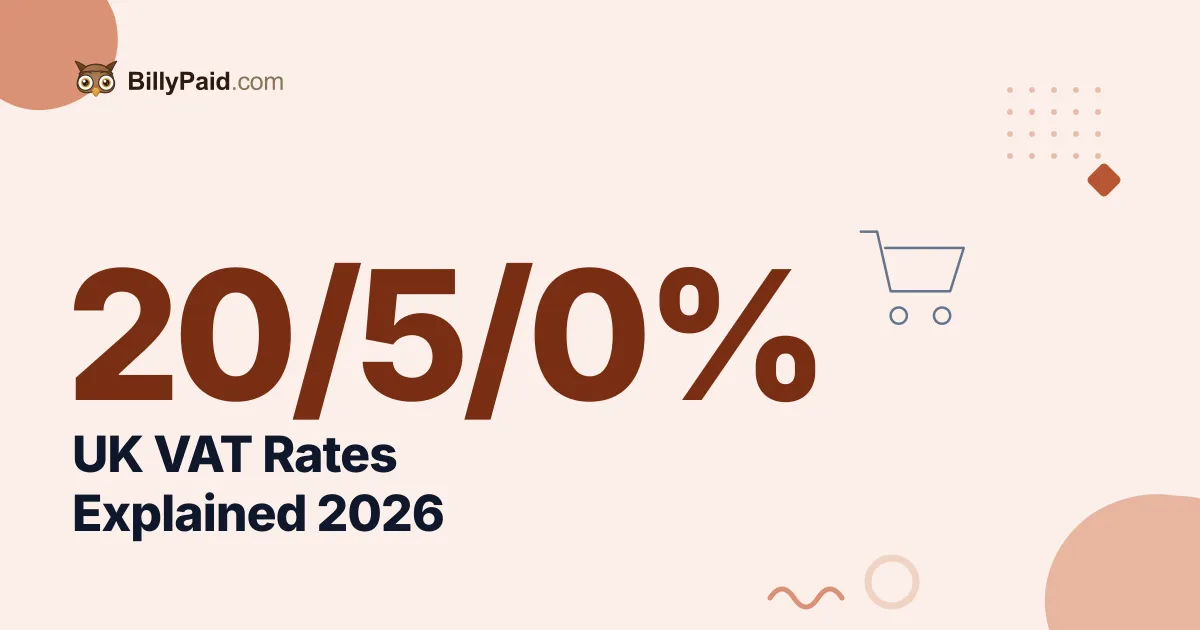
UK VAT runs on three rates, 20% standard, 5% reduced, and 0% zero, and which one applies depends on the specific goods or services supplied, not on the seller’s turnover or preference. Getting the rate wrong on an invoice is one of the most common VAT errors a UK business makes, and it is entirely avoidable once the three categories are clear.
What Is the UK’s 20% Standard Rate?
The default rate, applied to any taxable supply that does not qualify for the reduced or zero rate. Most goods and services a UK business sells fall here: professional services, most retail goods, catering, alcoholic drinks, and hot food and takeaways all carry the standard 20% rate.
Figure 1: The UK’s three VAT rates span the full range from 0% to 20%. Source: HMRC, Rates of VAT on Different Goods and Services.
Because the standard rate is the default, a business only needs to actively identify supplies that qualify for the reduced or zero rate; everything else is charged at 20% without a separate lookup being required.
What Falls Under the 5% Reduced Rate?
A specific, HMRC-defined list of categories, not a general middle tier a business can apply at its own discretion. Confirmed examples include electricity and gas for domestic and residential use, or for non-business use by a charity, mobility aids for older people, smoking cessation products such as nicotine patches and gum, and children’s car seats, booster seats, and carrycots fitted with restraint straps.
Figure 2: Which UK VAT rate applies to a supply depends on the specific category, not the seller’s judgment. Source: HMRC, Rates of VAT on Different Goods and Services.
A business cannot extend the reduced rate to an item just because it feels similar to one on the list; HMRC’s category boundaries are specific, and applying 5% to a standard-rated item is a compliance error even when the underlying product seems comparable to a genuinely reduced-rate one.
What Falls Under the 0% Zero Rate?
The widest of the three categories by number of items, though still a defined list rather than a general exemption for essentials. Confirmed examples include most food and drink for human consumption, books, magazines, and newspapers, children’s clothing and footwear, passenger transport in a vehicle, boat, or aircraft carrying 10 or more passengers, equipment for disabled people, and incontinence and sanitary protection products.
Energy-saving materials, such as insulation and certain heating equipment, currently carry a temporary zero rate for installation, due to end 31 March 2027, at which point the rate reverts unless extended. Not all food is zero-rated either: hot food, food eaten in, and categories such as confectionery, crisps, and alcoholic drinks are standard-rated regardless of the general food rule.
What Is the Difference Between Zero-Rated and Exempt?
A meaningful one for VAT recovery, even though the customer pays no VAT either way. A zero-rated supply is still legally a taxable supply, just charged at 0%, which means a business making zero-rated sales can still reclaim VAT on its own purchases. An exempt supply sits outside the VAT system entirely, and a business making only exempt supplies generally cannot reclaim input VAT at all.
Figure 3: GBP 90,000 of taxable turnover, which does not include exempt or out-of-scope income, is the line at which charging these rates becomes mandatory. Source: HMRC, Rates of VAT on Different Goods and Services; GOV.UK, Register for VAT.
Common exempt categories include financial services, insurance, and certain health and education services. Whether a business needs to charge any of these three rates at all depends on crossing the VAT registration threshold in the first place, covered in BillyPaid’s guide to who needs to register for VAT.
| Rate | Example Categories | Registration Required? |
|---|---|---|
| 20% Standard | Most goods and services, professional services, alcohol, hot food | Yes, once registered |
| 5% Reduced | Domestic energy, mobility aids, children’s car seats, smoking cessation | Yes, once registered |
| 0% Zero | Most food, books, children’s clothing, public transport, disabled equipment | Yes, once registered |
Figure 4: Every UK VAT-taxable supply falls under one of three rates, with the standard rate applying by default. Source: HMRC, Rates of VAT on Different Goods and Services.
How Does the VAT Gap Relate to These Rates?
Directly. Charging the wrong rate, or missing a zero or reduced-rate relief a business is entitled to, is one of the recurring causes HMRC’s own VAT gap analysis points to when it explains the shortfall between theoretical and actual VAT receipts. The UK VAT gap reached 6.5% of theoretical liability in 2024-25, or GBP 11.9 billion, up from 5.0% the year before.
Figure 5: The UK VAT gap has narrowed substantially since the mid-2000s, though it ticked up in the most recent year on record. Source: HMRC, VAT Gap Estimates.
That gap remains far below where it stood two decades ago, at 13.8% in 2005-06, but the recent rise is a reminder that correct rate application on every invoice line is not a minor detail; multiplied across 2.73 million VAT-registered UK businesses, small rate errors add up. The full 2026 picture on UK VAT collection is covered in BillyPaid’s UK VAT data report.
The Bottom Line
Three rates cover every UK VAT-taxable supply, and the rate a business charges is determined by what it sells, not by choice. The 20% standard rate is the default; the 5% and 0% rates apply only to specific, HMRC-defined categories, and confusing a reduced-rate item with a zero-rated one, or applying either rate to something that is actually standard-rated, is a common and avoidable source of invoicing errors.
BillyPaid’s invoice generator applies the correct UK VAT rate automatically once a business selects the right category for each line item, so getting this right does not depend on memorizing HMRC’s full category list. For the mechanics of actually adding the right amount of VAT to a price once the rate is known, see BillyPaid’s guide to adding VAT to a UK invoice.
Frequently Asked Questions
What are the UK’s VAT rates in 2026? Three: 20% standard rate for most goods and services, 5% reduced rate for specific categories such as domestic energy and mobility aids, and 0% zero rate for categories including most food, books, and children’s clothing, per HMRC guidance.
What is the difference between zero-rated and VAT-exempt? A zero-rated supply is still VAT-taxable, just at 0%, so a business making zero-rated sales can still reclaim VAT on its own purchases. An exempt supply is outside VAT entirely, and a business making only exempt supplies generally cannot reclaim input VAT.
What rate of VAT applies to food? Most food and drink for human consumption is zero-rated, but there are exceptions: hot food, food eaten in, and categories such as confectionery, crisps, and alcoholic drinks are standard-rated at 20%, per HMRC’s VAT rates guidance.
How big is the UK VAT gap in 2026? 6.5% of theoretical VAT liability for the 2024-25 tax year, or GBP 11.9 billion, according to HMRC’s second VAT gap estimate published 3 March 2026, up from 5.0% the year before.
Sources and References
- HMRC, Rates of VAT on Different Goods and Services
- HMRC, VAT Gap Estimates (second estimate, tax year 2024 to 2025, published 3 March 2026)
- GOV.UK, VAT Guide (VAT Notice 700)
- GOV.UK, Register for VAT
Note: All figures verified as of November 2026.