Australia’s slowest-paying large businesses now take 64 days to pay 95% of their small business invoices, up from 58 days the prior reporting cycle, according to the Payment Times Reporting Scheme regulator’s January 2026 update. For a small business on the other end of that invoice, waiting is not a strategy. What follows is the actual guidance, from ASBFEO, the Commonwealth’s own payment policy, and the broader 2026 reminder data, on when and how to follow up.
How long do Australian small businesses actually wait to get paid in 2026?
Longer than most owners expect, and the gap has two different faces depending on which businesses are paying. Xero Small Business Insights for the March quarter of 2026 found the typical Australian small business waits an average of 24.1 days to be paid after issuing an invoice, and settles an average of 6.9 days past the agreed due date once it does. That is the everyday reality across the small business economy.
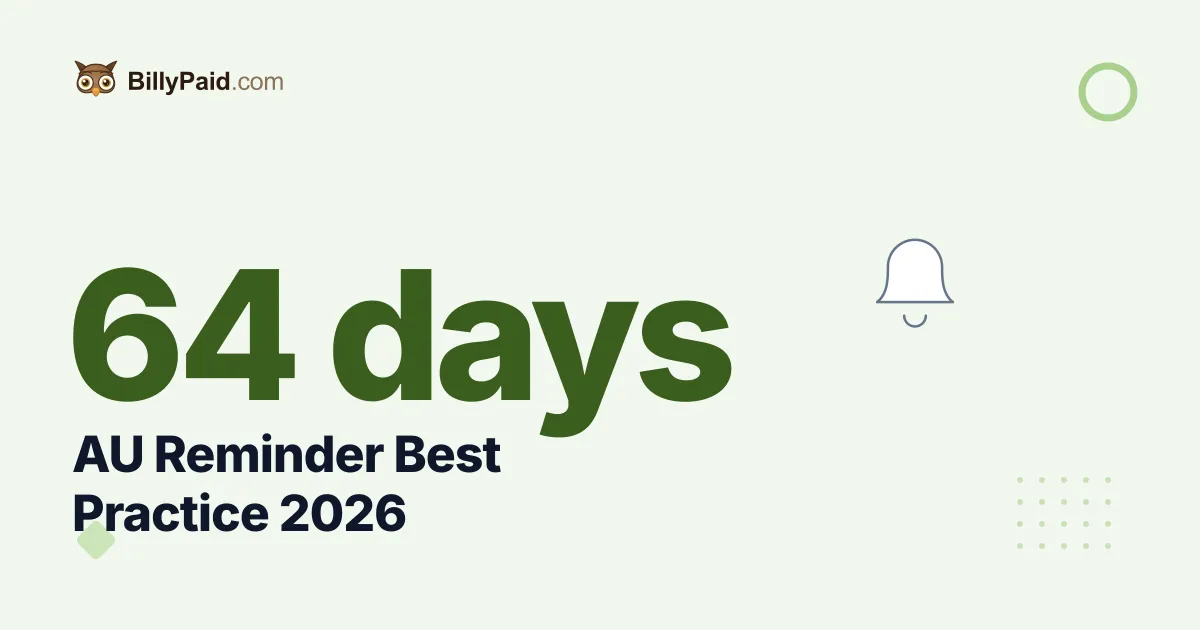
Large businesses reporting under the Payment Times Reporting Scheme (PTRS) tell a sharper story at the slow end. The scheme’s key metric, the number of days it takes a large business to pay 95% of its small business invoices, rose to 64 days in the regulator’s January 2026 update, up from 58 days the previous cycle, covering the reporting period from 1 January to 30 June 2025. The regulator’s own framing is blunt: this measure “worsened significantly” that cycle, meaning the slowest payers are stretching out further rather than catching up.
Figure 1: The number of days it takes a large business to pay 95% of its small business invoices rose from 58 to 64 in the space of one reporting cycle. Source: Payment Times Reporting Scheme regulator, January 2026 update.
Both figures point the same direction: a small business cannot assume payment lands on the due date, whether it’s dealing with a typical local client or a large reporting entity further down its own supply chain. That’s exactly the gap a reminder process is built to close, since a business that starts checking before the due date has already acted before the invoice is even overdue.
Figure 2: The typical Australian small business waits over three weeks to be paid, and payment itself lands nearly a week past the due date on average. Source: Xero Small Business Insights, March quarter 2026.
What does ASBFEO recommend for following up an overdue invoice?
Start before the invoice is even due, not after. The Australian Small Business and Family Enterprise Ombudsman’s published guidance is specific: ten days before payment is due, check that the invoice has actually been processed and is scheduled to be paid. That single step catches a meaningful share of “late” payments that are really just a processing delay nobody flagged in time.
If the due date passes anyway, ASBFEO’s next step is fast: if payment is one to two days overdue, contact the accounts area directly, ask whether a problem has prevented payment, and find out what would help resolve it. That is a noticeably tighter window than many small businesses use in practice, where a first reminder often waits a week or more past the due date out of a reluctance to seem pushy over a couple of days’ delay.
business.gov.au’s own guidance for what happens next follows a similar escalation path: a phone, email, letter, or in-person reminder first, a second reminder if the customer misses the next agreed date or doesn’t respond, then a formal letter of demand, dispute resolution or mediation (ASBFEO offers this at no cost), a debt collection agency, and legal action, including a small claims tribunal, as the last resort. None of that guidance names a recommended interval between each formal escalation step beyond the ten-day and one-to-two-day windows above, which is exactly where a business’s own reminder sequence needs to fill the gap with a consistent, repeatable cadence.
| Stage | AU government guidance | What triggers it |
|---|---|---|
| Pre-due check | 10 days before due date | ASBFEO: confirm the invoice is processed and scheduled to be paid |
| First contact | 1-2 days overdue | ASBFEO: contact accounts directly, ask what’s holding payment up |
| Second reminder | No response, or next agreed date missed | business.gov.au: repeat by phone, email, or letter |
| Letter of demand | Reminders unanswered | business.gov.au: formal written demand, own or via a legal professional |
| Dispute support | Formal demand unresolved | ASBFEO: free mediation and Dispute Support tool |
| Debt collection / legal action | Informal steps exhausted | business.gov.au: collection agency, small claims tribunal, or court |
Table 1: The Australian government’s own published escalation ladder for an overdue invoice, from ASBFEO and business.gov.au. Neither source specifies a recommended gap between the later formal steps. Sources: ASBFEO; business.gov.au.
Does consistent follow-up actually get Australian businesses paid faster?
Substantially, and the data isn’t close. Chaser’s 2026 Accounts Receivable Report, based on 163 validated responses from finance professionals across the UK, Australia, and more than 20 other countries, found that businesses which follow up on 100% of their overdue invoices get paid within a week 28% of the time, compared to just 16% for businesses that leave some invoices completely uncontacted. That’s a 76% relative improvement from consistency alone, before wording, channel, or automation choice even enter the picture.
Figure 3: Businesses that chase every overdue invoice get paid within a week nearly twice as often as those that leave some invoices uncontacted. Source: Chaser, 2026 Accounts Receivable Report.
The same effectiveness data broken down in more detail found 31% of businesses don’t follow up on every overdue invoice each month, most commonly because a smaller share, not the whole ledger, gets left uncontacted. For a small business already carrying the 24.1-day average wait Xero’s data shows above, skipping a reminder on even a handful of invoices is skipping the single lever ASBFEO’s own guidance and the broader industry data agree does the most work.
Does reminder wording change whether an Australian business gets paid?
It does, and the effect shows up even before an invoice reaches a formal collections conversation. FreshBooks’s analysis of more than 1 million small business invoices found that invoices carrying a stated late-fee or “Interest” note are ultimately paid 92.15% of the time, well above the 78.62% baseline paid rate across all invoices regardless of wording. That dataset isn’t broken out by country, so it can’t be read as an Australia-specific figure on its own, but nothing in the ASBFEO or business.gov.au guidance above suggests Australian customers respond differently to a clear, specific ask than customers anywhere else.
Figure 4: Invoices that name a consequence, a stated late fee or interest charge, are paid noticeably more often than the unwritten default. Source: FreshBooks, analysis of 1M+ invoices.
For Australian construction and trade businesses specifically, where overdue invoices are reported at a higher rate than the small business economy overall, reminder data for AU tradies covers the industry-specific numbers this general dataset can’t.
What payment benchmark does the Australian government set for its own suppliers?
A tighter one than most small businesses set for their own customers. Under the Commonwealth’s Supplier Pay On-Time or Pay Interest Policy (Resource Management Guide 417), a non-corporate Commonwealth entity paying a supplier through a PEPPOL e-invoice must pay within 5 days, or owe interest if that interest reaches $100 or more. Outside that e-invoicing pathway, the standard payment term is 20 days, or a shorter period if one was agreed.
Figure 5: The Commonwealth pays its own e-invoiced suppliers in a fraction of the 20-day standard term it otherwise allows. Source: Department of Finance, Resource Management Guide No. 417.
The interest itself is calculated using the ATO’s general interest charge rate, the same published quarterly rate that applies to overdue tax debts, applied from the day payment was due. It’s a useful reference point for any small business setting its own terms: the government that writes the rules for late payment interest applies a materially shorter benchmark to itself when the invoice arrives electronically than it expects most of its own suppliers to tolerate.
Can an Australian business legally charge interest or a late fee to get paid faster?
Generally yes, with one condition that catches businesses out: the customer needs to have agreed to it in a contract or trading terms before the work was supplied. A business usually can’t add an interest clause unilaterally after issuing an invoice that had no such term written into it from the start, and where a customer is a consumer rather than a business, the clause also needs to comply with Australian Consumer Law’s unfair contract terms regime.
In practice, many Australian small businesses that do include an interest clause set it in the single or low double digits annually, and the New South Wales government publishes a free online calculator specifically to work out the amount owed on an unpaid invoice once that rate is agreed. Setting the clause up front costs nothing and, per the FreshBooks wording data above, correlates with a materially higher chance of actually being paid, well before the question of legally enforcing it ever comes up.
The Bottom Line
Every piece of Australian government guidance on this points the same direction: check in before an invoice is overdue, act within a day or two once it is, and don’t rely on memory to make either happen consistently. ASBFEO’s own timeline, a check at 10 days before the due date and contact within 1-2 days after, is tighter than what most small businesses actually run, and the 2026 data backs the discipline: consistent follow-up nearly doubles the odds of getting paid within a week, and naming a consequence in the reminder itself lifts the ultimate paid rate further still. None of that requires a bigger team, just a process that fires on every invoice by default. A BillyPaid payment reminder runs that exact cadence automatically, so ASBFEO’s 10-day and 1-2-day windows don’t depend on someone remembering to check.
Frequently Asked Questions
How long do Australian small businesses actually wait to get paid in 2026? 24.1 days on average after issuing an invoice, and invoices settle an average of 6.9 days past their due date, according to Xero Small Business Insights for the March quarter of 2026. Among large businesses reporting under the Payment Times Reporting Scheme, the slowest payers now take 64 days to pay 95% of their small business invoices, up from 58 days the prior cycle, per the regulator’s January 2026 update covering 1 January to 30 June 2025.
What does ASBFEO recommend for following up an overdue invoice? The Australian Small Business and Family Enterprise Ombudsman recommends checking in before an invoice is even overdue: ten days before payment is due, confirm the invoice has been processed and is scheduled to be paid. If payment is one to two days overdue, contact the accounts area directly to ask what’s holding it up. If that doesn’t resolve it, ASBFEO’s free Dispute Support tool helps map out next steps, including formal mediation.
Does following up on every overdue invoice actually get Australian businesses paid faster? Yes. Businesses that follow up on 100% of their overdue invoices get paid within a week 28% of the time, versus just 16% for businesses that leave some invoices uncontacted, a 76% relative improvement from consistency alone, according to Chaser’s 2026 Accounts Receivable Report (163 finance professionals, UK and Australia-led). Wording matters too: FreshBooks’s analysis of more than 1 million invoices found that invoices carrying a stated late-fee or Interest note are ultimately paid 92.15% of the time, versus a 78.62% baseline.
Can Australian businesses legally charge interest on an overdue invoice? Generally yes, but only if the customer agreed to it in a contract or trading terms before the work was supplied; a business usually cannot add interest unilaterally after the fact. Many small businesses set a rate in the single or low double digits per annum, and the New South Wales government publishes a free online late-payment interest calculator. The Commonwealth’s own Supplier Pay On-Time or Pay Interest Policy uses the same mechanism at the top level: an agency that misses its payment window owes interest calculated at the ATO’s general interest charge rate, once that interest reaches $100 or more.
Sources and References
- Payment Times Reporting Scheme: Media release, Regulator’s update, January 2026 (reporting period 1 January to 30 June 2025), the 95th-percentile payment time rising from 58 to 64 days.
- Xero: Australian Small Business Insights, March quarter 2026 media release, average days to be paid and average days paid late.
- Australian Small Business and Family Enterprise Ombudsman: Payment Times, the 10-days-before and 1-2-days-overdue follow-up guidance, and the Dispute Support escalation pathway.
- business.gov.au: What to do when you haven’t been paid, the reminder-to-legal-action escalation sequence.
- Department of Finance: Supplier Pay On-Time or Pay Interest Policy, Resource Management Guide No. 417, the 5-day PEPPOL e-invoice benchmark, the 20-day standard term, and the $100 interest threshold.
- Chaser: The 2026 Accounts Receivable Report (163 validated responses, UK/Australia-led, fielded late 2025-early 2026), paid-within-a-week rate by follow-up consistency.
- FreshBooks: Use Your Invoice Payment Terms to Get Paid Faster (analysis of 1M+ small business invoices over a 1-year period), ultimate paid rate by invoice wording.
- Sprintlaw: Late Payment Interest in Australia: How to Charge It Legally, the requirement for a pre-agreed contract term and typical small business interest rate ranges.
Note: All figures verified as of October 2026.