The federal test for who counts as an independent contractor took another step this week, and the headline can mislead. The rule has cleared White House review. It has not been published as a final rule, and as of October 31, 2026 it is not in force.
What happened this week
According to Bloomberg Law’s October 30 report, the White House’s Office of Information and Regulatory Affairs finished its review of the Labor Department’s independent-contractor rule, “setting up the department to finalize the rule.” Bloomberg says the department sent the final rule to that office late in September. Law firm Ogletree’s October 9 Beltway Buzz had already noted the submission and said the department would publish the final rule once the review ends.
Cleared for review is not the same as final
Clearing review means the White House has finished looking at the draft. The rule only takes effect after the Labor Department publishes it in the Federal Register and the effective date passes. We checked the Federal Register’s public listing on October 31 and found no final rule for this topic, only the February proposal. The Labor Department’s rule listing on reginfo.gov shows a target of October 2026 for the final rule, but a target is not a publication, and we could not confirm an effective date.
We also could not confirm the exact day the review ended. Bloomberg says only that it finished “recently.”
The text can still differ from the proposal
Everything about the content comes from the February proposal. Ogletree’s wording is careful on this point: if the rule is finalized as proposed, it would use an economic realities test built around two core factors. A final text can change from the draft, so treat the proposal as a guide, not a guarantee.
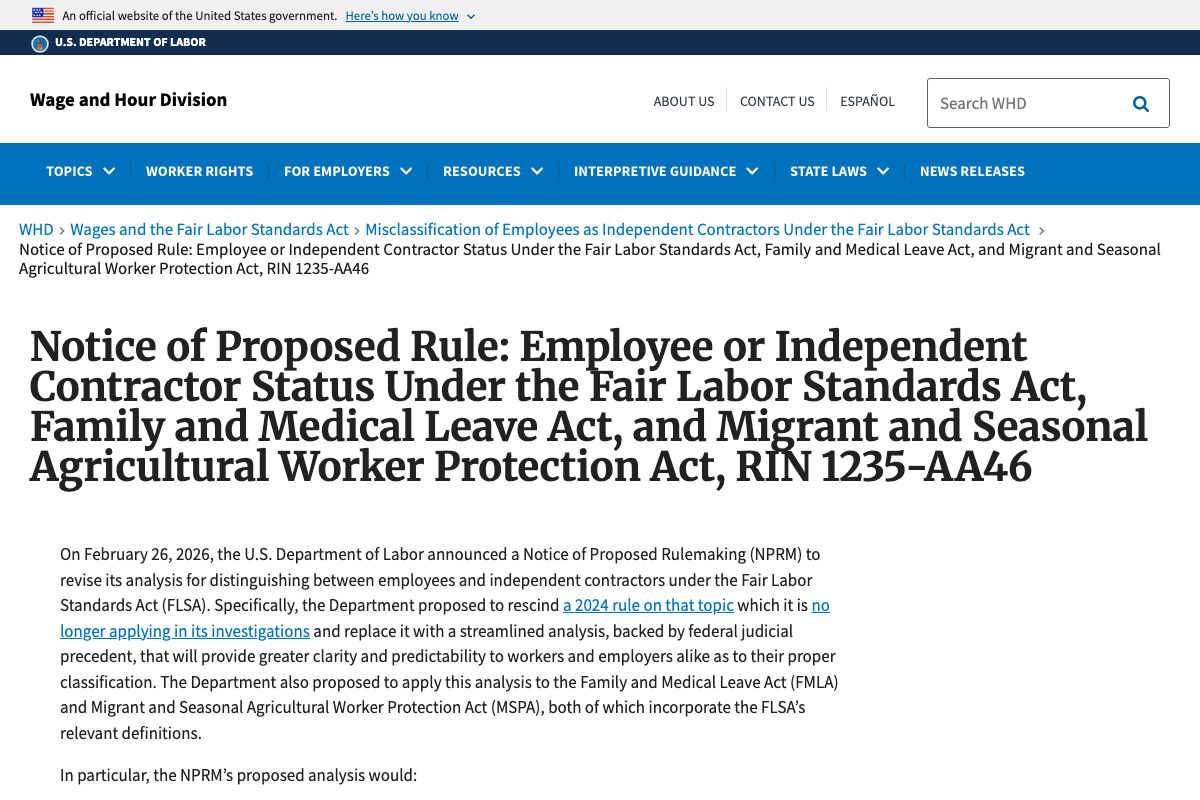
The Labor Department announced the proposal on February 26, 2026. It would rescind the 2024 rule and replace it with a streamlined analysis, and it would apply the same analysis under the Family and Medical Leave Act and the Migrant and Seasonal Agricultural Worker Protection Act. The 60-day comment period closed on April 28, 2026. Our earlier post on what the proposal would change covers the comparison in more depth.
Two factors would count for more than the other three
The Labor Department’s proposal lists five factors: control over the work, opportunity for profit or loss, the skill required, how permanent the relationship is, and whether the work is part of an integrated unit of production. It names the first two as “core” factors with greater weight. Its Q&A page says that when both core factors point to the same answer, there is a substantial likelihood that answer is the worker’s accurate classification.
| 2024 rule | 2026 proposal | |
|---|---|---|
| Number of factors | Six | Five |
| Factors named as “core” | None | Control, and opportunity for profit or loss |
| Laws covered | Fair Labor Standards Act | Fair Labor Standards Act, FMLA, and MSPA |
The proposal also says the parties’ actual practices matter more than what a contract allows on paper. Those practices are the part you control, which is why the paperwork habits below matter.
What this changes for you today
Nothing, yet. The Labor Department’s own page says it is no longer applying the 2024 rule in its investigations, but the proposal itself would not decide how a state, the IRS, or a court classifies you. State tests such as California’s ABC test run on their own terms.
What you can do now is leave a record that shows you run a business: your own rates, your own methods, your own clients, and an invoice for every engagement. That is the evidence both core factors would look for if the final rule matches the proposal. A BillyPaid invoice for each job keeps that record dated and in your name.