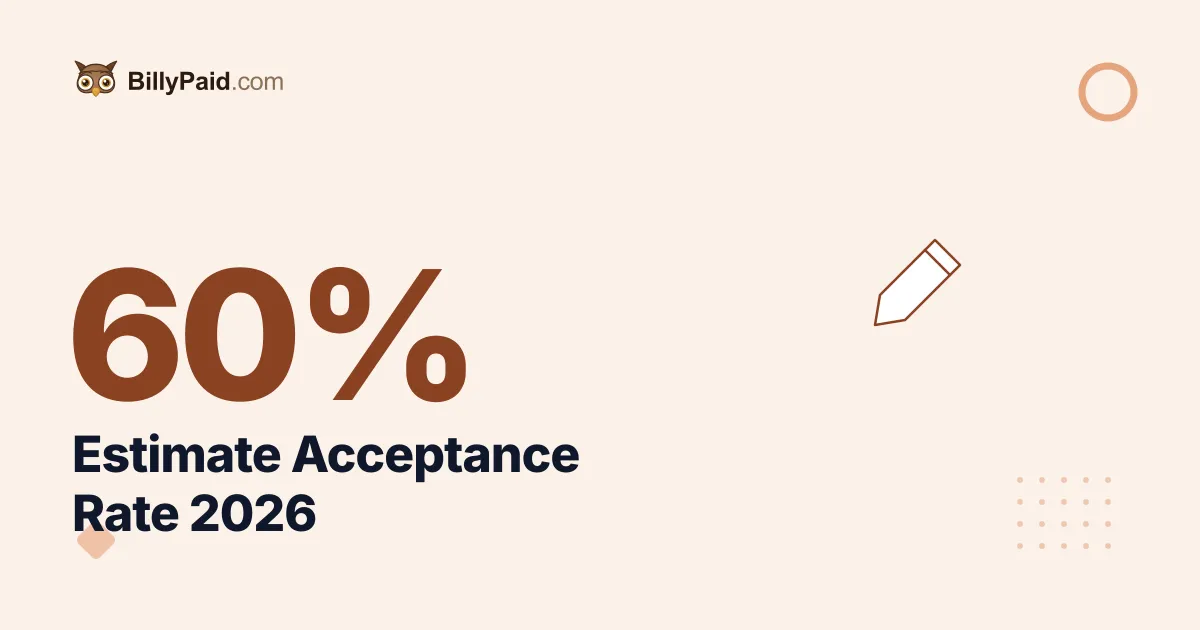
Requesting an e-signature on a quote or estimate lifts the close rate by 15% and closes the deal 60% faster than one sent without a signature request, according to Proposify’s State of Proposals 2026 report. That is one of the largest single, low-effort levers in the entire 2026 data set, and it costs nothing to add. This report focuses specifically on what moves an estimate from sent to accepted, both in general B2B data and in trade-specific benchmarks for contractors, where a slow-to-sign estimate has a direct cost in lost jobs.
Does requesting an e-signature on an estimate actually speed up acceptance?
Clearly, and by a wide margin. Proposify’s State of Proposals 2026 report, based on 742,137 proposals sent through the platform in 2025, found that requesting an e-signature lifts a proposal’s close rate by 15% and closes the deal 60% faster than a proposal without one. Having the seller sign the document first, before it ever reaches the client, pushes both numbers further: a 65% increase in close rate and a 25% faster close on top of that.
Figure 1: Close-rate index vs a no-feature baseline of 100. Source: Proposify, State of Proposals 2026.
A BillyPaid estimate sends with the signature request already built into the same link the client opens, rather than as a separate step added after the fact, which is the mechanism behind both lifts rather than a bolt-on feature layered on top of an existing workflow. Once a client signs, one click turns that accepted estimate straight into an invoice, closing the gap between acceptance and getting paid that the 60% and 25% speed figures above are actually measuring.
Figure 2: Estimate sent, e-signature requested, 60% faster close. Source: Proposify, State of Proposals 2026.
What is a typical estimate acceptance rate for a contractor or tradesperson?
Lower than the general B2B figures above, and far more dependent on speed and follow-up. ServiceTitan’s 2024 Pulse Report, an annual benchmark of field-service contractor performance, puts average HVAC lead-to-job conversion in the 30% to 40% range, with top-quartile operators, the contractors with the most disciplined follow-up process, converting 50% or more of the leads they receive. Separately, Service Roundtable and Nexstar Network data place residential HVAC replacement close rates on in-home estimates at 30% to 50%, with top performers converting above 60%.
Figure 3: HVAC contractor lead-to-job conversion, average vs top quartile. Source: ServiceTitan, 2024 Pulse Report.
Those ranges sit meaningfully below Proposify’s 34% general-proposal close rate at the low end and meaningfully above it at the top end, which points to a wider spread in trade-specific estimate acceptance than in general B2B proposals. A contractor converting at the bottom of the 30% to 40% band is not unusual; a contractor converting above 50% is doing something specific and repeatable that the report attributes to process rather than luck.
What actually separates a top-performing contractor’s close rate from average?
Follow-up discipline, not price or brand. ServiceTitan’s 2024 Pulse Report found that HVAC contractors in the top quartile for follow-up consistency convert 50% or more of the estimates they deliver, a gap over the 30% to 40% industry average the report attributes almost entirely to how systematically a contractor follows up on a sent estimate, rather than to any pricing advantage or brand reputation.
Figure 4: Close-rate and speed lift from signature mechanics. Source: Proposify, State of Proposals 2026.
That finding lines up directly with the general B2B data above: an e-signature request and a seller-signs-first workflow are both, at their core, a form of built-in follow-up, removing the manual step of a contractor having to call or text a client to ask whether they have decided. A contractor relying on a phone call to close the loop is competing against a system that already closes 60% faster on its own.
Does having multiple people at the client’s business look at the estimate help?
Yes, measurably. Proposify’s State of Proposals 2026 report found that when more than one stakeholder at the client’s company views a proposal before deciding, the close rate jumps 20% compared to a proposal only one person ever opens. For a contractor bidding a job where both a property manager and an owner need to sign off, or a B2B buyer where a finance contact reviews alongside the requester, that 20% lift is a reason to make an estimate easy to forward rather than assuming only the original recipient will ever see it.
Figure 5: Top-performing contractor estimate close rate. Source: Service Roundtable and Nexstar Network data.
The Bottom Line
The single clearest lever in this data is the one that costs nothing to add: requesting a signature, and having the seller sign first when possible. That single change accounts for the largest close-rate lift in Proposify’s entire 2026 data set, and it maps directly onto the follow-up discipline that ServiceTitan’s 2024 Pulse Report identifies as the real difference between an average and a top-quartile contractor. A BillyPaid estimate builds that signature request into the send itself, and turns an accepted estimate into an invoice with one click, closing the loop the data above shows moves the fastest.
Frequently Asked Questions
Does requesting an e-signature on an estimate actually speed up acceptance? Yes. Proposify’s State of Proposals 2026 report found that requesting an e-signature lifts a proposal’s close rate by 15% and closes the deal 60% faster than a proposal sent without one. Having the seller sign the document first, before it goes to the client, pushes that further, lifting the close rate by 65% and speeding the process up by 25%.
What is a typical estimate acceptance rate for a contractor or tradesperson? ServiceTitan’s 2024 Pulse Report puts average HVAC contractor lead-to-job conversion in the 30% to 40% range, with top-quartile operators, those with the most disciplined follow-up, hitting 50% or higher. Separately, Service Roundtable and Nexstar Network data place residential HVAC replacement close rates on in-home estimates at 30% to 50%, with top performers converting above 60%.
What actually separates a top-performing contractor’s close rate from average? Follow-up discipline, according to ServiceTitan’s 2024 Pulse Report, which found that HVAC contractors in the top quartile for follow-up consistency convert 50% or more of the estimates they deliver, a gap versus the 30% to 40% industry average that the report attributes almost entirely to how systematically a contractor follows up rather than to price, brand, or any other single factor.
Does having multiple people at the client’s business look at the estimate help? Yes. Proposify’s State of Proposals 2026 report found that when more than one stakeholder at the client’s company views a proposal before deciding, the close rate jumps 20% compared to a proposal only one person ever opens.
Sources and References
- Proposify: State of Proposals 2026, e-signature and seller-signs-first close-rate and speed effects, and multiple-stakeholder viewing effect, based on 742,137 proposals analyzed across 30 industries in 2025.
- ServiceTitan: 2024 Pulse Report, HVAC contractor lead-to-job conversion range and top-quartile follow-up performance, referenced via industry benchmark coverage of the report’s field-service findings.
- Service Roundtable and Nexstar Network, residential HVAC replacement close rate on in-home estimates, average and top-performer ranges, referenced via industry benchmark coverage of the associations’ member data.
Note: All figures verified as of August 2026.