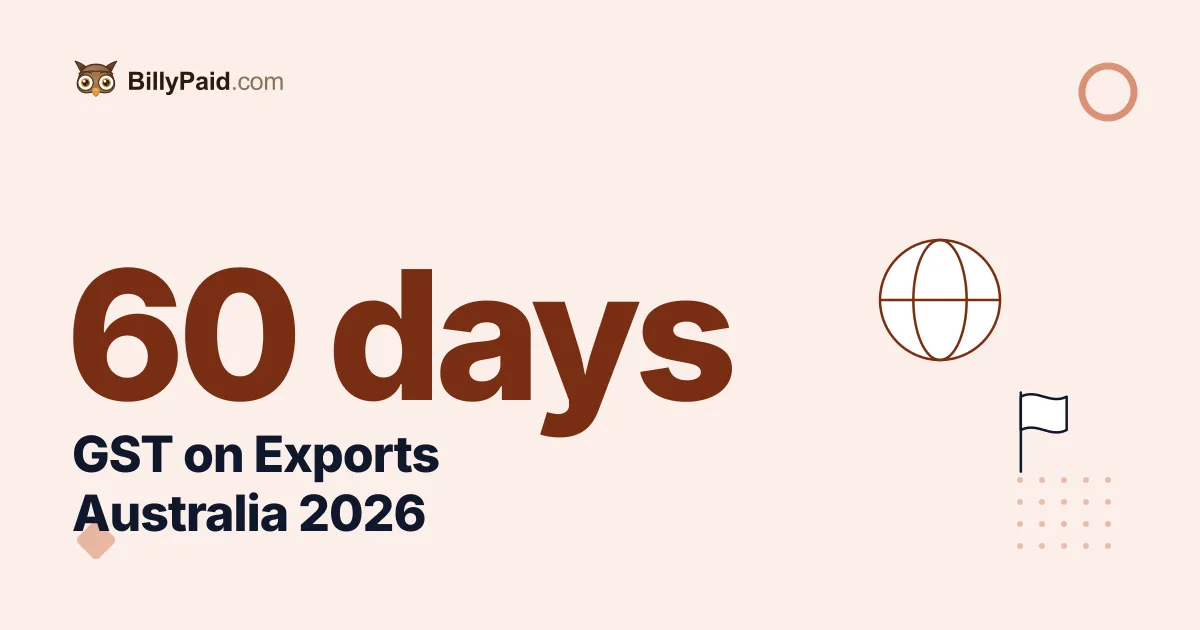
Exports of goods and services from Australia are generally GST-free, but “generally” is doing real work in that sentence. Exported goods only keep that GST-free status if they actually leave the country within 60 days of the supplier receiving payment or issuing an invoice, whichever happens first, according to the Australian Taxation Office. Miss that window without a documented extension, and a sale nobody charged GST on can turn into a taxable supply after the fact. This guide covers the specific rules and time limits for GST-free exports, the invoice documentation that substantiates the claim, and the mistakes that trip exporters up on both goods and services.
Are exports from Australia GST-free by default?
Not automatically, and not unconditionally. Exports of goods, services, and other things are GST-free under Subdivision 38-E of the GST Act, but each category has its own conditions attached, and none of them are satisfied just because the customer happens to be overseas.
Figure 1: The 60-day window a supplier has to export goods and keep the sale GST-free. Source: Australian Taxation Office, Exports and GST.
For goods, the condition is a fixed time limit measured from a payment or invoicing event. For services and other things, the condition is about where the recipient is and where the service is actually used, not simply where the invoice gets sent. A GST-registered exporter still needs to charge GST on a sale that fails its category’s conditions, exactly as if the customer were in Australia, and can still claim GST credits on the inputs used to make a genuinely GST-free export, since GST-free sales are not the same as input-taxed sales for credit purposes.
None of this changes anything about invoicing mechanics beyond the GST line itself. An export invoice still needs the same buyer and seller details, itemized pricing, and ABN that any other Australian tax invoice needs; the only difference is a $0 GST amount and, ideally, a note that the sale is GST-free under the export rules, so a bookkeeper reconciling the BAS later does not have to guess why no GST appears on an otherwise ordinary-looking invoice.
The stakes of getting that distinction right are not small. The ATO collected $90.2 billion in net GST cash in the 2024-25 financial year, according to its GST Administration Annual Performance Report, up from $60.2 billion five years earlier. Every one of those dollars depends on invoices that correctly flag which sales carried GST and which were legitimately GST-free, export sales included.
Figure 2: Net GST cash collections have grown every year on record, all of it resting on invoices that correctly sort taxable sales from GST-free exports. Source: Australian Taxation Office, GST Administration Annual Performance Report, 2023-24 and 2024-25.
A misclassified export invoice is not a rounding error against that backdrop, it is either GST the ATO never collects or GST a customer never should have been charged, and the rules below exist to keep that line clean on both goods and services.
How does the 60-day rule work for exported goods?
Exported goods are GST-free if they are exported from Australia within 60 days of one of two trigger events, whichever occurs first: the supplier receiving any payment for the goods, or the supplier issuing an invoice for the goods, according to the ATO. If the goods are paid for in installments, the relevant payment or invoice is the final installment, not the first one, so a deposit taken months before shipment does not start the clock early.
Suppliers who cannot meet the 60-day deadline are not automatically out of luck. They can apply to the ATO, through Online services for business, to request an extension of the 60-day period, and the Commissioner automatically grants an extension where a ship or aircraft departs its final Australian port after the 60-day period has already ended, for the additional time actually required. One category gets a longer window built in from the start: new boats sold for private recreational use do not have to meet the 60-day test at all, provided the boat is exported from Australia within 12 months.
Figure 3: The standard export time limit for goods, compared with the extended window for new recreational boats. Source: Australian Taxation Office, Exports and GST.
That gap matters for anyone selling into a niche the standard rule was not built for. A business exporting industrial equipment on 60-day supplier terms has a genuinely tight window once an invoice goes out; a boat dealer selling to an overseas buyer who wants to sail the vessel around Australia first has months of legitimate breathing room the goods rule would not otherwise allow.
Are exported services and other supplies GST-free too?
Usually, but the test is stricter than “the customer is overseas.” A supply of a service is GST-free only if the recipient of the service is outside Australia and the service is actually used outside Australia, according to the ATO. A service performed in Australia does not become GST-free just because the invoice goes to an address overseas.
The ATO’s own example makes the distinction concrete: a GST-registered Australian school provides tuition to overseas students who are physically studying in Australia, then bills the students’ overseas parents directly. Even though the recipient, the parent paying the invoice, is outside Australia, the supply is not GST-free, because the tuition itself is provided to students who are in Australia. The same logic applies to consulting delivered on-site in Australia to an overseas-headquartered client, or repair work performed on equipment that never leaves the country. “Other exports,” a broader category covering rights, financial supplies, and other professional services sold for consumption outside Australia, follow their own specific rules under the same subdivision, so a supplier dealing in anything other than straightforward goods or on-site services should not assume the general recipient test settles the question on its own.
Figure 4: The GST component a domestic taxable sale carries, whether of goods or services, versus the 0% that applies once a sale genuinely meets the export GST-free conditions. Source: Australian Taxation Office, How GST works.
What invoice documentation proves a GST-free export claim?
Sufficient documentary evidence that a person independent of the transaction could reasonably conclude the goods were exported, according to Goods and Services Tax Ruling GSTR 2002/6. That standard has three parts: evidence there was a supply of goods, evidence the supplier was the entity that exported them, and evidence the export happened within the specified time limits.
The invoice itself is only ever the starting point for that evidence, not the end of it. An ATO-compliant tax invoice, the kind BillyPaid’s Australian tax invoice requirements guide covers field by field, establishes what was sold, to whom, and for how much. It says nothing on its own about whether the goods actually crossed the border, which is exactly the gap the documentary evidence rule exists to close, and exactly why an exporter who only ever files invoices, with no shipping paperwork attached, is the one most likely to fail this test if the ATO ever asks to see the evidence.
Figure 5: What counts as sufficient evidence of an export, and what does not, under GSTR 2002/6. Source: Australian Taxation Office, GSTR 2002/6.
In practice, that means two categories of paperwork working together, not one document standing alone. Commercial documents, purchase orders, invoices, receipts, and banking records identify the supplier, the recipient, the goods, and the payment arrangements, but the ATO expects these to clearly link to transport documents that show the goods were actually received by a carrier and consigned to a foreign destination. Depending on how the goods physically leave, that transport evidence might be a bill of lading, sea waybill, or air waybill where the recipient engages a shipping line or airline directly; a house bill, consignment note, or certificate of shipment where a freight forwarder or courier is involved; a postal certificate for goods posted overseas; or a customs-stamped export entry for goods carried out as accompanied baggage. An invoice by itself, however detailed, does not satisfy this standard, because it says nothing about whether the goods actually left the country.
| Trigger event | Time limit | Applies to |
|---|---|---|
| Payment received or invoice issued (single payment) | 60 days | Standard goods exports |
| Final installment paid or invoiced | 60 days from final installment | Goods paid in installments |
| Sale of the boat | 12 months | New recreational boats, private use |
Table 1: The GST-free export time limits by trigger event. Source: Australian Taxation Office, Exports and GST.
There is also a practical safe harbor built into the timing rule. If a supplier obtains sufficient documentary evidence within the 60-day export period, or after that period but before the due date for lodging the next business activity statement, the documentary evidence requirement is treated as met, according to GSTR 2002/6. BillyPaid’s BAS lodgment guide covers exactly how tight or generous that BAS due-date window is depending on a business’s reporting cadence. Miss even that extended deadline without obtaining the evidence, though, and the supply reverts to being a taxable one on the BAS.
What happens if goods are not exported within the time limit?
The sale stops being GST-free and becomes a taxable supply, and the ATO treats a supplier’s discovery of that fact as an adjustment event. If a supplier who supplied goods GST-free later becomes aware the goods were not exported, or were not exported within the specified time limit, that adjustment has to be reflected on a BAS, which in practice usually means GST becomes payable on a sale the customer was never billed for it on.
Because that risk sits with the supplier, some export contracts build in a safeguard from the start. GSTR 2002/6 describes agreements where the parties price a sale GST-free on the understanding that if the buyer fails to export the goods and provide documentary evidence within 60 days, the supplier is entitled to increase the price by the GST amount, effectively recovering it from the buyer after the fact. That kind of clause matters most when the supplier hands over control of the goods before export, an ex-works sale to a foreign buyer taking delivery domestically, for instance, and has no way of confirming independently that the goods actually left the country.
What are the most common GST export mistakes exporters make?
Two mistakes account for most of the trouble, and both come from treating “the customer is overseas” as the whole rule rather than the starting point. The first is missing the 60-day trigger event, most often by counting from the shipment date rather than the date payment was received or the invoice was issued, which can leave a business believing it still has weeks of runway when the clock has already been running. The second is assuming exports do not count toward the $75,000 GST turnover registration threshold, since no GST was ever charged on them; in fact GST-free sales are included in GST turnover, and only input-taxed sales such as financial supplies and residential rent are excluded, according to the ATO. An exporter selling $40,000 domestically and $40,000 overseas GST-free already has $80,000 of GST turnover, past the threshold, purely from adding two GST-free-looking numbers together.
A handful of smaller mistakes show up regularly too. Exporters sometimes confuse the business export rules covered here with the Tourist Refund Scheme, a separate GST-free arrangement for travelers carrying goods out as accompanied luggage with its own $900 declaration threshold, when the two schemes have nothing to do with each other. Others treat an export as automatically GST-free the moment an invoice is raised, without keeping the transport documentation that actually proves the goods left the country, which is the single most common reason a GST-free export claim fails an ATO review. And services suppliers frequently apply the goods test’s simple “overseas customer” logic to a service, missing the requirement that the service also be used outside Australia, the exact gap in the ATO’s own overseas-student tuition example. A GST classification error on an export invoice is also just one more reason a payable invoice bounces back for correction, adding directly onto an already slow-paying market; BillyPaid’s Australian late payment data covers how much that delay already costs on its own.
The Bottom Line
GST-free treatment on an Australian export invoice is conditional, not automatic, and the conditions differ by what is being exported. Goods need to physically leave the country within 60 days of payment or invoice, with a 12-month exception for recreational boats and an extension process for genuine delays. Services need both an overseas recipient and overseas use, not just an overseas billing address. And every GST-free export claim needs documentary evidence, transport documents linked to the commercial paperwork, not an invoice standing alone, obtained within the 60-day window or before the next BAS is due at the latest. The distinction that catches exporters most often is not any of these, though: GST-free export sales still count toward the $75,000 GST turnover threshold, the same way a taxable domestic sale would.
BillyPaid’s invoice generator tracks GST status per line item so an export invoice can be marked GST-free without losing the audit trail back to the underlying sale, and keeps every invoice formatted to the ATO’s tax invoice content rules whether the sale carries GST or not. Exporters invoicing overseas customers in a foreign currency have their own cross-border mechanics to think about too, covered in BillyPaid’s invoice currency data. The broader question of which supplies qualify as GST-free versus taxable in the first place, beyond exports specifically, is worth its own closer look before the next BAS is due.
Frequently Asked Questions
Are exports of goods from Australia GST-free?
Generally yes, but only if the goods are exported within 60 days of whichever happens first, the supplier receiving payment or the supplier issuing an invoice, according to the Australian Taxation Office. For goods paid for in installments, that 60-day clock runs from the final installment, not the first one, and suppliers can apply to the ATO for an extension of the 60-day period.
What happens if the goods are not exported within 60 days?
The sale stops qualifying as a GST-free export and becomes a taxable supply, which the ATO treats as an adjustment event once the supplier becomes aware the goods were not exported, or not exported in time. That can mean GST becomes payable retroactively on a sale the customer was never charged GST on, which is why some export contracts include a clause letting the supplier recover the GST from the buyer if the goods are not exported in time.
What documents prove a GST-free export claim?
The ATO requires sufficient documentary evidence for an independent party to reasonably conclude the goods were supplied, exported by the supplier, and exported within the time limit, per GSTR 2002/6. That is usually a combination of commercial documents, purchase orders, invoices, banking records, and transport documents such as a bill of lading, air waybill, or customs-stamped export declaration. An invoice or purchase order on its own, without a matching transport document, is not enough.
Do GST-free export sales count toward the $75,000 GST registration threshold?
Yes. GST turnover includes GST-free sales, exports among them, and only excludes input-taxed sales such as financial supplies and residential rent, according to the ATO. A business that exports $40,000 of GST-free goods and sells $40,000 domestically has $80,000 of GST turnover, already past the $75,000 threshold, even though none of the export revenue ever carried GST.
Sources and References
- Australian Taxation Office: Exports and GST, the 60-day export time limit, trigger events, the recreational boat exception, and the recipient-and-use test for exported services, last updated 28 July 2023.
- Australian Taxation Office: GST-free sales, exports of goods and other exports overview.
- Australian Taxation Office: GSTR 2002/6, Goods and Services Tax Ruling on exports of goods, the documentary evidence standard, the BAS due-date safe harbor, and adjustment events for goods not exported in time.
- Australian Taxation Office: GST definitions, confirming GST-free sales are included in GST turnover while input-taxed sales are excluded.
- Australian Taxation Office: Registering for GST, the $75,000 GST turnover registration threshold.
- Australian Taxation Office: GST Administration Annual Performance Report 2023-24, GST revenue performance, net GST cash collections by financial year, 2019-20 through 2023-24.
- Australian Taxation Office: GST Administration Annual Performance Report 2024-25, net GST cash collections of $90.2 billion.
Note: All figures verified as of November 2026.