Australia’s services exports rose 7.9% to a record $134.3 billion in the 2024-25 financial year, according to the Australian Bureau of Statistics, and a large share of that trade runs through small businesses invoicing a single overseas client rather than shipping a container. Billing someone outside Australia works differently to billing a domestic client on three fronts: GST treatment, currency, and what the client actually needs from the document for their own tax purposes. Here’s how each piece works in practice.
Figure 1: Australia’s services exports hit a record $134.3 billion in the 2024-25 financial year, up 7.9% on the year before. Source: Australian Bureau of Statistics, International Trade: Supplementary Information, Financial Year, 2024-25.
Do you have to charge GST when invoicing an overseas client?
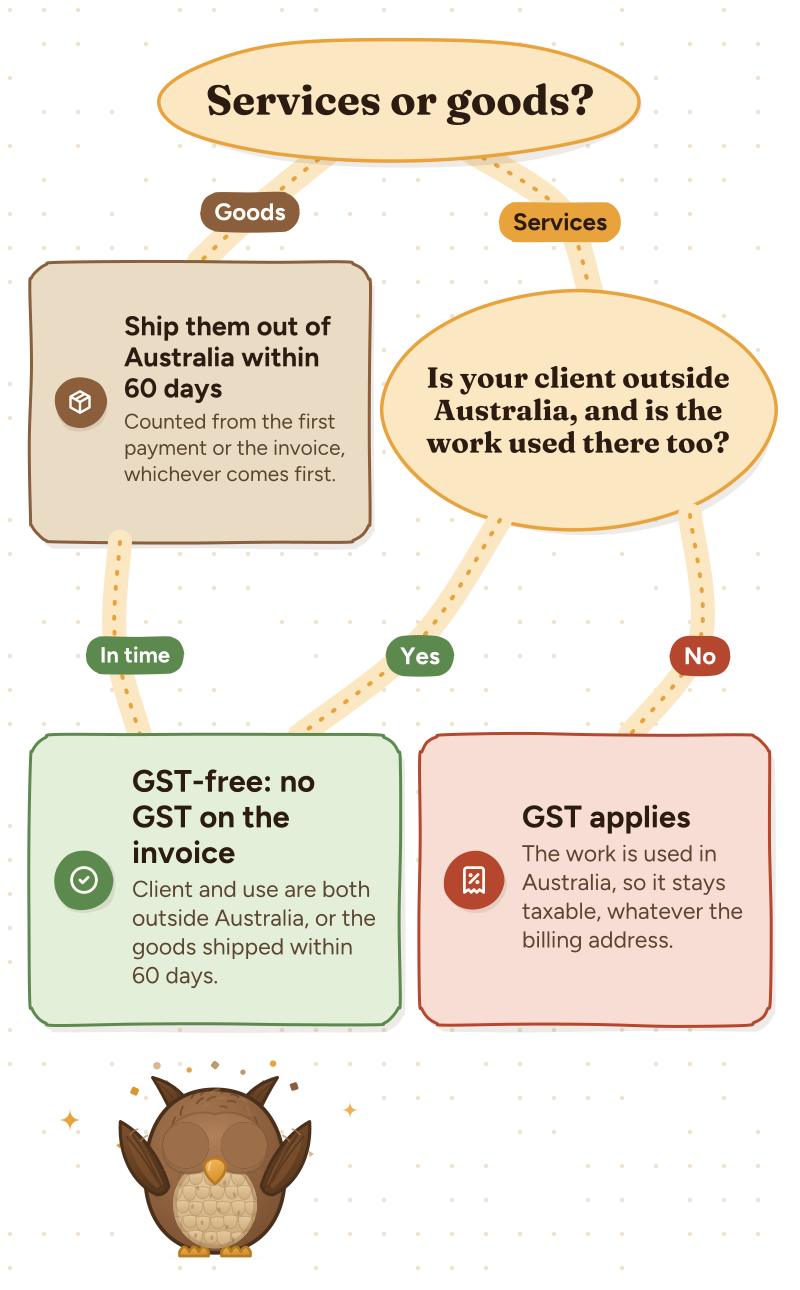
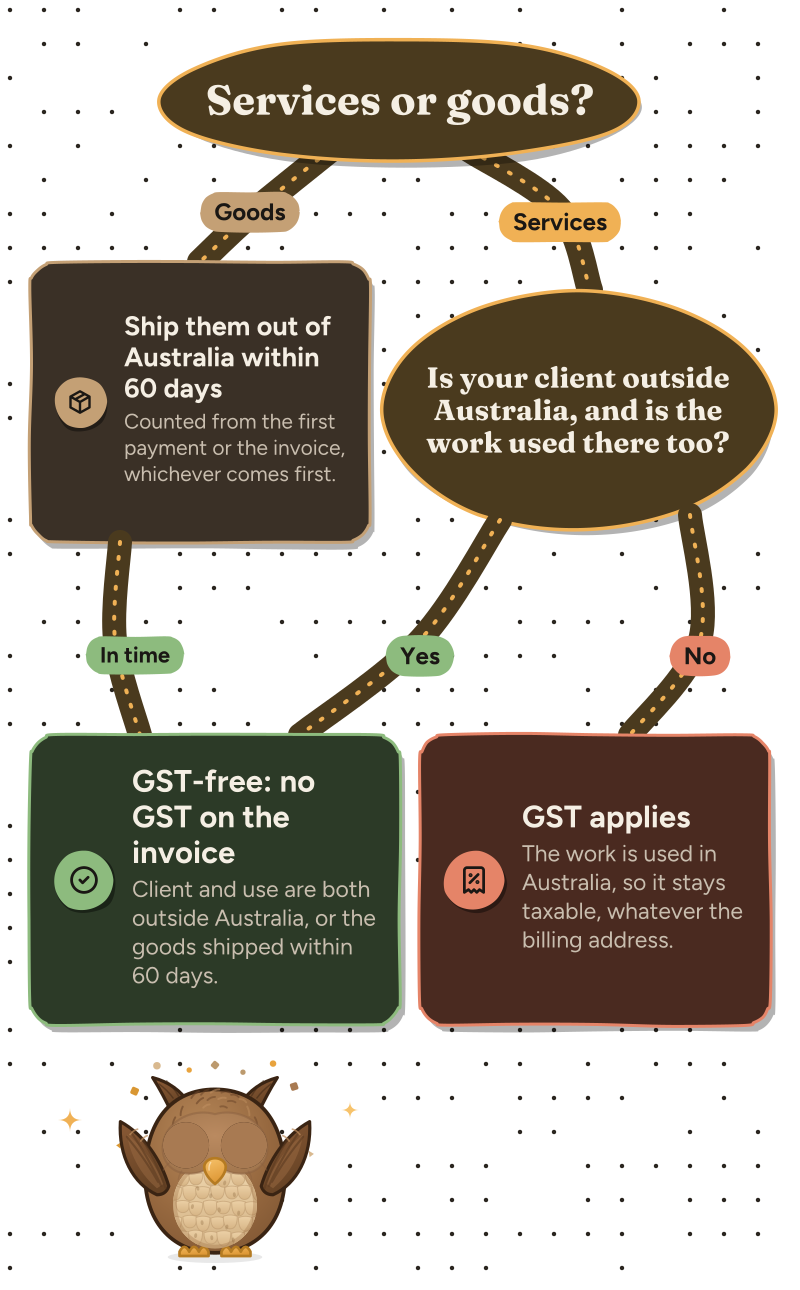
Usually not. The Australian Taxation Office’s rule is a two-part test: a supply of service is GST-free if the recipient is outside Australia and the service is used or enjoyed outside Australia, or if the supply is made to a non-resident who isn’t in Australia when the supply happens. A Perth-based consultant who writes a market-entry report for a manufacturer based in Singapore, with the finished report used entirely by that Singapore business, doesn’t include GST on the invoice, even though the report was researched and written from Australia.
The exception matters just as much as the rule. If the service is actually delivered or used inside Australia, it stays taxable no matter where the client is legally based or billed from. A UK company that pays an Australian contractor to fit out a Melbourne office is buying a service used in Australia, so GST still applies, even though the paying entity is entirely overseas. The deeper mechanics of that GST-free test, including how it interacts with exported goods specifically, get their own dedicated breakdown separately; this guide focuses on getting the invoice itself right once you know GST-free treatment applies.
Figure 2: The client’s billing address isn’t the test; where the work is used and enjoyed is. Source: Australian Taxation Office, Exports and GST.
How does GST-free treatment differ for goods versus services?
The two tests aren’t the same, and mixing them up is one of the most common mistakes exporters make. Exported goods are GST-free if the supplier ships them out of Australia within 60 days of whichever happens first: receiving payment for the goods, or issuing the invoice for them. If the goods are paid for in installments, that 60-day clock runs from the final installment, not the first one. Suppliers can request an extension of that 60-day window through Online services for business if a shipment is genuinely delayed, but that request has to be made before the deadline passes, not after the fact.
Exported services have no shipping deadline to track, because there’s nothing physically leaving the country; instead, everything turns on the recipient-and-usage test described above. That’s a meaningful practical difference for a business that sells both, such as a tradie who exports equipment overseas but also bills a short consulting call to an overseas buyer. The equipment sale has a 60-day clock running against it from the moment of payment or invoice; the consulting call doesn’t, but it does need the client to genuinely be outside Australia when the call happens.
Figure 3: Miss the export window and the sale can become a taxable domestic sale retroactively. Source: Australian Taxation Office, Exports and GST.
| Category | Key rule | Practical checkpoint |
|---|---|---|
| Exported goods | GST-free if shipped within 60 days of the first payment or invoice | An extension is available from the ATO if a shipment is delayed |
| Exported services | GST-free if the recipient is outside Australia and the work is used or enjoyed outside Australia | The same work delivered or used in Australia stays taxable, regardless of billing address |
| Currency reporting | GST must be reported to the ATO in Australian dollars | Convert using the RBA rate, a major bank’s rate, or an agreed rate, applied consistently |
| Australia’s 2024-25 services trade | $134.3 billion, up 7.9% on the year before | Travel services alone made up 60.9% of that total |
Table 1: The core distinctions between exporting goods and exporting services, side by side. Sources: Australian Taxation Office; Australian Bureau of Statistics.
This decision tree gives you the answer in two questions.
What currency should you invoice an overseas client in?
Either works, as long as it’s stated unambiguously. Some Australian businesses invoice in AUD and let the client’s bank handle the conversion; others invoice in the client’s local currency to speed up approval on that end, since a finance team is often faster to pay an invoice already in the currency their own budget is tracked in. What doesn’t change is the reporting obligation: regardless of what currency appears on the invoice, GST has to be reported to the ATO in Australian dollars, converted using the Reserve Bank of Australia’s rate, a major bank’s rate, or a rate formally agreed with the client, and whichever method is chosen has to be applied consistently rather than switched transaction to transaction.
Figure 4: Services exports climbed in three of the last four financial years, reaching a record $134.3 billion in 2024-25. Source: Australian Bureau of Statistics, International Trade: Supplementary Information, Financial Year, 2024-25.
The one habit worth building early is stating currency by its three-letter ISO code (AUD, USD, GBP, SGD) rather than a bare dollar sign, since $100 means three different things depending on whether it’s Australian, American, or Singapore dollars, and an ambiguous symbol is exactly the kind of detail that stalls an overseas payment while someone confirms which currency was actually meant. Cross-border invoicing data shows this kind of currency mismatch is a recurring, avoidable source of payment delay, not a one-off edge case, particularly for a business that bills clients in several different countries across a single month. Setting the currency once, at invoice level, on an invoice built for the purpose removes the guesswork for both sides, and it’s worth doing regardless of which category of service is being billed or how large the underlying contract is. It also matters for how the export shows up in your own books later, since reconciling a foreign-currency invoice against an AUD-denominated GST return is far simpler when the original currency was unambiguous from day one.
Figure 5: Travel dominates Australia’s services exports, but “other services”, the category most overseas-client invoicing sits in, grew fastest. Source: Australian Bureau of Statistics, International Trade: Supplementary Information, Financial Year, 2024-25.
What does an overseas client actually need on the invoice for their own tax records?
Less than a domestic tax invoice, but not nothing. Because a GST-free export carries no GST component, the ATO’s detailed tax invoice format, the one that requires a specific set of details once a taxable sale reaches certain thresholds, simply doesn’t apply; there’s no GST amount to disclose. What the client still needs is a clear commercial invoice: your registered business name and ABN, an invoice number and date, an itemized description of what was supplied, the total and the currency it’s expressed in, your payment terms, and a plain note explaining why no GST was charged, such as “GST-free export”. Overseas clients frequently need that last detail for their own tax filings, since a foreign tax authority reviewing the client’s deductions may ask why a supplier didn’t charge a consumption tax that would normally apply to a domestic purchase.
Keep the underlying evidence too, not just the invoice. The ATO’s standard five-year record-keeping period applies to export invoices the same as any other business record, and if the GST-free treatment is ever reviewed, what actually gets asked for is the supporting trail: the client’s overseas address, the contract or engagement letter, email correspondence confirming where the work was used, and, for goods, shipping documentation. An invoice that states “GST-free export” with nothing behind it is a claim, not proof.
How should you get paid, and what do international payment options actually cost?
Cost is often the part small business owners underestimate most. The Australian Competition and Consumer Commission’s most recent review of the market found that Australians who don’t compare providers are missing out on more than $200 million a year in potential savings on international money transfers, even after several years of the industry adopting better price transparency. On a transfer of roughly $3,000, the ACCC found consumers could typically save more than $100 by switching from a big four bank to a lower-cost provider, and that gap widens further on larger transfers.
That fee gap runs both ways: it applies to money an Australian business sends overseas, and the same exchange-rate margins and transfer fees show up when an overseas client pays an invoice back into an Australian account, whether that payment arrives as a traditional bank wire, through a payment platform, or via a dedicated multi-currency provider. A bank wire is familiar and reliable but tends to sit at the expensive end, since the receiving bank, the sending bank, and the currency conversion itself can each carry their own margin. Sending an invoice with a built-in payable link removes some of that friction for the client, letting them pay by card or a supported payment method directly against the invoice rather than manually keying in international bank details, which also cuts down on the transposition errors that delay an overseas payment reaching the right account at all. The ATO’s own guidance still applies underneath whichever payment rail is used: Australia’s broader late payment patterns show that a slow-paying client rarely fixes itself, and a consistent follow-up sequence works just as well on an overseas invoice as a domestic one.
The Bottom Line
Invoicing an overseas client from Australia comes down to three separate questions, not one: does GST apply, what currency should the invoice use, and what does the client actually need for their own records. Get the GST-free test right by checking where the work is used and enjoyed, not just where the client is billed. State the currency in its ISO code and keep the conversion method consistent for GST reporting. And build the commercial details, the ABN, the itemized description, the GST-free note, and the supporting evidence, into the invoice from the start rather than reconstructing them later if the ATO ever asks. A business exporting services worth a share of Australia’s $134.3 billion 2024-25 total doesn’t need a different invoicing process for every overseas client, just one that already accounts for these three questions before it’s sent.
Frequently Asked Questions
Do I have to charge GST when invoicing an overseas client from Australia? Usually not. A service is GST-free once the recipient is outside Australia and the work is used or enjoyed outside Australia, or the service is supplied to a non-resident who isn’t in Australia when the work is done, according to the Australian Taxation Office. The exception is a service actually delivered or used inside Australia, such as work on a property located here; that stays taxable no matter where the client is billed.
What currency should I invoice an overseas client in? Either Australian dollars or the client’s local currency works, as long as the currency is stated clearly using its three-letter ISO code. Whatever currency the invoice uses, GST still has to be reported to the ATO in Australian dollars, converted using the Reserve Bank of Australia’s rate, a major bank’s rate, or a rate agreed with the client, applied consistently transaction to transaction.
Does an overseas client need a tax invoice from an Australian business? Generally no, not in the domestic sense. A GST-free export carries no GST component, so the detailed tax invoice format the ATO requires for a taxable sale doesn’t apply. The client still needs a clear commercial invoice with your business name, ABN, an itemized description, the currency, and a note explaining why no GST was charged, since their own tax authority may ask for that record.
How long should I keep records for a GST-free export invoice? Keep every export invoice for the ATO’s standard five-year record-keeping period, along with the documents that prove the sale was genuinely GST-free, such as the client’s overseas address, contracts, correspondence, or shipping paperwork. Those records are what an ATO review would ask for if the GST-free treatment is ever questioned.
Sources and References
- Australian Bureau of Statistics: International Trade, Supplementary Information, Financial Year, 2024-25, total services exports rose $9,891 million (7.9%) to $134,324 million, and the travel, transport, and other services breakdown.
- Australian Bureau of Statistics: Characteristics of Australian Exporters, 2019-20 financial year, 56,274 registered exporters, 62% classified as small exporters.
- Australian Taxation Office: Exports and GST (last updated 28 July 2023), the 60-day export window for goods and the recipient/usage test for GST-free services.
- Australian Taxation Office: Goods and Services Tax: Foreign Currency Conversion Determination 2018 (FOREX 2018/1), the requirement to report GST in Australian dollars and the accepted exchange rate sources.
- Australian Competition and Consumer Commission: Improved transparency lowers international money transfer costs, but switching promises extra $200m in savings per year (30 July 2024), the missed savings estimate and the big four bank versus low-cost provider comparison.
Note: All figures verified as of November 2026.