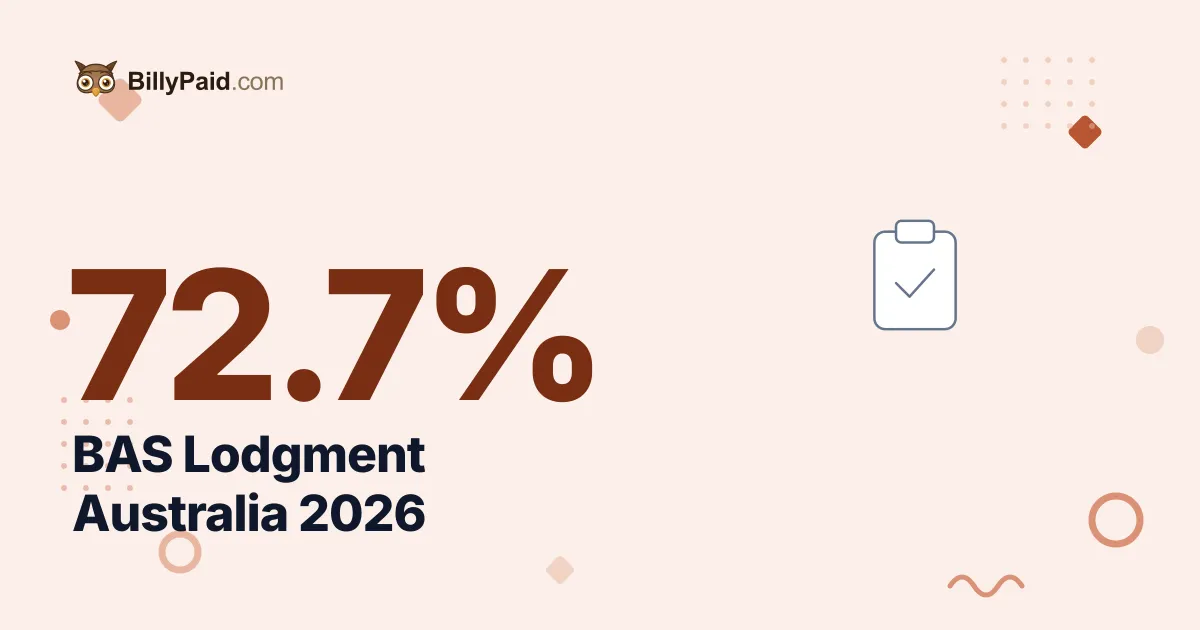
72.7% of Australian business activity statements were lodged on time in the 2024-25 financial year, according to the Australian Taxation Office’s GST Administration Annual Performance Report 2024-25, the fourth consecutive year that figure has improved. The rest of the picture, how often you actually need to lodge, when each type is due, and who is doing the filing, matters just as much as the headline number for a small business trying to stay off the ATO’s radar.
How many Australian BAS are lodged on time?
72.7% of BAS were lodged on time in FY2024-25, according to the ATO, up from 71.6% the year before. The result splits by lodgment frequency: monthly lodgers hit 71.8% on time and quarterly lodgers hit 72.9%, both counted against the ATO’s own definition of on time, lodged within 7 days of the due date. That is a meaningfully higher bar than a flat “lodged at all” figure: separately, the ATO reports that 84.5% of all BAS were lodged in FY2024-25 regardless of timing, so the gap between “lodged” and “lodged on time” is still close to 12 percentage points. The ATO attributes part of the on-time improvement to a cleanup of the lodgment population itself, canceling roughly 32,000 outstanding BAS obligations for businesses that were no longer operating, 78% of which belonged to small businesses.
Figure 1: 72.7% of Australian BAS were lodged on time in the 2024-25 financial year. Source: Australian Taxation Office, GST Administration Annual Performance Report 2024-25.
Figure 2: On-time BAS lodgment by reporting frequency, FY2024-25. Source: Australian Taxation Office, GST Administration Annual Performance Report 2024-25, Table 4.7.
Is on-time BAS lodgment actually improving?
Yes, slowly and with a dip along the way. Total on-time BAS lodgment moved from 70.3% in 2020-21 to 70.1% in 2021-22, then climbed three years straight to 71.2%, 71.6%, and 72.7% by 2024-25, according to the ATO’s own 5-year series. That is a net gain of 2.4 percentage points over five years, not a dramatic swing, but a real and sustained one after the mid-series dip. Monthly lodgers show a bumpier path than quarterly lodgers over the same period, falling as low as 69.0% in 2023-24 before recovering to 71.8% in 2024-25, while quarterly lodgers have climbed almost every year since 2021-22. An invoicing workflow that produces the numbers a BAS needs as you go, rather than reconstructing them at deadline time, is one of the more direct ways a business controls which side of that improving average it lands on.
Figure 3: On-time BAS lodgment, then versus now: 70.3% in 2020-21 versus 72.7% in 2024-25. Source: Australian Taxation Office, GST Administration Annual Performance Report 2024-25.
How often do you need to lodge a BAS?
It depends on GST turnover, not on preference. Quarterly lodgment is the default if GST turnover is under $20 million and the ATO has not directed otherwise, according to the ATO’s reporting-options guidance. Monthly lodgment becomes compulsory once GST turnover reaches $20 million, and it is optional below that threshold for businesses that want smaller, more frequent payments. Annual lodgment is the narrowest option: it is only available to businesses that are voluntarily registered for GST, meaning their turnover sits under the $75,000 registration threshold ($150,000 for not-for-profits), and have not elected to pay GST by installments. The ATO can also move a business onto monthly reporting involuntarily: in March 2025, it used its legislative powers to shift approximately 3,500 small business entities from quarterly to monthly GST reporting, specifically targeting businesses with ongoing compliance issues that had not responded to earlier interventions.
Figure 4: On-time lodgment rate, monthly versus quarterly BAS, FY2023-24 to FY2024-25. Source: Australian Taxation Office, GST Administration Annual Performance Report 2024-25, Table 4.7.
When exactly is your BAS due?
The due date depends entirely on which of the three cycles above applies. A quarterly BAS is due 28 days after the quarter ends, and a monthly BAS is due on the 21st day of the following month, for example a July monthly BAS is due 21 August, according to the ATO’s published due-date schedule. Lodging online can add a further concession on top of those dates for most quarters.
| Lodgment frequency | Period covered | Due date |
|---|---|---|
| Quarterly | Jul-Sep (Q1) | 28 October |
| Quarterly | Oct-Dec (Q2) | 28 February |
| Quarterly | Jan-Mar (Q3) | 28 April |
| Quarterly | Apr-Jun (Q4) | 28 July |
| Monthly | Any calendar month | 21st of the next month |
| Annual | Financial year | 31 October |
Table 1: BAS and annual GST return due dates by lodgment frequency. Source: Australian Taxation Office, Due Dates for Lodging and Paying Your BAS.
Businesses that lodge online may be eligible for an extra 2 weeks to lodge and pay a quarterly BAS, though that concession does not apply to the October-December quarter, since its 28 February due date already builds in a one-month extension. A registered tax or BAS agent can also secure different due dates for their clients. If a business is not required to lodge an income tax return, its annual GST return falls due earlier, on 28 February following the tax period rather than 31 October.
Who actually lodges your BAS, you or a registered agent?
A registered tax or BAS agent, more often than not. 60.0% of BAS were filed by an intermediary or tax agent in FY2024-25, according to the ATO, up from 59.6% the year before and 56.6% back in 2020-21, a steady five-year climb. Whoever does the filing, the lodgment itself is now overwhelmingly digital: 95.3% of all BAS were lodged electronically in FY2024-25, up from 94.5% the year before, with monthly remitters at 95.4%, quarterly remitters at 95.2%, and annual remitters highest of all at 97.2%. Paper BAS lodgment, in other words, is now a rounding error across every reporting frequency.
Figure 5: Share of BAS filed by a registered tax or BAS agent versus self-lodged, FY2024-25. Source: Australian Taxation Office, GST Administration Annual Performance Report 2024-25, Table 4.10.
How does BAS performance compare to the ATO’s broader lodgment target?
It runs measurably below it. Australia’s broader “activity statements lodged on time” measure, a Commissioner of Taxation Annual Report metric covering activity statements more broadly, not only GST-registered BAS but also installment activity statements, came in at 77.3% for 2024-25 against the ATO’s own 78% target, according to the audited Commissioner of Taxation Annual Report 2024-25. That is 1.6 percentage points above the prior year’s 75.6% result and the fourth consecutive year of improvement, with the volume of on-time lodgments rising 7.8%, from 11.7 million in 2023-24 to 12.6 million in 2024-25. The small business taxpayer segment is called out specifically as the main drag on the result, running 4.1 percentage points below the overall 77.3% figure. A business that consistently misses that window risks a failure-to-lodge penalty, and how the ATO calculates and escalates that penalty is its own topic worth understanding in detail before it applies to you.
Figure 6: Actual on-time lodgment rate for Australian activity statements versus the ATO’s 78% target, FY2024-25. Source: Commissioner of Taxation Annual Report 2024-25.
How does your BAS connect to the GST you report?
Directly. Every BAS is the vehicle through which a GST-registered business reports and pays the GST it has collected, and that reporting chain fed the $90.2 billion in net GST cash Australia collected in FY2024-25. Getting the underlying numbers right starts with the tax invoices a business issues and receives all quarter or month long: a GST-compliant tax invoice generated the same way every time is what turns a BAS from a reconstruction exercise into a formality. For the revenue side of that same GST system, Australia’s 2026 GST collection numbers cover what the $90.2 billion actually represents and how the gap between theoretical and collected GST is trending.
| Data point | Figure | Source |
|---|---|---|
| BAS lodged on time, FY2024-25 (total) | 72.7% | Australian Taxation Office |
| BAS lodged on time, FY2024-25 (monthly) | 71.8% | Australian Taxation Office |
| BAS lodged electronically, FY2024-25 | 95.3% | Australian Taxation Office |
| BAS filed by a tax or BAS agent, FY2024-25 | 60.0% | Australian Taxation Office |
| Activity statements lodged on time (all types) | 77.3% (target 78%) | Commissioner of Taxation Annual Report 2024-25 |
Table 2: The headline BAS lodgment figures referenced throughout this piece.
The Bottom Line
A quarterly BAS is due 28 days after the quarter ends, a monthly BAS is due on the 21st of the next month, and which of those cycles applies to a given business comes down to GST turnover, not choice. Against that backdrop, 72.7% on-time lodgment nationally is progress, four straight years of it, but it still leaves more than a quarter of BAS running late, and the broader 77.3% activity-statement figure sits under the ATO’s own 78% target. Late lodgment is not a paperwork footnote either, since the ATO’s failure-to-lodge penalty regime applies to a BAS the same way it applies to any other required document. Chronic late payment from customers is one of the biggest reasons a business scrambles at BAS time in the first place; Australia’s late payment data covers how widespread that problem is. Whichever frequency a business lodges on, the numbers on the BAS are only as reliable as the invoices behind them, which is where a consistent, ATO-compliant invoicing process earns its keep.
Frequently Asked Questions
What percentage of Australian BAS are lodged on time? 72.7% of business activity statements were lodged on time in the 2024-25 financial year, according to the Australian Taxation Office’s GST Administration Annual Performance Report 2024-25. That splits into 71.8% for monthly lodgers and 72.9% for quarterly lodgers, and it is the fourth straight year the total has improved, up from 71.6% in 2023-24 and 70.3% in 2020-21.
How often do I need to lodge a BAS? It depends on your GST turnover. Quarterly lodgment is the default if your GST turnover is under $20 million and the ATO has not directed you otherwise. Monthly lodgment is compulsory once GST turnover reaches $20 million and optional below that. Annual lodgment is available only if you are voluntarily registered for GST with turnover under $75,000 (or $150,000 for not-for-profits) and have not elected to pay GST by installments.
When is my BAS due? Quarterly BAS are due 28 days after the quarter ends: 28 October, 28 February, 28 April, and 28 July. Monthly BAS are due on the 21st of the following month. Annual GST returns are due 31 October, or 28 February following the tax period if you are not required to lodge an income tax return. Lodging online can add a further 2-week concession to most quarterly due dates.
Do most businesses lodge their own BAS or use a tax agent? Most now use an agent. 60.0% of BAS were filed by a registered tax or BAS agent rather than the business itself in 2024-25, according to the ATO, up from 59.6% the year before and 56.6% in 2020-21, a steady multi-year climb toward agent-lodged BAS becoming the majority channel.
Sources and References
- Australian Taxation Office: GST Administration Annual Performance Report 2024-25, GST Compliance, BAS lodgment, on-time lodgment, and electronic lodgment tables (4.6-4.10).
- Australian Taxation Office: Due Dates for Lodging and Paying Your BAS, monthly, quarterly, and annual due dates and lodgment concessions.
- Australian Taxation Office: Quarterly GST Reporting, quarterly reporting eligibility and installment dates.
- Australian Taxation Office: Monthly GST Reporting, the $20 million compulsory-monthly turnover threshold.
- Australian Taxation Office: Annual GST Reporting, eligibility for voluntary annual GST reporting.
- Australian National Audit Office: Audit Report of the 2024-25 Annual Performance Statements, Australian Taxation Office, Commissioner of Taxation Annual Report 2024-25 activity statement on-time lodgment measure (Table 3.13).
- Australian Taxation Office: Registering for GST, GST turnover registration threshold.
Note: All figures verified as of October 2026.