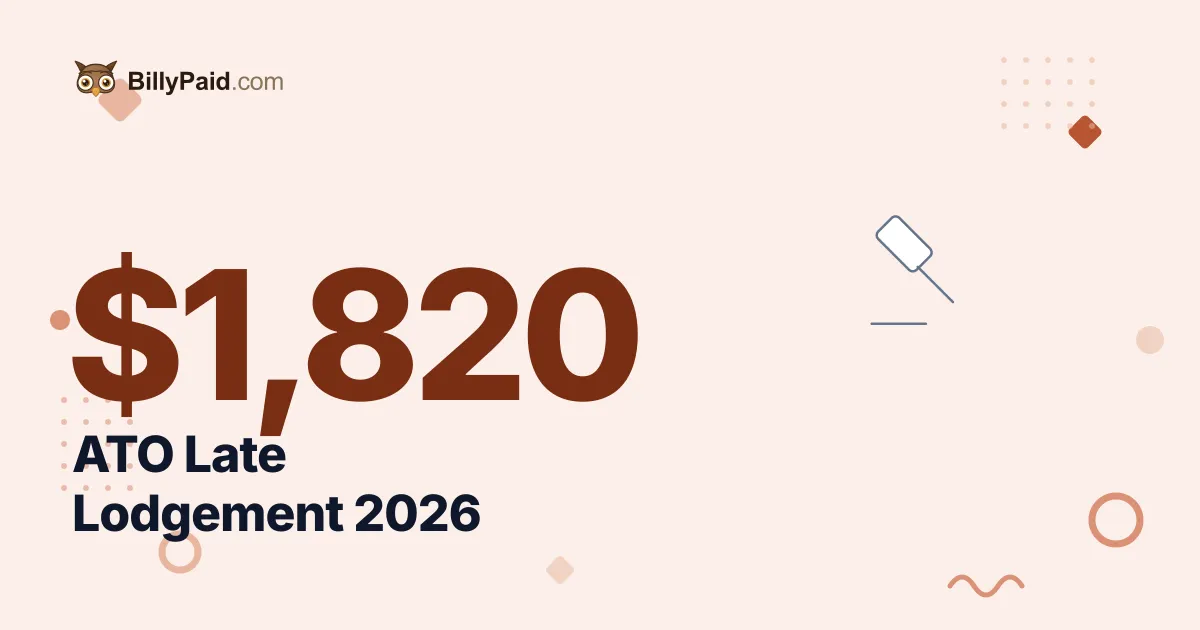
The ATO’s failure to lodge (FTL) on time penalty tops out at $1,820 for an individual or small business that misses one lodgment deadline, calculated as five penalty units at the $364 rate that applies to infringements from 1 July 2026, according to the Australian Taxation Office. That cap only holds for the smallest entities. Below is how the penalty is built, how fast it climbs, and how much bigger it gets for a medium-sized company, a large withholder, or a multinational.
What is the ATO’s failure to lodge penalty, and when does it apply?
An FTL penalty applies whenever you have an obligation to lodge or report by a set date and miss it, most commonly a tax return, a Business Activity Statement (BAS), a fringe benefits tax return, or an annual GST return. The ATO says it generally does not apply the penalty for an isolated late lodgment. Instead, it warns you by phone or in writing and issues a notice to lodge first, giving you a chance to catch up or explain your circumstances before a penalty is applied.
If a penalty is applied, the ATO’s written notice sets out the reason, the dollar amount, and a due date for payment of at least 14 days from the date of the notice. That structure, warning first and a minimum notice period before payment is due, is the same regardless of entity size; what changes with size is how the dollar figure is calculated.
Figure 1: The maximum failure to lodge penalty for an individual or small business, five penalty units at the current $364 rate. Source: Australian Taxation Office.
How much is the ATO late lodgement penalty in 2026?
Every administrative tax penalty in Australia, not just FTL, is calculated as a multiple of a single “penalty unit” dollar value that the government periodically raises. For infringements occurring from 1 July 2026, that value is $364, up from $330 for the period 7 November 2024 to 30 June 2026, according to the ATO’s penalty unit table. The increases have come more often and gotten larger in recent years: $222 from July 2020, $275 from January 2023, $313 from July 2023, $330 from November 2024, and now $364, five increases in six years after a run of relative stability through most of the 2010s.
Figure 2: Penalty unit value used to calculate ATO administrative penalties, 2017 to 2026. Source: Australian Taxation Office, Penalty units.
The FTL penalty itself is not a flat fee. It is a formula: one penalty unit for every 28-day period (or part of one) that the lodgment is overdue, multiplied by an entity-size factor. For an individual or small withholder, that formula alone determines the bill, which is why $1,820 is the number worth knowing for most small businesses reading this.
How do penalty units accrue for each 28-day period you’re late?
The base FTL penalty grows by one penalty unit for every 28 days, or part of a 28-day period, that a document stays overdue, and it stops growing once it reaches 5 penalty units. For an individual or small withholder at the current $364 rate, that produces a fixed staircase: $364 up to 28 days late, $728 from 29 to 56 days, $1,092 from 57 to 84 days, $1,456 from 85 to 112 days, and $1,820 for anything overdue by more than 112 days, roughly 16 weeks. The ATO calculates the number of 28-day periods from the original due date, not from any later notice date, so the clock is already running before you receive a warning.
Figure 3: Cumulative failure to lodge penalty for an individual or small withholder, by days overdue. Source: Australian Taxation Office.
That cap matters in practice: a lodgment that is a year late costs the same base penalty as one that is 16 weeks late, since the ATO stops adding units after the fifth 28-day period. The real cost of chronic lateness usually comes from the general interest charge accruing on any unpaid tax debt in the meantime, not from the FTL penalty continuing to climb.
Does the penalty scale differently for small, medium, and large businesses?
Yes, substantially. The ATO calculates the FTL base penalty (the 28-day, 5-unit-capped figure above) and then applies a multiplier based on the size category the entity fell into for the month the document was due, using the same small, medium, and large withholder categories that also govern PAYG withholding schedules. A small withholder, one that withholds less than $25,000 a year, gets the base rate. A medium withholder, roughly $25,000 to $1 million in annual withholding, or assessable income or GST turnover between $1 million and $20 million, has the base penalty doubled. A large withholder, over $1 million in annual withholding, or income or turnover of $20 million or more, has it multiplied by 5.
Figure 4: Maximum failure to lodge penalty by entity size, at the current $364 penalty unit rate. Source: Australian Taxation Office.
| Entity type | FTL multiplier | Maximum penalty (5 units) |
|---|---|---|
| Individual / small withholder | 1x | $1,820 |
| Medium withholder | 2x | $3,640 |
| Large withholder | 5x | $9,100 |
| Significant global entity | 500x | $910,000 |
A business that grows from a small to a medium withholder does not just risk a bigger tax bill if it slips on a lodgment; the penalty for the exact same 28-day delay doubles the moment it crosses that threshold. Getting invoices, BAS figures, and other records ready before a deadline matters more, not less, as a business scales past the small-withholder line, and it starts with issuing an ATO-compliant tax invoice correctly the first time so nothing needs correcting after the fact.
How much bigger is the penalty for significant global entities?
Far bigger. A significant global entity (SGE), broadly a group with global income of $1 billion or more, has its FTL base penalty multiplied by 500 rather than the 1x, 2x, or 5x that applies to individuals, medium, and large withholders. The ATO’s own SGE penalty table shows the effect directly: $182,000 for a lodgment up to 28 days late, and $364,000 for 29 to 56 days late, scaling up to $910,000 at the five-unit cap. That is 500 times the $1,820 an individual or small business would pay for missing the exact same deadline.
Figure 5: The maximum failure to lodge penalty for a significant global entity, 500 times the base rate applied to individuals and small withholders. Source: Australian Taxation Office, Significant global entities: penalties.
The 500x multiplier applies to the same range of approved forms as everyone else, including income tax returns, activity statements, GST annual returns, fringe benefits tax returns, and country-by-country reporting statements. It has applied to all SGEs since 1 July 2017, and to SGE subsidiary members of a consolidated or MEC group since December 2019, so it is not a new or temporary measure.
What is safe harbor, and can an FTL penalty be remitted?
Both protections exist, and they are different. Safe harbor removes liability for the penalty entirely: if a registered tax or BAS agent lodged (or was meant to lodge) on your behalf, and you can show you gave that agent everything they needed to lodge on time, and the agent’s failure was not reckless or an intentional disregard of the law, you are not liable for the FTL penalty at all. Tax professionals can request this directly through Online Services for Agents.
Remission is a separate, discretionary process for anyone else, or for anyone who does not qualify for safe harbor. The ATO reviews every remission request on its own merits rather than against a fixed list, but its guidance names several circumstances where it is likely to remit some or all of a penalty: a severe illness affecting you, a person you were caring for, or your registered agent; a natural disaster such as a fire or flood; missing information you genuinely tried to obtain from a third party like an employer; and family or domestic violence or other vulnerability that affected your ability to lodge.
The Bottom Line
The dollar figure at the center of the ATO’s failure to lodge penalty, currently $364 per unit and $1,820 at the small-entity cap, is simple once you know the formula: one unit per 28 days late, capped at five, then multiplied by an entity-size factor that ranges from 1x for an individual up to 500x for a significant global entity. The unit value itself has climbed five times since 2020 and shows no sign of leveling off, which means the same lodgment delay costs meaningfully more today than it did even two years ago.
The practical takeaway for a small business is that the penalty scale changes the moment you cross from a small to a medium withholder, so growth itself raises the stakes of a missed BAS or return deadline, not just the size of the underlying tax bill. Keeping GST-compliant records and issuing an invoice correctly the first time removes one common cause of the “waiting on information from someone else” delays that push a lodgment past its due date in the first place. For the broader picture of how late payment and GST obligations interact for Australian small businesses, see BillyPaid’s data on Australian late payment and Australia’s GST numbers for 2026.
Frequently Asked Questions
How much is the ATO’s failure to lodge penalty in 2026?
For an individual or small withholder, the failure to lodge (FTL) penalty is one penalty unit for every 28 days (or part of a 28-day period) a lodgment is overdue, capped at 5 penalty units. At the $364 penalty unit value that applies to infringements from 1 July 2026, that is a maximum of $1,820 for a single late lodgment, according to the Australian Taxation Office.
How often does the ATO penalty unit increase, and by how much?
The ATO has raised the penalty unit value five times since 2020: from $222 to $275 in January 2023, to $313 in July 2023, to $330 in November 2024, and to $364 from 1 July 2026, an increase of just over 10% at each step. Every FTL and other administrative tax penalty is calculated as a multiple of this single unit value.
What counts as a small, medium, or large entity for FTL penalty purposes?
The ATO classifies entities using its PAYG withholding categories. A small withholder withholds less than $25,000 a year; a medium withholder withholds $25,000 to $1 million a year, or has assessable income or GST turnover of $1 million to $20 million; a large withholder withholds more than $1 million a year, or has income or turnover of $20 million or more. The FTL base penalty is multiplied by 2 for medium withholders and by 5 for large withholders.
Can an ATO late lodgement penalty be remitted or waived?
Yes. The ATO reviews every remission request on its merits and is more likely to remit a penalty for circumstances like a severe illness affecting you or your registered tax agent, a natural disaster, missing information from a third party such as an employer, or family violence and vulnerability. If a registered tax or BAS agent handled your lodgment and you supplied all the required information on time, safe harbor provisions can mean you are not liable for the penalty at all.
Sources and References
- Australian Taxation Office: Failure to lodge on time penalty, base penalty calculation, safe harbor, and remission process.
- Australian Taxation Office: Penalty units, penalty unit dollar value by effective date, 2012 to 2026.
- Australian Taxation Office: Significant global entities, penalties, 500x FTL multiplier and SGE penalty table.
- Australian Taxation Office: Penalties, overview of statutory and penalty-unit-based administrative penalties.
Note: All figures verified as of October 2026.