Victoria’s Domestic Building Contracts Act 1995 lets a builder claim up to 35-40% of a home-build contract in a single payment at lock-up stage, the largest slice of any stage in the standard six-stage progress schedule and roughly double what a builder can invoice at deposit. That single figure sits inside a wider patchwork: deposit caps that range from 5% to 10% depending on the state, insurance certificates that have to change hands before a builder can even bank the deposit, and a Queensland rule that stops a builder invoicing ahead of the work itself. This guide covers what a compliant Australian builder’s progress-payment invoice needs to include in 2026, how that payment structure actually breaks down stage by stage, and how it connects to the construction sector’s wider late-payment problem.
What are the standard progress-payment stages for an Australian home build?
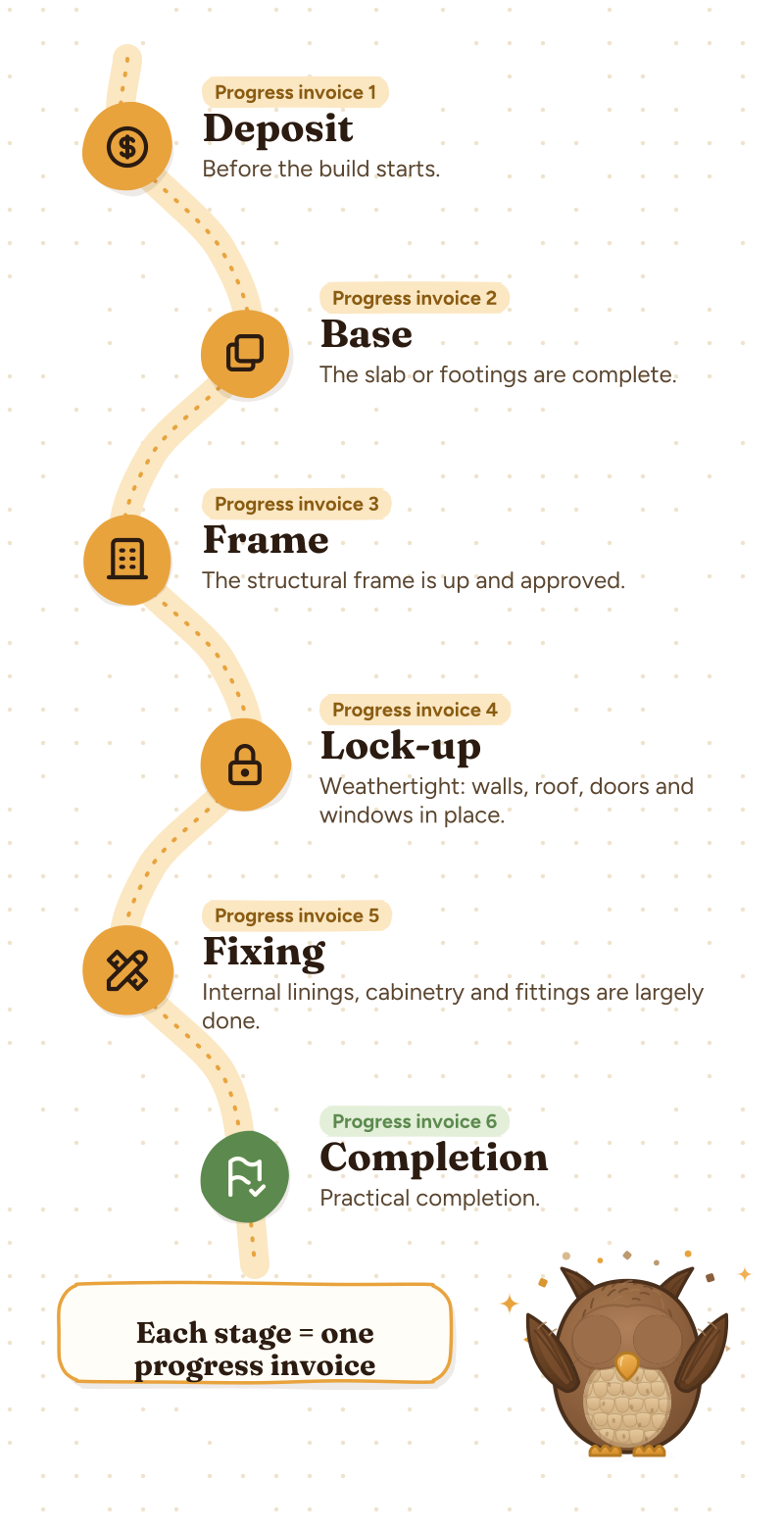
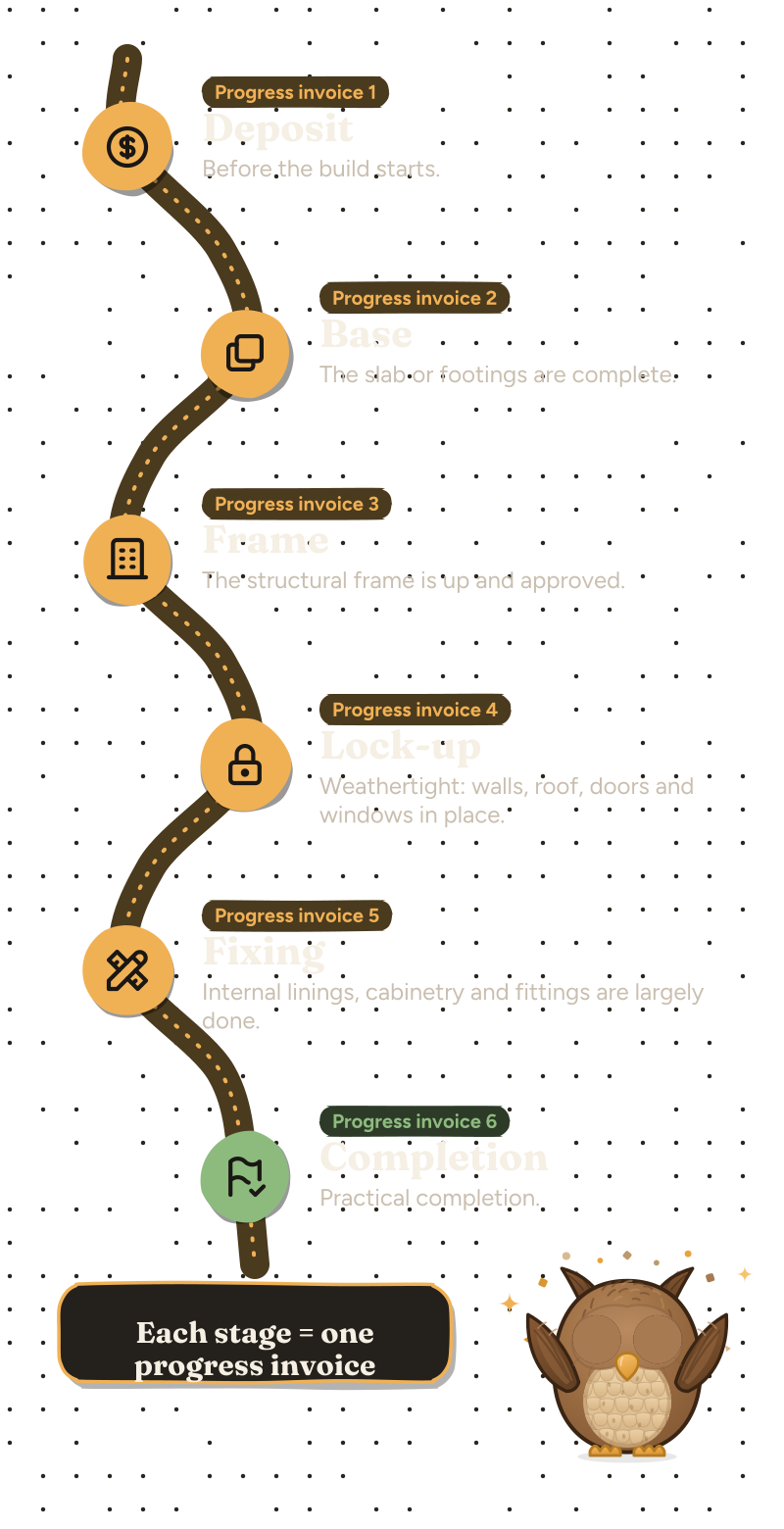
Deposit, base stage, frame stage, lock-up stage, fixing stage and completion, the same six-stage structure used across HIA and Master Builders contracts nationally, whether or not a state legislates the exact percentages. Base stage is paid once the slab or footings are complete; frame stage once the structural frame is up and approved; lock-up stage once the building is weathertight, external walls, roof, doors and windows all in place; and fixing stage once internal linings, cabinetry and fittings are largely done, leaving completion as the final payment at practical completion.
This diagram shows the six claims in the order a build triggers them: each stage is one progress invoice.
Victoria is the one state that puts hard numbers on each of those stages in law. Under the Domestic Building Contracts Act 1995, the deposit is capped, base stage can run up to 20% of the contract price, frame stage up to 25%, lock-up stage up to 35-40%, and fixing stage up to 25%, according to Consumer Affairs Victoria. A contract cannot set every stage to its maximum at once and still add up to 100%, so in practice a compliant Victorian schedule picks a specific value inside each range.
Figure 1: A compliant Victorian progress-payment schedule, one example within the Domestic Building Contracts Act 1995’s per-stage caps. Source: Consumer Affairs Victoria.
BillyPaid’s invoice generator lets a builder itemize each stage claim separately, with the GST treatment and stage description on one line, so a progress invoice reads the same way from deposit through to completion rather than being rebuilt from scratch for every claim.
How much deposit can an Australian builder legally charge?
Less than most homeowners expect, and it varies sharply by state. On a contract worth $20,000 or more, Victoria, Queensland and South Australia all cap the builder’s deposit at 5% of the contract price. New South Wales is the outlier at double that: a maximum deposit of 10% of the contract price, according to the NSW Government’s own guide to home building contracts. Unlike Victoria, NSW does not legislate fixed percentages for the later progress-payment stages either, only requiring that each payment be tied to a specified amount or percentage against actual, completed work, according to Contracts Specialist, a construction law firm that has reviewed the section directly.
Figure 2: Maximum builder deposit on a $20,000-plus contract, by state. Source: NSW Government; Consumer Affairs Victoria; Queensland Building and Construction Commission.
Below the $20,000 mark, the caps loosen. Victoria allows up to 10% on a smaller contract, and Queensland runs a three-tier system that gets more generous the smaller the job.
Does Queensland’s deposit cap really change based on job size?
Yes, in three distinct steps rather than one flat number. For work valued at $3,300 or less, a Queensland builder can take a deposit of up to 20% of the contract price. Between $3,301 and $19,999 (QBCC’s “level 1” contracts), the cap drops to 10%. At $20,000 or more (“level 2”), it falls again to 5%, the same ceiling Victoria and South Australia apply at that threshold, according to the Queensland Building and Construction Commission. A separate 20% exception applies regardless of contract value for customized off-site work, such as prefabricated kitchens or sheds, where more than half the contract’s value is built away from the client’s property before it ever arrives on site.
Figure 3: Queensland’s maximum builder deposit, by contract value tier. Source: Queensland Building and Construction Commission.
South Australia’s own trigger point for this kind of tiered treatment recently moved. Building and trade work under $20,000 now counts as “minor” under the Building Work Contractors Act 1995, up from a $12,000 threshold before 10 November 2025, a change that affects which small building jobs need a written contract at all, according to Consumer and Business Services SA.
Figure 4: South Australia’s minor building work threshold, before and after the change. Source: Consumer and Business Services SA.
How much can a builder actually claim before the work is done?
Less than the stage percentages alone might suggest, since every state ties a progress claim back to work genuinely completed rather than letting a builder invoice ahead of the job. Under the Home Building Act 1989 (NSW), a progress payment claim has to be a specified amount or percentage of the contract price tied to work actually done or costs actually incurred, supported by invoices or receipts where the payment is on an as-incurred basis. Queensland writes the same principle into an explicit number: a builder cannot claim more than 50% of the total contract value, including the deposit already paid, until at least half of the onsite work is physically complete, according to the QBCC.
Figure 5: Maximum share of contract value a Queensland builder can claim before half the onsite work is done. Source: Queensland Building and Construction Commission.
The practical effect for invoicing is that a progress-payment invoice cannot just restate the contract’s stage percentages; it has to describe what was actually completed for that specific claim, since both the homeowner and, in a dispute, an adjudicator will check the invoiced stage against what was really finished on site.
What license, registration and insurance disclosure has to happen before that first payment?
A license or registration number in the contract, and in two states an insurance certificate before a cent changes hands. NSW requires the contractor’s license number in every home building contract, small or large, and a licensed builder doing work worth more than $20,000 (including GST) must hold Home Building Compensation Fund cover, providing proof of it to the homeowner before starting work or taking any payment, including the deposit, according to icare, the fund’s operator. That cover runs up to $340,000, protecting the homeowner if the builder cannot finish the job or fix a defect because of insolvency, death or disappearance, per HIA Insurance’s own HBCF product page.
Victoria runs a comparable but separately triggered system. Work over $10,000 generally has to be carried out by someone registered with the Building and Plumbing Commission (the regulator formed when the former Victorian Building Authority, Domestic Building Dispute Resolution Victoria and the state’s domestic building insurer were merged), according to Consumer Affairs Victoria. Separately, on any job worth more than $16,000, the builder has to hand the client a copy of the domestic building insurance policy and a certificate of currency before taking a deposit or any other payment at all.
| State | Trigger | Requirement | Threshold or amount |
|---|---|---|---|
| NSW | Any home building contract | Contractor license number in the contract | No minimum value |
| NSW | Job worth $20,000+ (incl. GST) | HBCF certificate shown before any payment | Cover up to $340,000 |
| VIC | Domestic building work | Registered building practitioner (BPC) | Work over $10,000 |
| VIC | Job worth $16,000+ | Domestic building insurance certificate before deposit | No separate cap stated |
Table 1: What has to be disclosed, and when, before an Australian builder can take a payment. Figures come from different named regulators and are not directly comparable across rows.
Much the same compliance patchwork already exists for Australian plumbers, just tied to different trigger points, a license number here, a compliance certificate there, so a builder issuing a progress invoice is really clearing two separate bars at once: the payment-percentage rules covered above, and this disclosure layer sitting underneath every claim.
How does builder progress-billing connect to Australia’s wider construction late-payment problem?
Directly, and not in the builder’s favor. 92% of Australian construction and trade firms carried at least one overdue invoice in the past 12 months, the worst rate CreditorWatch tracks across any industry, a figure covered in full in the 2026 data on construction late payment. Every state and territory layers Security of Payment legislation on top of the deposit and stage rules above specifically to get contractors paid faster once a progress claim is disputed or ignored, a patchwork broken down state by state here, and the same Australia-wide late-payment data shows how far actual payment times still run past the deadlines those Acts set.
Retention money adds a further layer specific to construction: typically around 5% of each progress payment held back and released only after the defects liability period, commonly six to twelve months after completion. None of that changes what a builder’s own progress invoice needs to say correctly the first time. A payable link and an automated reminder sequence close the same gap for a builder chasing a disputed or simply forgotten stage payment that they close for every other trade, work that starts with an invoice clear enough that there is nothing to dispute in the first place.
The Bottom Line
An Australian builder’s progress-payment invoice has to clear rules that stack on top of each other rather than replace one another. The stage structure itself, deposit through completion, is broadly the same nationally, but only Victoria legislates the exact percentage caps, up to 35-40% at lock-up alone. Deposit caps split states into two camps, 5% in Victoria, Queensland and South Australia against 10% in NSW, and Queensland adds an explicit rule that no more than 50% of the contract can be claimed before half the onsite work is actually done. Underneath all of that sits a disclosure layer that has to happen before the first dollar moves: a license number in every NSW contract plus HBCF cover up to $340,000 over $20,000, and in Victoria a registered practitioner over $10,000 plus an insurance certificate over $16,000. BillyPaid’s invoice generator itemizes each stage claim with the correct GST treatment by default, and its estimate tool keeps the original quote and every progress invoice that follows it on the same record, so a builder is not rebuilding the paperwork from scratch at every single stage of the build.
Frequently Asked Questions
What are the standard progress-payment stages for a home build in Australia?
Deposit, base stage, frame stage, lock-up stage, fixing stage and completion, the same six-stage structure used across HIA and Master Builders contracts nationally. Under Victoria’s Domestic Building Contracts Act 1995, each named stage carries its own maximum percentage cap, with lock-up the largest single payment at up to 40% of the contract price.
How much deposit can an Australian builder legally charge?
It depends on the state and the contract value. On a contract worth $20,000 or more, Victoria, Queensland and South Australia all cap the deposit at 5% of the contract price, while New South Wales allows up to 10%, according to each state’s own building regulator. Below $20,000, most states allow a higher deposit, up to 10% in Victoria and 20% in Queensland for very small jobs.
Can a builder invoice for materials that have not been delivered to site yet?
Generally no. Under the Home Building Act 1989 (NSW), a progress payment claim has to be for work actually done or costs actually incurred, and Queensland goes further with an explicit cap: a builder cannot claim more than 50% of the total contract value, including the deposit, until at least half of the onsite work is complete, according to the Queensland Building and Construction Commission.
Does a builder need to show a license or registration number before taking a deposit?
Yes, and in several states an insurance certificate has to accompany it. NSW requires the contractor’s license number in every home building contract, and a Home Building Compensation Fund certificate before any payment on jobs over $20,000, per NSW Fair Trading and icare. Victoria requires a domestic building insurance certificate before a deposit on jobs over $16,000, and any work over $10,000 has to be carried out by someone registered with the Building and Plumbing Commission, per Consumer Affairs Victoria.
Sources and References
- Australian Taxation Office: Setting up your business invoices
- NSW Government: Contracts for residential building work
- NSW Government: Guide to providing home building contracts
- Contracts Specialist: Homeowner’s guide to the HIA progress payment schedule in NSW
- icare: Do I need HBCF cover
- HIA Insurance Services: Home Warranty Insurance NSW
- Consumer Affairs Victoria: Deposits and payments for domestic building
- Consumer Affairs Victoria: Becoming a registered building practitioner
- Queensland Building and Construction Commission: Deposits and progress payments
- Consumer and Business Services SA: South Australia’s building and construction industry changes
- Build-it: Construction cash crunch as late payments hammer tradies, citing CreditorWatch
- Procore: Understanding retention in construction contracts, Australia’s rules and best practices
Note: All figures verified as of November 2026.