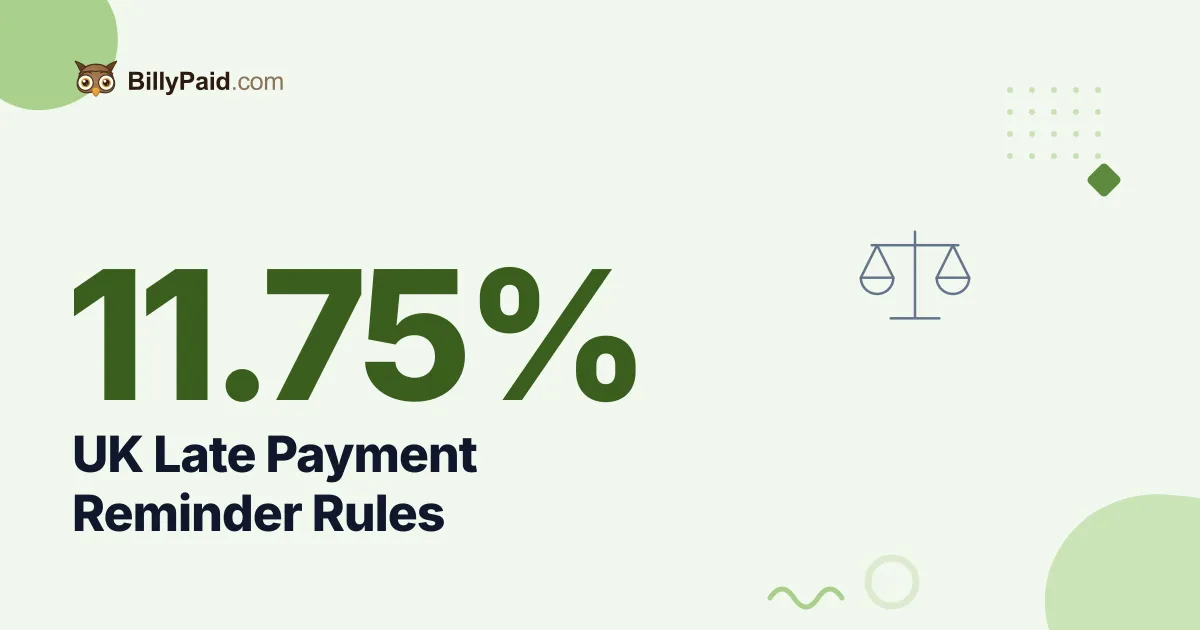
A UK business can legally add 11.75% annual interest to a late payment reminder in 2026, the Bank of England base rate plus the 8 percentage point margin set by the Late Payment of Commercial Debts (Interest) Act 1998, according to the UK government’s own guidance on the Act. That right exists automatically, with no need to state it on the original invoice, and it sits alongside a fixed compensation fee and a set of enforcement rules that are about to change substantially.
What Gives a UK Business the Right to Charge Interest on a Reminder?
The Late Payment of Commercial Debts (Interest) Act 1998 implies a term into every qualifying business-to-business contract: if payment is late, the supplier is automatically entitled to statutory interest, whether or not the invoice or contract ever mentions it. There is no separate step to “activate” the right and no need for a court order first. Interest starts accruing the day after the agreed payment date, or 30 days after delivery or invoicing if no date was agreed, and keeps running until the debt is paid in full.
Figure 1: An affected UK small business loses close to 90 hours a year to invoice chasing, time the statutory right to interest exists partly to compensate for. Source: UK Department for Business and Trade, Time to Pay Up (March 2026).
The Act only covers commercial debts between businesses, not consumer transactions, and a contract can agree a different remedy in place of the statutory rate as long as that alternative gives the supplier a “substantial remedy.” In practice most UK invoices simply rely on the statutory default rather than negotiating something else, because the default rate is already set well above typical bank lending rates.
How Much Interest Can You Add to a Late Payment Reminder in 2026?
11.75% a year, for a UK commercial debt overdue at any point in 2026. The rate is fixed twice yearly under the Late Payment of Commercial Debts (Rate of Interest) (No. 3) Order 2002: the Bank of England’s base rate as it stood on the preceding December 31 sets the rate for interest running between January and June, and the base rate on the preceding June 30 sets the rate for July through December. With the base rate held at 3.75% at both reference points in this cycle, the statutory rate works out to 11.75% for the whole of 2026, the base rate plus the Act’s fixed 8-point margin.
Figure 2: The UK’s statutory late-payment interest rate is set twice a year against the Bank of England base rate. Source: Late Payment of Commercial Debts (Rate of Interest) (No. 3) Order 2002; Bank of England.
Because the rate is simple interest calculated on the original overdue amount, not compounded, a business chasing a 5,000 pound invoice that is 60 days late is owed roughly 96 pounds in accrued interest at 11.75% a year, on top of whatever fixed compensation applies. It’s a modest amount on any single invoice, which is exactly why most small businesses never bother to actually collect it, a point covered in more depth in BillyPaid’s country-by-country breakdown of overdue-invoice interest.
What Fixed Compensation Can You Add on Top of Interest?
A flat fee of 40, 70, or 100 pounds, depending on the size of the debt, under the Late Payment of Commercial Debts Regulations 2002. Unlike interest, which accrues gradually, the fixed sum is owed in full the moment payment becomes late, and a business is entitled to it whether or not it ever actually charges the statutory interest rate as well.
Figure 3: The UK’s fixed late-payment compensation scales with the size of the overdue debt. Source: Late Payment of Commercial Debts Regulations 2002.
| Debt Size | Fixed Compensation | Statutory Interest |
|---|---|---|
| Under GBP 1,000 | GBP 40 | 11.75%/yr |
| GBP 1,000 to 9,999.99 | GBP 70 | 11.75%/yr |
| GBP 10,000 or more | GBP 100 | 11.75%/yr |
| Beyond the fixed fee | N/A | Reasonable recovery costs also claimable |
If the fixed compensation doesn’t cover the actual cost of chasing the debt, such as legal or debt-collection fees, the creditor can also claim the difference as a reasonable additional cost, though that part isn’t automatic in the way the fixed fee is.
What Does the Small Business Commissioner Do When a Reminder Isn’t Enough?
The Office of the Small Business Commissioner runs a free enquiry and mediation service for a small business stuck on an unresolved payment dispute with a larger customer, established under the Enterprise Act 2016. A business can raise an enquiry directly through the Commissioner’s website; the service includes guidance on invoicing and contract terms and a calculator for working out interest and compensation owed under the 1998 Act, without needing to go to court first.
Figure 4: Late payment touches more than one in four UK businesses in a given year. Source: UK Department for Business and Trade, Time to Pay Up (March 2026).
The Commissioner also administers the Fair Payment Code, the government-backed successor to the Prompt Payment Code launched in December 2024. Businesses that pay at least 95% of invoices within 30 days qualify for a Gold award, 95% within 60 days (including 95% to small businesses within 30 days) for Silver, and 95% within 60 days for Bronze; awards last two years and carry no fee, but a business already failing its statutory reporting duties isn’t eligible to apply.
What’s Changing in the UK’s Late Payment Rules in 2026?
The Department for Business and Trade published its response to the “Time to Pay Up” late payment consultation in March 2026, after running the consultation from July to October 2025 and receiving over 850 responses. The government confirmed it will legislate for eight measures once parliamentary time allows, calling it the most significant late payment legislation in over 25 years.
Figure 5: Consultation respondents backed every proposed reform measure, most strongly the power to fine persistent late payers. Source: UK Department for Business and Trade, Time to Pay Up (March 2026).
The headline change is mandatory statutory interest: businesses will no longer be able to contract out of the 8-point-above-base-rate default, closing the loophole that currently lets a large customer impose a lower rate by agreement. A 60-day maximum payment term follows, with limited exemptions for contracts between two large companies or for imported and exported goods, phasing in no earlier than 2027 and dropping to 45 days after five years, subject to further consultation. A 30-day window to raise a dispute is also planned, so a business that stays silent past that point has to pay the invoice in full with interest running. On the enforcement side, the Small Business Commissioner is set to gain the power to investigate suspected poor payers, compel disclosure of evidence, adjudicate disputes outside the courts, and fine large companies that persistently pay late, with fines potentially set at twice the unpaid statutory interest a company owed in its last reporting period once a “trigger point,” such as 25% or more of suppliers paid late, is crossed.
What Must Large UK Companies Already Report About Payment Practices?
Large qualifying companies and LLPs, those exceeding two of three thresholds (54 million pounds turnover, 27 million pounds balance sheet, or 250 employees) for the past two financial years, must already publish payment-practice reports twice a year within 30 days of each six-month period ending, under the Reporting on Payment Practices and Performance Regulations 2017. Reports must state the average time to pay, the percentage of invoices paid within 30, 31-60, and 61-plus days, the percentage paid outside agreed terms, and, since January 2025, the total monetary value of overdue payments, alongside narrative on standard payment terms and dispute processes.
That existing duty is the foundation the March 2026 reforms build on directly: the same twice-yearly data will be used to identify which large companies persistently pay late and calculate any future fine, and a new requirement will add the total statutory interest owed and paid to what’s reported. A business chasing a late payment from a large UK customer can already check that customer’s published payment record before it ever needs to send a reminder.
UK Late Payment Rules: Today vs. the Confirmed 2026 Reforms
| Rule | Current Position (2026) | Confirmed Reform | Legal Basis |
|---|---|---|---|
| Statutory interest | 11.75%/yr, can be contracted out of | Mandatory, no contracting out | Late Payment of Commercial Debts (Interest) Act 1998 |
| Maximum payment term | No general statutory cap | 60 days (45 after 5 years), from 2027 | New legislation, per DBT March 2026 response |
| Invoice dispute window | Not currently time-limited | 30-day deadline to raise a dispute | New legislation, per DBT March 2026 response |
| SBC enforcement power | Mediation and guidance only | Power to investigate, adjudicate, and fine | Enterprise Act 2016; expanded powers confirmed March 2026 |
The Bottom Line
The legal groundwork for a UK late payment reminder is already generous to the supplier: 11.75% statutory interest, a fixed fee of up to 100 pounds, and a free Small Business Commissioner service to fall back on, all without needing a court. What’s changing in 2026 and beyond is enforcement, not the underlying entitlement. Mandatory interest, a 60-day payment cap, and real fining power for the Commissioner are all designed to close the gap between what businesses are legally owed and what they actually collect, a gap that currently costs the UK economy close to 11 billion pounds a year.
Most of that gap has nothing to do with the law being unclear and everything to do with reminders that never get sent consistently: 31% of businesses don’t chase every overdue invoice at all. BillyPaid’s payment reminders let a UK business state its statutory interest rate and fixed fee on every overdue-invoice email automatically, so the entitlement described in this guide actually reaches a customer’s inbox instead of sitting unused in the Act. For the wording that gets invoices paid fastest once a reminder does go out, see BillyPaid’s data on polite versus firm reminder language.
None of this touches VAT. A UK invoice’s late payment terms and its VAT treatment are governed by entirely separate rules, and a business selling under the UK’s VAT regime needs to get both right on the same document, a topic BillyPaid covers in its own dedicated UK VAT and late payment guide.
Frequently Asked Questions
What interest can a UK business charge on a late invoice reminder? 11.75% a year for invoices overdue in 2026, the Bank of England base rate of 3.75% plus the 8 percentage point margin set by the Late Payment of Commercial Debts (Interest) Act 1998. The rate resets every six months against the base rate in force on the preceding June 30 or December 31.
Can I add a fixed fee to a late payment reminder as well as interest? Yes. The Late Payment of Commercial Debts Regulations 2002 add a fixed compensation payment on top of statutory interest: 40 pounds for a debt under 1,000 pounds, 70 pounds for 1,000 to 9,999.99 pounds, and 100 pounds for 10,000 pounds or more, and the right applies automatically once payment is late.
What does the UK Small Business Commissioner do about unpaid reminders? The Office of the Small Business Commissioner runs a free enquiry and mediation service for small businesses stuck on an unresolved payment dispute with a larger customer, under powers set out in the Enterprise Act 2016. The government’s March 2026 response to its late payment consultation confirmed it will also gain the power to investigate, adjudicate, and fine persistent late payers.
Is the UK bringing in new late payment rules after 2026? Yes. The Department for Business and Trade’s March 2026 response to its late payment consultation confirmed the government will legislate for mandatory statutory interest with no contracting out, a 60-day maximum payment term starting no earlier than 2027, a 30-day deadline to dispute an invoice, and new fining powers for the Small Business Commissioner, once parliamentary time allows.
Sources and References
- UK Legislation, Late Payment of Commercial Debts (Interest) Act 1998
- UK Legislation, The Late Payment of Commercial Debts Regulations 2002
- UK Department for Business and Trade / London Economics, Late Payments Research: Estimating the Total Economic Cost of Late Payments and Their Impact on the UK Economy (31 July 2025)
- UK Department for Business and Trade, Time to Pay Up: Government Response to 2025 Late Payment Consultation (March 2026)
- Office of the Small Business Commissioner
- Office of the Small Business Commissioner, About the Fair Payment Code
- GOV.UK, Duty to Report Guidance on Payment Practices and Performance
- UK Legislation, The Late Payment of Commercial Debts (Rate of Interest) (No. 3) Order 2002
Note: All figures verified as of October 2026.