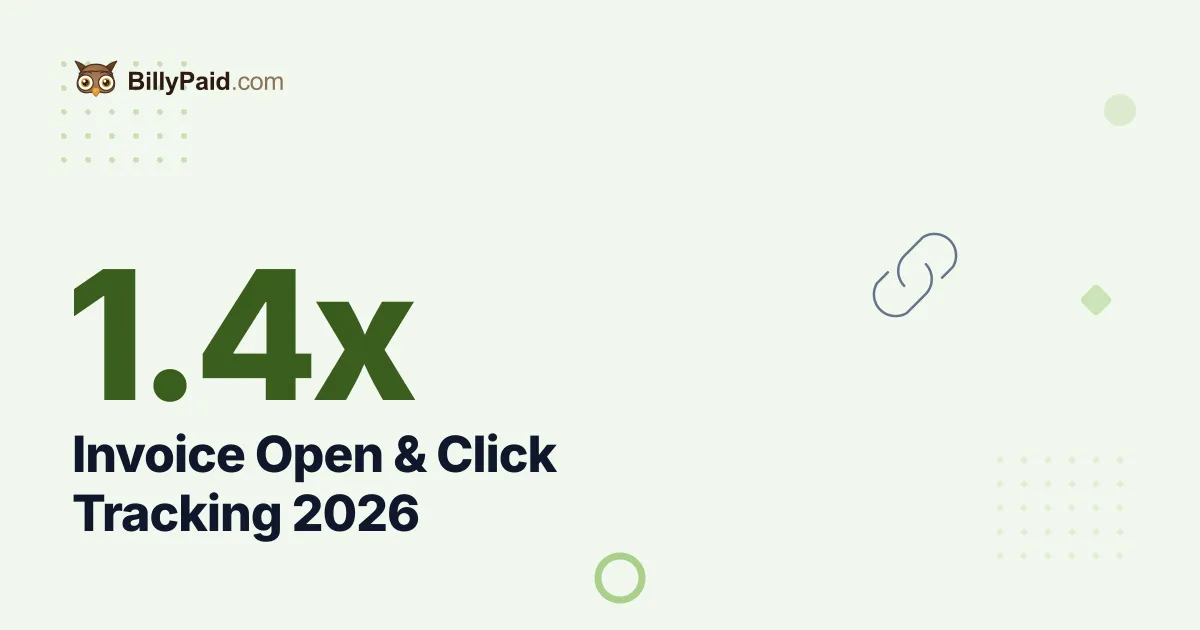
Invoices with a tracked, clicked payment link get paid 1.4 times faster on average than invoices without one, according to Intuit QuickBooks’ analysis of 90 days of QuickBooks Payments data ending April 2025. That click, not the “opened” notification most invoicing tools show first, is the tracking signal actually worth trusting in 2026: Apple’s Mail Privacy Protection now touches the majority of tracked email opens, which means an “opened” status can register before anyone has actually read the invoice. This guide breaks down what open and click tracking data can and cannot tell a small business about whether an invoice is about to get paid.
What does “invoice tracking” actually measure?
Three separate signals, and only two of them are reliable. Most invoicing platforms show a status timeline that moves from Sent to Opened (or Viewed) to Paid, and some add a distinct click event when the recipient follows the payment link inside the email or invoice PDF. The Paid signal is unambiguous. The click signal, someone actually following a link to view or pay the invoice, requires a deliberate action and is close to unambiguous too. The Opened signal is the weak link: it typically fires the moment a tracking pixel loads, and in 2026 that can happen automatically, at delivery time, without a human ever looking at the message.
Figure 1: Invoices are paid 1.4 times faster once the payment link actually gets clicked. Source: Intuit QuickBooks Payments data, 90 days ending April 2025.
Can you trust an invoice’s “opened” or “seen” status?
Only partially, and less than most invoicing software’s status timeline implies. Litmus’s Email Client Market Share data, current as of August 2026 and built from more than 1 billion tracked opens, shows Apple Mail (iPhone, iPad, and Mac combined) handling 62.26% of all email opens. Apple’s Mail Privacy Protection, active for a large share of that Apple Mail traffic, pre-loads message images the instant an email is delivered, which registers as an “open” in most tracking systems regardless of whether the recipient has actually looked at it. Litmus’s own guidance is explicit about the fix: shift from tracking open rate to tracking click-through and conversion data instead, because those require a real action. For the full breakdown of which email clients handle invoice opens and by how much, see invoice email open rate data for 2026.
That does not make the Opened status useless. A missing Opened status still tells you the invoice sat in an inbox unread, which is a legitimate reason to check whether it landed in spam or went to the wrong address before assuming the client is ignoring it deliberately. It just should not be read as proof the invoice was reviewed.
Does a click on the payment link actually predict faster payment?
Yes, and it is the strongest tracking signal available for an invoice specifically. QuickBooks measured the average number of days it took to pay invoices sent with its Online Invoice feature, which embeds a clickable payment link, against invoices from QuickBooks Payments users who did not use that feature, over the 90 days ending April 2025. Invoices with the tracked payment link were paid 1.4 times faster on average. Xero reports a comparable pattern from its own online-payments program: invoices with a Pay Now button, which runs on Stripe and lets a client pay by card, digital wallet, or direct debit straight from the invoice, get paid up to twice as fast as invoices without that option. Separately, 81% of Xero customers agree online invoice payments help them get paid on time, and 86% say they prefer paying by card, a preference a click-tracked payment link can satisfy in one step.
Figure 2: A large majority of Xero customers say a clickable online payment option changes whether they get paid on time. Source: Xero, Accept Online Payments (2025 to 2026).
The two companies measure different products with different methodologies, so a 1.4x figure and a “twice as fast” figure should not be treated as the same number, but they point the same direction: a client clicking through to a working payment method, something a platform can actually track and confirm, correlates with getting paid meaningfully faster than a PDF that only states an amount owed. For the deeper breakdown of what a payment link changes about how fast an invoice gets settled, see invoice PDF vs link data for 2026.
How does click behavior on a reminder compare with the original invoice send?
It runs slightly ahead, and the timing data helps explain why. GetResponse’s 2024 Benchmarks Report, drawn from 4.4 billion tracked sends in 2023, found autoresponder-style sequences, the automated, expected structure closest to a scheduled invoice reminder, clicking at 5.59%, ahead of a single triggered send’s 5.02% and well above a one-off newsletter’s 3.84%. The same report found 44.14% of all clicks on tracked automated sends land within the first hour after delivery, meaning tracking data is most actionable early: if a click has not registered within the first working day, that is a stronger signal to escalate a follow-up than a missing Opened status would be on its own.
Figure 3: Automated, sequence-style sends click more than one-off newsletters, and the gap holds across every message type GetResponse tracked. Source: GetResponse Email Marketing Benchmarks Report, 2024.
That timing pattern is exactly what a reminder sequence that runs automatically is built to use: a scheduled follow-up that fires based on days since the invoice was sent or the payment link was last clicked, rather than a manual check of a status column. For the fuller data on how a follow-up email’s engagement compares with the original invoice send, see invoice follow-up email open rate data for 2026.
What does poor tracking visibility cost businesses in time and cash flow?
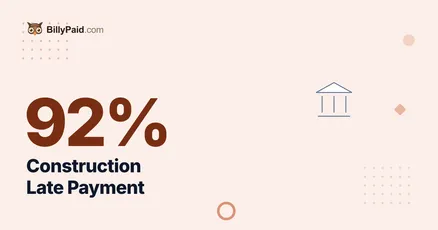
More than most owners expect. Chaser’s 2026 Accounts Receivable Report, based on 163 validated responses from finance professionals across the UK, Australia, and more than 20 other countries, fielded between late 2025 and early 2026, found that 92% of businesses say their invoices are typically paid after the due date, and 17% say they typically wait more than 30 days past due. Without a reliable way to see which invoices actually need a nudge, that gap gets closed manually: the same report found 76% of businesses spend three or more hours a week on accounts receivable tasks, and 40% spend six or more hours, time largely spent checking spreadsheets and inboxes for status that automated tracking would surface instantly.
Figure 4: The large majority of businesses report getting paid after the due date, which is the core reason invoice tracking and follow-up visibility matter. Source: Chaser, 2026 Accounts Receivable Report.
Figure 5: A large share of businesses spend real weekly hours on accounts receivable work, much of it manual status-checking that tracking data can replace. Source: Chaser, 2026 Accounts Receivable Report.
The wider pattern in structured, tracked follow-up backs this up: a consistent reminder cadence collects a meaningfully higher share of invoices than ad hoc chasing, the hub finding for this whole reminders-and-collections cluster.
Comparison: What Each Invoice Tracking Signal Actually Tells You
| Signal | Reliability in 2026 | What it correlates with | Source |
|---|---|---|---|
| Email “opened” (pixel-based) | Low for Apple Mail traffic; can fire at delivery, not at reading | Little on its own | Litmus, August 2026 |
| Payment link clicked | High; requires a deliberate action | 1.4x faster payment (QuickBooks) | QuickBooks Payments, 90 days to Apr 2025 |
| Online Pay Now option present | High; measurable at the invoice level | Up to 2x faster payment (Xero) | Xero, Accept Online Payments |
| Invoice marked paid | Highest; the outcome itself | N/A | Platform payment record |
Table 1: Open tracking is the least reliable signal an invoicing tool surfaces; click tracking and the paid status itself are what actually correlate with faster payment. Sources: Litmus, QuickBooks, Xero.
The Bottom Line
No invoicing platform publishes a single dedicated benchmark for “invoice open and click tracking” as its own category, but the adjacent 2026 data is consistent: the open signal most status timelines lead with is compromised for a majority of email traffic by Apple’s Mail Privacy Protection, while the click signal, someone actually following the payment link, correlates with getting paid up to twice as fast. Businesses that lack that visibility are spending real hours a week manually checking which invoices need a nudge, and 92% report getting paid after the due date regardless. Tracking that actually matters watches for a click and a paid status, not just a pixel fired at delivery, and turns that watch into an automatic follow-up rather than a spreadsheet check. A BillyPaid payment reminder sequence uses exactly that signal to decide when to nudge a client, so a follow-up never depends on someone remembering to check whether an “opened” status can actually be trusted.
Frequently Asked Questions
What does “invoice tracking” actually measure: opens, clicks, or something else? Most invoicing platforms surface three signals: whether the email was opened, whether the recipient clicked through to view or pay the invoice, and whether it was ultimately marked paid. Of the three, the click and paid signals are the reliable ones. The open signal is compromised for a majority of recipients by Apple’s Mail Privacy Protection, which auto-loads tracking pixels on delivery regardless of whether anyone reads the message.
Can you trust an invoice’s “opened” or “seen” status? Only partially. Litmus’s Email Client Market Share data, current as of August 2026 and based on more than 1 billion tracked opens, shows Apple Mail handling 62.26% of all email opens, and Apple’s Mail Privacy Protection means a large share of those register as opened the moment the email is delivered, not when a person reads it. Litmus itself now recommends tracking clicks and conversions instead of open rate for this reason.
Does a clicked payment link actually predict faster payment? Yes, and it is the strongest tracking signal available. Intuit QuickBooks measured invoices sent with its Online Invoice feature, which embeds a payment link, getting paid 1.4 times faster on average than invoices without one, over 90 days of QuickBooks Payments data ending April 2025. Xero reports a similar pattern: invoices with its online Pay Now button get paid up to twice as fast, and 81% of Xero customers agree online payments help them get paid on time.
How much time do businesses spend chasing invoices without automated tracking? A lot. Chaser’s 2026 Accounts Receivable Report, based on 163 validated responses from finance professionals across the UK, Australia, and more than 20 other countries, found that 76% of businesses spend three or more hours a week on accounts receivable tasks, and 40% spend six or more hours, much of it manually checking which invoices still need a follow-up.
Sources and References
- Intuit QuickBooks, Payment Links (2025), invoices paid 1.4x faster with the Online Invoice feature, 90 days ending April 2025.
- Xero, Accept Online Payments (2025 to 2026), online invoice payments paid up to twice as fast, 81% and 86% customer figures.
- Litmus, Email Client Market Share, current as of August 2026, 1 billion+ opens tracked, Apple Mail Privacy Protection impact and click-tracking recommendation.
- Chaser, The 2026 Accounts Receivable Report (163 validated responses, UK/Australia-led, fielded late 2025-early 2026), share paid after due date, hours per week spent on accounts receivable tasks.
- GetResponse, Email Marketing Benchmarks Report (2024), click rate by message type, first-hour engagement share.
Note: All figures verified as of October 2026.