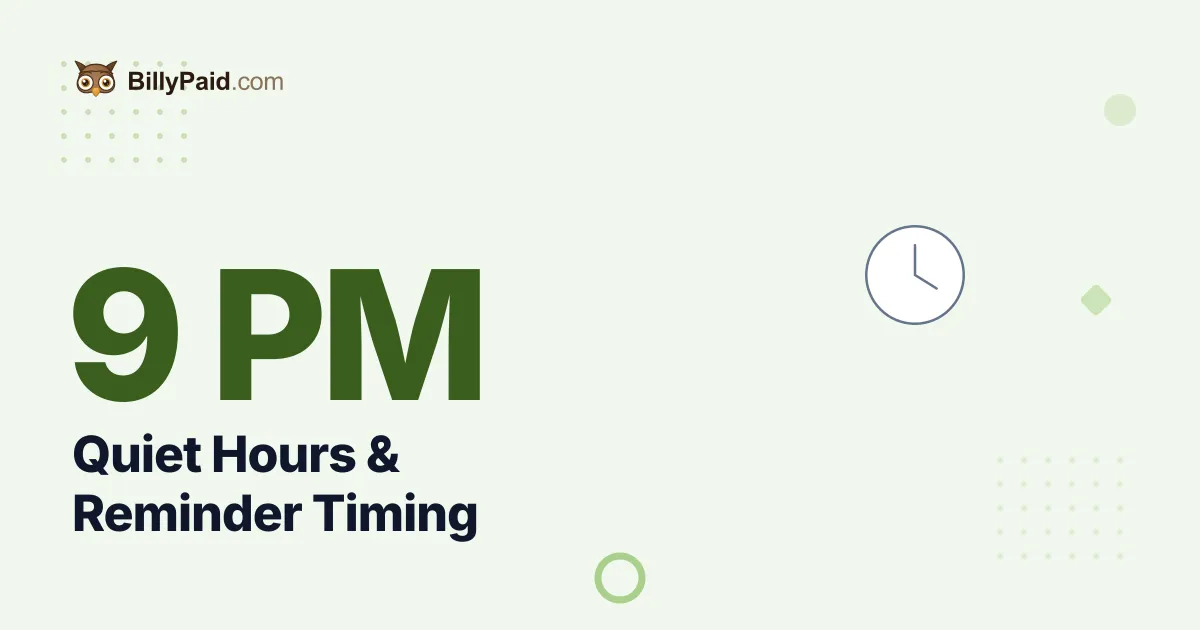
Two of the three legal frameworks that govern when someone can be contacted about a debt land on the exact same closing hour: 9 p.m., local time. The US Fair Debt Collection Practices Act sets that boundary, and so does Australia’s ASIC/ACCC debt collection guideline, even though the two rules start their allowed window at different points in the morning. The UK, by contrast, does not fix a clock hour at all. Here is what each rule actually says, and whether any of it changes when a routine invoice reminder should go out.
Why does “quiet hours” language show up next to payment reminders at all?
The term comes from debt-collection law, not invoicing software. It describes the window during which a collector is legally presumed to be contacting someone at a reasonable time, and outside of which contact is treated as harassment unless the person has separately agreed to it. Because a growing share of business-to-business reminders now run on autopilot, the same “what hour is this allowed to land” question has started showing up in accounts-receivable conversations even when no debt collector, and often no legal requirement at all, is actually involved.
Figure 1: The shared legal cutoff for contacting someone about a debt in the US and Australia. Source: 15 U.S.C. Section 1692c(a)(1); ASIC/ACCC, Debt collection guideline for collectors and creditors (RG 96, April 2021).
What does US law actually say about contact hours?
Plainly and specifically. The FDCPA states that, absent knowledge to the contrary, a debt collector must assume the only convenient time to contact a consumer is “after 8 o’clock antemeridian and before 9 o’clock postmeridian, local time at the consumer’s location” (15 U.S.C. Section 1692c(a)(1)). The Consumer Financial Protection Bureau summarizes this the same way: collectors are generally prohibited from calling before 8 a.m. or after 9 p.m.
A near-identical rule covers ordinary telephone solicitation, separate from debt collection specifically. Under an FCC rule implementing the Telephone Consumer Protection Act, “no person or entity shall initiate any telephone solicitation to any residential telephone subscriber before the hour of 8 a.m. or after 9 p.m. (local time at the called party’s location)” (47 CFR Section 64.1200(c)(1)). The TCPA’s private right of action makes getting this wrong expensive: statutory damages run 500 dollars per violation, rising to 1,500 dollars for a knowing or willful violation, calculated per individual call or text with no aggregate cap (47 U.S.C. Section 227(b)(3)).
How does Australia’s rule compare, and where does it diverge?
Australia’s version, jointly issued by ASIC and the ACCC, uses the same 9 p.m. closing time but a different structure. Under the Debt collection guideline for collectors and creditors (RG 96, April 2021), phone contact with a debtor is treated as reasonable Monday to Friday from 7:30 a.m. to 9 p.m., and on weekends from 9 a.m. to 9 p.m., with no contact recommended at all on national public holidays. Face-to-face contact is held to a narrower window, 9 a.m. to 9 p.m. on both weekdays and weekends. All of these times run to the debtor’s own state or territory, the same “local time” principle the US rules use.
Figure 2: Legally reasonable hours to contact someone about a debt by phone, hour by hour. Source: 15 U.S.C. Section 1692c(a)(1); 47 CFR Section 64.1200(c)(1); ASIC/ACCC, RG 96 (April 2021). Hours rounded to the nearest bucket; Australia’s weekday window opens at 7:30 a.m.
Line them up hour by hour and the pattern is unmistakable: every one of these frameworks closes at 9 p.m., and every one of them opens sometime in the mid-to-late morning, with the exact opening hour being the only real point of difference. Australia’s weekday window is a half-hour more generous than the US federal floor, and its weekend window is ninety minutes tighter than its own weekday one.
Why doesn’t the UK set a fixed number?
This is the genuine outlier in the comparison, and it is easy to miss because several secondary summaries online quote a UK “8 a.m. to 9 p.m.” rule that does not actually exist in the current regulation. The FCA’s own consumer credit sourcebook, rule CONC 7.9.4R, states only that “a firm must not contact customers at unreasonable times and must pay due regard to the reasonable requests of customers (for example, customers who work in a shift pattern) in respect of when, where and how they may be contacted.” No clock hours, no specific days, are written into that rule. The FCA deliberately left the standard flexible, judged against the individual customer’s own circumstances rather than a single number that applies to everyone.
Do any of these clock-hour rules actually apply to an ordinary invoice reminder?
Less often than the terminology suggests. The FDCPA’s specific 8 a.m. to 9 p.m. rule targets third-party debt collectors pursuing consumer debt, and a typical B2B invoice reminder is neither consumer debt nor sent by a third-party collector, so it usually sits outside that particular statute’s reach. The TCPA’s rule is broader in one respect: it can cover automated calls and texts regardless of who sends them, original creditor included, which is worth knowing before scheduling any autodialed reminder sequence. What sidesteps almost all of this in practice is the channel businesses actually use: 91% rely on email as their payment-reminder follow-up channel, according to Chaser’s 2026 Accounts Receivable Report, a survey of 163 validated responses fielded across the UK, Australia, and more than twenty other countries in late 2025 and early 2026. Email, unlike an automated call or text, isn’t governed by any of the clock-hour rules above at all.
Figure 3: Share of businesses using email as a payment-reminder follow-up channel, 2026. Source: Chaser, 2026 Accounts Receivable Report (163 validated responses).
That does not mean timing is irrelevant to email reminders, only that the legal quiet-hours rules above rarely apply to them. The best time to send an invoice barely moves engagement by the hour anyway: Omnisend’s 2026 analysis of roughly 26 billion email sends found under 2 percentage points separating the best and worst hour-and-day slot of the week. Consistency in the follow-up sequence matters far more than the exact minute a reminder lands, which is also why 31% of businesses still don’t chase every overdue invoice at all, a bigger gap than any send-time choice could close.
Does chasing at a smarter time actually get you paid faster?
According to Chaser, yes, though the underlying methodology behind these particular figures isn’t published in detail. The company’s Recommended Chasing Times feature uses a debtor’s own past behavior, payments made, emails opened, replies sent, to calculate when a follow-up is most likely to land. Chaser reports that customers using the feature get paid 3 days sooner than those who don’t, a 25.8% increase in payment speed; need to send one fewer reminder per invoice, a 36.6% gain in chase efficiency; and see the typical wait for a reply shrink to 2.4 days, a 6.9% reduction in wait time.
Figure 4: Self-reported effect of AI-recommended chasing times versus standard scheduling, 2026. Source: Chaser, Recommended Chasing Times.
Treat those specific percentages as a vendor’s own reported comparison rather than an independently audited study, since Chaser doesn’t publish the sample size or control-group design behind them on that page. The direction is nonetheless consistent with everything else in this data: reminders sent when a specific customer is actually likely to engage outperform reminders sent on a fixed, one-size-fits-all clock. The best reminder cadence matters here too, and so does which side of the due date a reminder falls on: pre-due reminders add roughly a point of collection probability with each message sent, while reminders sent after the deadline has already passed add essentially none, per that same data.
Does adding SMS on top of email change the outcome?
It appears to, by a meaningful margin. Chaser’s 2026 Accounts Receivable Report found that combining SMS with email in the reminder sequence was associated with a 49% relative lift in the share of invoices paid within two weeks, compared with email alone. Text messages inherit the TCPA’s quiet-hours exposure that email doesn’t carry, so a business layering SMS into its reminder sequence has a real, not just courteous, reason to keep those sends inside the 8 a.m. to 9 p.m. window.
Figure 5: Reported two-week payment rate, email alone versus email plus SMS, indexed to an email-only baseline of 100. Source: Chaser, 2026 Accounts Receivable Report.
Quiet Hours at a Glance
| Rule | Allowed contact hours | Applies to | Source |
|---|---|---|---|
| FDCPA (US) | 8 a.m. to 9 p.m., local time, any day | Third-party debt collectors, consumer debt | 15 U.S.C. Section 1692c(a)(1) |
| FCC telephone solicitation rule (US) | 8 a.m. to 9 p.m., local time | Telemarketing and solicitation calls | 47 CFR Section 64.1200(c)(1) |
| ASIC/ACCC (Australia), weekdays | 7:30 a.m. to 9 p.m. | Debt collectors and creditors, phone contact | RG 96, April 2021 |
| ASIC/ACCC (Australia), weekends | 9 a.m. to 9 p.m. | Debt collectors and creditors, phone contact | RG 96, April 2021 |
| FCA CONC 7.9.4R (UK) | No fixed hours; a “reasonable times” standard | Firms collecting consumer credit debts | FCA Handbook |
Table 1: Every legal contact-hour rule this article verified, side by side. The US and Australian frameworks both close at 9 p.m.; the UK sets no fixed number at all.
The Bottom Line
None of the legal quiet-hours rules above were written with a routine B2B invoice reminder in mind, and most of them, strictly read, don’t apply to one. But the 9 p.m. cutoff that both the US and Australia converge on is a reasonable floor for any business to adopt voluntarily, especially once SMS or an autodialed call joins the sequence, where the TCPA’s exposure is real regardless of who’s sending. BillyPaid’s payment reminders run on a day-based cadence today, configurable before-due nudges, an on-due message, then a fixed after-due ladder, rather than an hour-of-day-aware scheduler; timezone-aware quiet-hours enforcement is a planned addition, not something the product does automatically yet. Until then, the practical move is simple: keep whatever reminder sequence you run, automated or not, landing inside standard business hours, since nothing in the data above suggests a reminder sent at 6 a.m. or 11 p.m. buys any real advantage over one sent at 10 a.m.
Frequently Asked Questions
What are quiet hours for payment reminders? Quiet hours are the legally protected window during which a debt collector, or in some cases the original creditor, is not allowed to contact someone about money owed. In the US, the Fair Debt Collection Practices Act presumes 8 a.m. to 9 p.m., the consumer’s local time, is the only convenient window (15 U.S.C. Section 1692c(a)(1)). Australia’s ASIC/ACCC debt collection guideline sets a similar but distinct window: 7:30 a.m. to 9 p.m. on weekdays and 9 a.m. to 9 p.m. on weekends, with no contact recommended on national public holidays.
What time can a debt collector legally call someone in the US? Between 8 a.m. and 9 p.m., the consumer’s local time, under the FDCPA. The same window applies to telephone solicitation calls generally under FCC rule 47 CFR Section 64.1200(c)(1). Calling or texting outside that window through an automated system can also trigger the Telephone Consumer Protection Act, which carries statutory damages of 500 to 1,500 dollars per violation under 47 U.S.C. Section 227(b)(3).
Do quiet-hours laws apply when a small business sends its own invoice reminders? Usually not in the strict legal sense. The FDCPA’s clock-hour rule targets third-party debt collectors chasing consumer debt, and most B2B invoice reminders are neither a consumer debt nor sent by a third-party collector. Automated calls or texts can still fall under the TCPA regardless of who sends them, which is one reason 91% of businesses use email, not phone contact, as their primary reminder channel, per Chaser’s 2026 Accounts Receivable Report. Following the same 8 a.m. to 9 p.m. window voluntarily is still good practice even where the law does not require it.
Does BillyPaid automatically enforce quiet hours on reminders? Not yet. BillyPaid’s reminder cadence today follows a day-based schedule, configurable before-due offsets, the due date itself, then a fixed after-due ladder, rather than an hour-of-day-aware sender. Timezone-aware quiet-hours enforcement is on the roadmap as a fast-follow feature, not a shipped one, so businesses should currently review and time their own reminder sequence to land inside standard business hours.
Sources and References
- Cornell Law School, Legal Information Institute: 15 U.S.C. Section 1692c, Fair Debt Collection Practices Act, communication in connection with debt collection.
- Consumer Financial Protection Bureau: When and how often can a debt collector call me on the phone?, plain-language summary of the FDCPA contact-hours rule.
- Cornell Law School, Legal Information Institute: 47 CFR Section 64.1200, FCC rules restricting telephone solicitation, including the 8 a.m. to 9 p.m. contact window.
- ACCC and ASIC: Debt collection guideline for collectors and creditors (RG 96, April 2021), Part 2, Section 4(a), hours of contact by phone and in person.
- Financial Conduct Authority: CONC 7.9, Contact with customers, UK consumer credit sourcebook rule on contact timing.
- Chaser: The 2026 Accounts Receivable Report (163 validated responses, UK/Australia-led, fielded late 2025 to early 2026), email follow-up channel share and SMS-plus-email payment-speed lift.
- Chaser: Recommended Chasing Times, self-reported payment-speed, chase-efficiency, and reply-wait comparison.
- Omnisend: The Best Time to Send an Email (2026 Research, roughly 26 billion emails analyzed), email open rate by day of week and hour.
Note: All figures verified as of October 2026.