A UK bill that would cap payment terms at 60 days has finished the House of Lords. It is not law, and it has no commencement date. If you invoice UK businesses, the useful question is what would actually change for your invoices if it passes.
The Bill is still a proposal with no start date
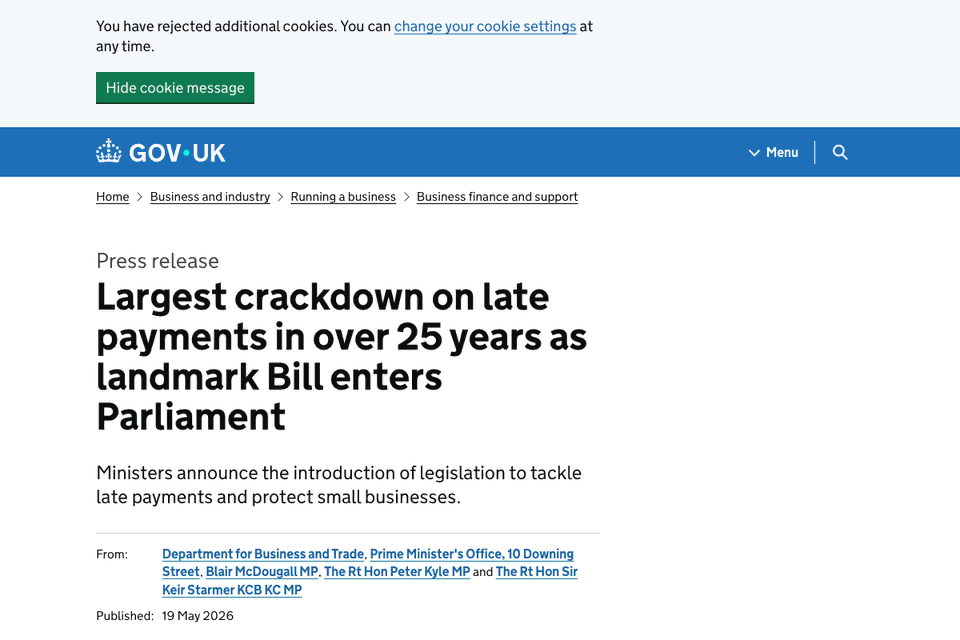
The government announced the legislation on 19 May 2026. According to the gov.uk press release, it is the Small Business Protections Bill, “formally known as the Commercial Payments Bill”, and it was introduced in the House of Lords that day. The release gives no commencement date or timetable.
Law firm Culbert Ellis reports that the Bill completed its third reading in the Lords on 20 October 2026, reached the Commons the following day, and is awaiting a second reading there. That is one source for those dates, so check the Parliament bill page before you rely on them. Until it passes the Commons and receives Royal Assent, nothing below applies to your contracts.
The 60-day cap is the genuinely new part
The Bill sets “a clear 60-day cap on payment terms on all large firms paying smaller suppliers,” per gov.uk. Law firm Geldards, writing on 25 June 2026, describes the draft detail: a 60-day maximum term, reduced to 30 days where the buyer is a public authority. A longer term would be void, and where no valid term exists, a 30-day default would be implied.
Geldards also lists exceptions, including contracts where both parties are large undertakings and contracts for importing or exporting goods and services.
The 8% interest margin is not new
Gov.uk says the Bill “builds on” the 1998 Late Payment of Commercial Debts law, and the headline interest rate is the same one you can already charge. The release puts late-payment interest at 8% above the Bank of England base rate, and gov.uk’s guidance on charging interest already describes it as “8% plus the Bank of England base rate” for business to business transactions.
What changes is that interest would become mandatory, according to the gov.uk release, and Geldards reports that any term trying to exclude or limit the right would be void. Today a large buyer can sometimes negotiate it away. Our guide to UK late payment reminder rules covers the interest and compensation rules that apply right now.
Disputes, retentions, and enforcement are the other changes
Culbert Ellis says a buyer that raises a dispute late, or without enough explanation, could owe the supplier compensation equal to the higher of 40 pounds or 1% of the contract price. Geldards puts the cutoff for raising a dispute at generally eight days before the due date, while Culbert Ellis says at least seven days, so that detail is still moving.
Gov.uk adds three more measures. The Small Business Commissioner would gain powers to investigate, adjudicate disputes and fine persistent late payers. Boards or audit committees of persistently late-paying large companies would have to publish explanations. And withholding retention payments under construction contracts would be banned.
| Rule | Today | Under the Bill as proposed |
|---|---|---|
| Maximum payment term | No statutory cap | 60 days (30 for public authorities) |
| Interest | 8% above base rate | 8% above base rate, mandatory |
| Fixed recovery charge | 40 to 100 pounds by debt size | Not mentioned in the sources cited here |
What to do with your invoice terms this week
Nothing in the Bill changes what you can do today. You can already charge statutory interest and the fixed recovery charge, which gov.uk sets at 40 pounds for debts under 1,000 pounds, 70 pounds from 1,000 to under 10,000 pounds, and 100 pounds for 10,000 or more.
Set your own terms at 30 days or less where you can, and state the due date and late-payment interest on every invoice. If a large client proposes 90 days, write down the date they agreed to and keep it. Terms that exceed a future cap would be void, but a dated record of what was agreed protects you whichever way the Bill ends up.
If you want those details on every invoice without retyping them, a BillyPaid invoice carries your due date, terms, and late-payment wording on each one.